



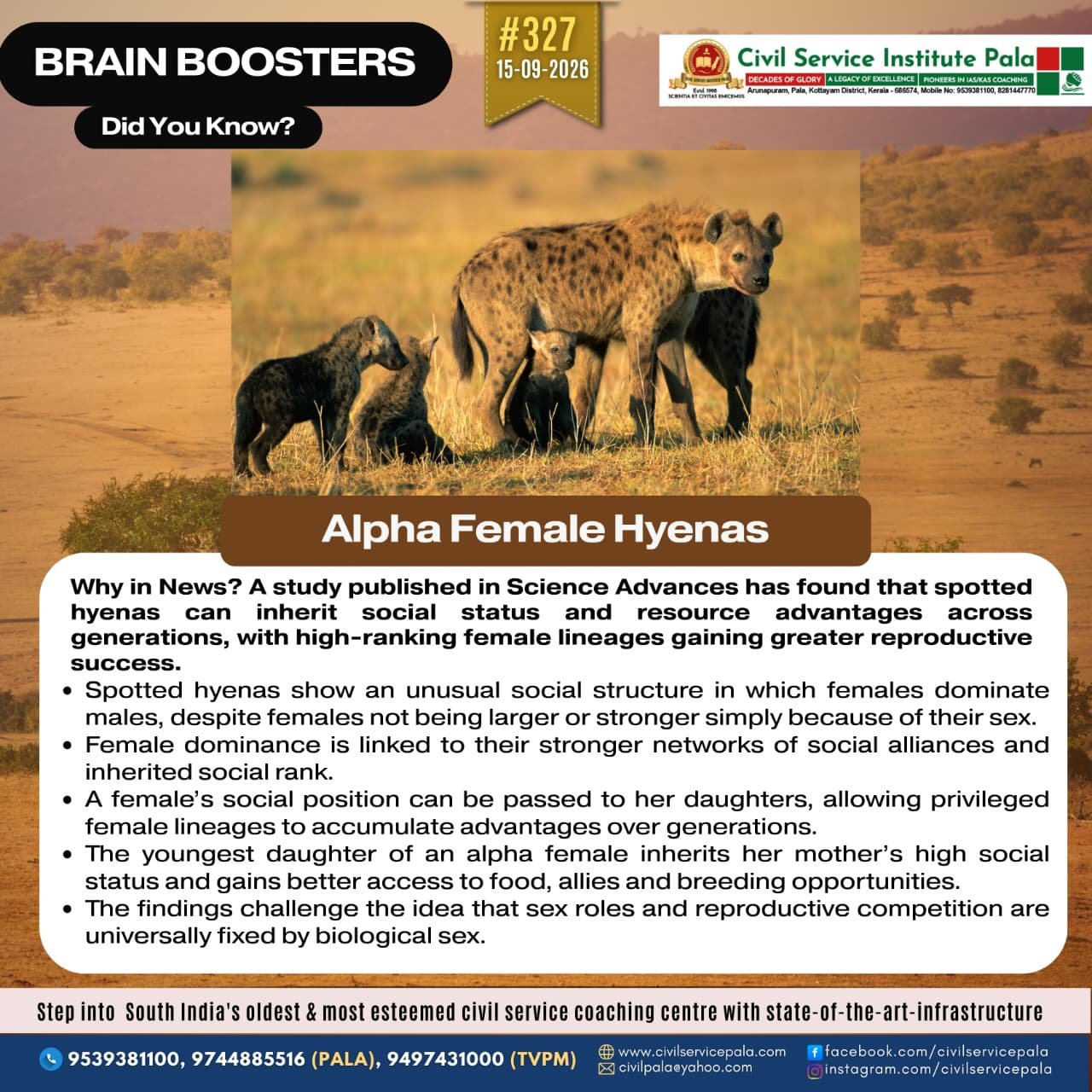
Alpha Female Hyenas
Social Inheritance and Female Dominance in Spotted Hyenas - The Privilege of Alpha Female Hyenas
Why in News?
A study published in Science Advances has found that spotted hyenas can inherit social status and resource advantages across generations, with high-ranking female lineages gaining greater reproductive success.
What is the Key Finding?
• Spotted hyenas show an unusual social structure in which females dominate males, despite females not being larger or stronger simply because of their sex.
• Female dominance is linked to their stronger networks of social alliances and inherited social rank.
• A female’s social position can be passed to her daughters, allowing privileged female lineages to accumulate advantages over generations.
• This creates socially inherited inequality, where access to food, allies and breeding opportunities depends partly on the social position inherited from the mother.
How Does Social Inheritance Work?
• Spotted hyenas live in a matrilineal society, meaning social relationships and rank are strongly organised through female lineages.
• The youngest daughter of an alpha female inherits her mother’s high social status and consequently gains better access to food, nutrition, allies and breeding opportunities.
• Better nutrition can help such individuals grow faster and survive longer, while their stronger social position provides additional advantages.
• These advantages can accumulate across generations, allowing a few elite female lineages to produce disproportionately more descendants.
• Thus, inheritance in this context is not limited to genes; social rank, relationships and access to resources can also be transmitted across generations.
Why Do Females Compete More?
• Researchers observed that male hyenas do not compete intensely with one another for social dominance. Instead, males often remain close to high-ranking females and try to establish relationships with them.
• Competition is much stronger among females, including instances of females killing the cubs of other females, despite their living in a society where many individuals are related.
• This pattern challenges the traditional expectation that males should face greater reproductive competition than females.
Darwin–Bateman Paradigm
• The Darwin–Bateman paradigm generally predicts greater reproductive competition among males because males can potentially father more offspring, while females bear greater reproductive costs through pregnancy and lactation.
• This is expected to make males more competitive for access to mates and females more selective in mating.
• Spotted hyenas challenge this expectation because female competition can be more intense than male competition, with social rank and inherited alliances influencing reproductive success.
Evidence from the Ngorongoro Study
• Researchers from the Leibniz Institute for Zoo and Wildlife Research and the Institute of Evolutionary Science of Montpellier studied eight resident spotted-hyena clans in the Ngorongoro Crater, Tanzania.
• The study used 29 years of data covering eight generations and 2,743 wild spotted hyenas.
• Researchers also used DNA obtained from material associated with faecal samples to establish paternity and reproductive relationships.
• In the clan called Lemala, researchers reconstructed a 30-year genealogical tree and found that almost all living members descended from a single founding female lineage.
• This extreme reproductive concentration provided evidence for investigating how inherited social rank could produce persistent advantages for particular female lineages.
Why is the Study Important?
• The findings challenge the idea that sex roles and reproductive competition are universally fixed by biological sex.
• They show that social structures can influence evolutionary outcomes by determining who gains resources, survives longer and produces more descendants.
• The study expands the meaning of inheritance by showing that socially transmitted advantages can operate alongside genetic inheritance.
• It also demonstrates the importance of long-term field studies, because patterns of social inheritance and reproductive inequality may become visible only across multiple generations.
