



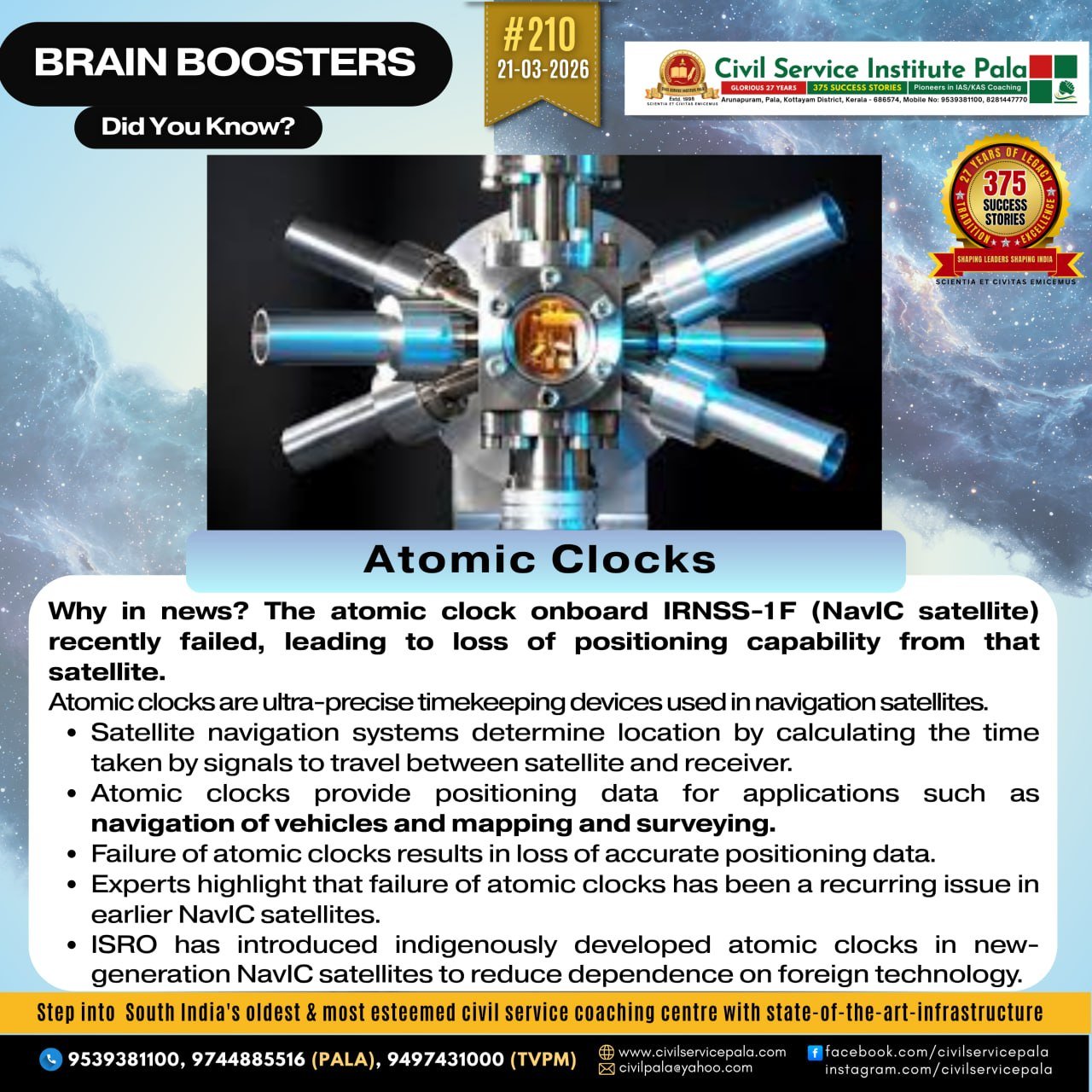
Atomic Clocks
Why in News?
• The atomic clock onboard IRNSS-1F (NavIC satellite) recently failed, leading to loss of positioning capability from that satellite.
• This has raised concerns over the reliability and performance of India’s indigenous navigation system (NavIC).
Background
• Atomic clocks are ultra-precise timekeeping devices used in navigation satellites.
• Satellite navigation systems determine location by calculating the time taken by signals to travel between satellite and receiver.
• Even a nanosecond-level error in time measurement can lead to significant location errors.
• Therefore, failure of atomic clocks results in loss of accurate positioning data.
What is NavIC (IRNSS)?
The Indian Regional Navigation Satellite System (IRNSS) is also referred to with the operational name of Navigation with Indian Constellation (NavIC)
• NavIC (Navigation with Indian Constellation) is India’s regional satellite navigation system developed by ISRO.
• It was designed as a 7-satellite constellation to provide positioning services over India and up to 1500 km beyond its borders.
• The system aims to provide accuracy of about 10 metres over the Indian landmass and surrounding countries.
• NavIC is designed to offer better signal availability in India, especially in difficult terrains like valleys and forests.
Challenges
• Experts highlight that failure of atomic clocks has been a recurring issue in earlier NavIC satellites.
• Several first-generation satellites are aging and nearing or exceeding their mission life (around 10 years).
• The recent failure of IRNSS-1F has further reduced the number of satellites providing positioning data.
• The NVS-02 satellite failed to reach its final orbit due to an electrical issue, limiting its operational use.
• There have been delays in developing user receivers, which slowed adoption of NavIC services.
Latest developments
• ISRO has introduced indigenously developed atomic clocks in new-generation NavIC satellites to reduce dependence on foreign technology after failures in earlier imported clocks.
• New-generation satellites have an extended mission life of about 12 years.
• They transmit signals in an additional L1 frequency, along with L5 and S bands.
