



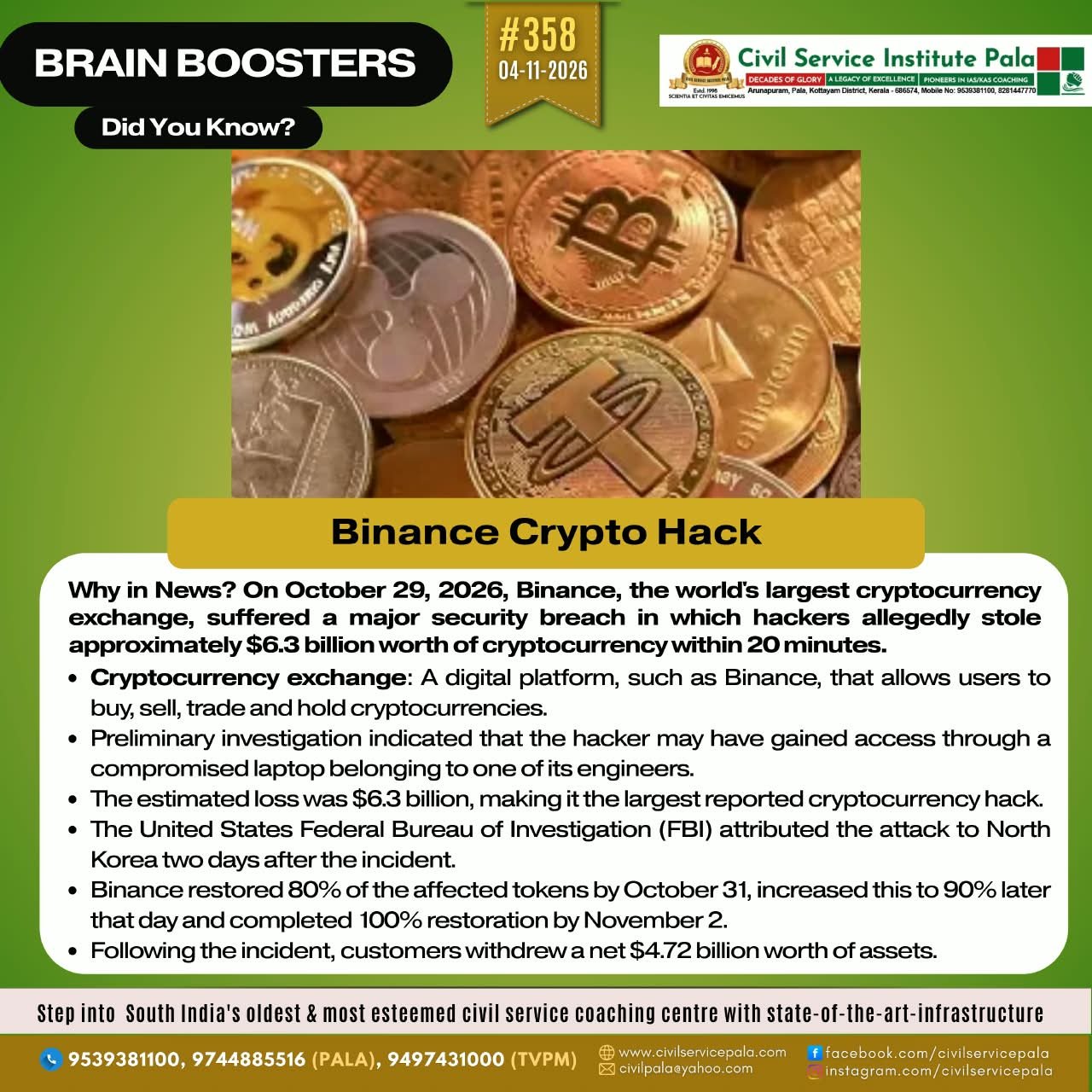
Binance Crypto Hack: $6.3 Billion Theft and the Role of SAFU
On October 29, 2026, Binance, the world's largest cryptocurrency exchange, suffered a major security breach in which hackers allegedly stole approximately $6.3 billion worth of cryptocurrency within 20 minutes. The incident exposed vulnerabilities in cryptocurrency exchange operations and highlighted the challenges of securing digital assets against sophisticated cyberattacks. Binance subsequently restored 100% of the affected funds by November 2.
How was the cryptocurrency hack carried out?
• Compromised employee device: Binance's preliminary investigation indicated that a hacker may have gained access through a compromised laptop belonging to one of its engineers, enabling unauthorised withdrawal transactions.
• Private key security: Cryptocurrency transactions use public and private keys for authentication. Binance reported no evidence that customers' private keys had been compromised.
• Scale of the attack: The estimated loss was approximately $6.3 billion, making it the largest cryptocurrency hack reported.
How do cryptocurrency transactions and operations work?
• Cryptocurrency: A digital asset that uses cryptographic techniques to secure transactions and operates through blockchain technology.
• Blockchain: A distributed digital ledger that records cryptocurrency transactions across a network of computers. Transactions are grouped into blocks and linked chronologically, making the recorded history difficult to alter.
• Cryptocurrency exchange: A digital platform such as Binance that allows users to buy, sell, trade and hold cryptocurrencies.
• Public and private keys: A public key functions as an identifier for receiving digital assets, while a private key is a confidential cryptographic credential used to authorise transactions. Anyone gaining control of a private key may be able to transfer the associated assets.
• Digital wallets: Software or hardware systems used to store and manage the cryptographic keys required to access cryptocurrency holdings. The assets themselves are recorded on the blockchain rather than physically stored in the wallet.
• Cryptocurrency withdrawal: The transfer of digital assets from an exchange account or wallet to another wallet address through an authorised blockchain transaction.
Who is suspected to be behind the attack?
• North Korean connection: The United States Federal Bureau of Investigation (FBI) attributed the attack to North Korea, two days after the incident.
• TraderTraitor network: Cryptocurrency security firm TRM Labs also linked the attack to TraderTraitor, a North Korean hacking network.
• Pattern of previous attacks: TRM Labs identified similarities in the methods used in the Binance incident and earlier attacks, including the $1.5 billion Bybit hack in February 2025 and the KelpDAO hack in April 2026.
• Cybercrime and cryptocurrency theft: North Korean-linked hacking groups have been associated with major cryptocurrency thefts, with stolen digital assets being used to generate funds outside conventional financial systems.
• Denial by North Korea: North Korea denied involvement, describing the accusation as a political provocation.
How did hackers exploit cryptocurrency lending platforms to launder the stolen funds?
• Cryptocurrency lending: Certain platforms allow users to deposit one cryptocurrency as collateral and borrow another cryptocurrency against it.
• Collateral: An asset deposited as security against a loan. The lending platform can claim or liquidate the collateral if the borrower defaults.
• Decentralised Finance (DeFi): Financial services such as lending and borrowing conducted through blockchain-based protocols, often using automated smart contracts rather than conventional financial intermediaries.
• Smart contracts: Self-executing computer programs deployed on a blockchain that automatically implement predefined conditions, such as issuing loans against deposited collateral.
How the laundering mechanism worked:
1. Deposit of stolen assets: The hacker reportedly deposited approximately $60 million worth of stolen USDT (Tether) into Aave, a cryptocurrency lending platform.
2. Using stolen funds as collateral: The deposited USDT was used as collateral to secure a loan.
3. Borrowing another cryptocurrency: The hacker borrowed approximately $60 million worth of Ethereum (ETH) against the deposited USDT.
4. Separating the assets: Authorities could potentially freeze the identifiable stolen USDT collateral. However, the Ethereum received through the lending transaction represented a separate loan, complicating the recovery process.
Important technical terms:
• USDT (Tether): A stablecoin designed to maintain a value close to the US dollar. Stablecoins aim to reduce the price volatility commonly associated with cryptocurrencies.
• Ethereum (ETH): The native cryptocurrency of the Ethereum blockchain, which also supports smart contracts and decentralised applications.
• Aave: A decentralised finance protocol that enables users to lend and borrow cryptocurrencies using digital assets as collateral.
• Cryptocurrency laundering: The process of moving or converting illegally obtained digital assets through different transactions and platforms to complicate the identification and recovery of their original source.
• On-chain intelligence: Information obtained by analysing transactions and activities recorded on public blockchains.
• Off-chain intelligence: Information obtained from sources outside blockchain transaction records, including investigative findings and other intelligence inputs.
How did Binance respond to the attack?
• Suspension of withdrawals: Binance temporarily froze withdrawals within hours of detecting the attack, resulting in approximately $3 billion worth of assets being frozen.
• Customer reassurance: The exchange announced that it was investigating the incident and would compensate affected customers.
• Gradual restoration: Binance partially resumed withdrawals on November 1 through a specified three-hour window.
• Large-scale withdrawals: Following the reopening, customers withdrew a net $4.72 billion worth of assets from the exchange.
• Restoration of customer funds: Binance restored 80% of the affected tokens by October 31, increased this to 90% later that day and completed 100% restoration by November 2.
• Continuing investigation: The investigation into the attack, identification of the perpetrators and recovery of stolen assets remain ongoing.
What is SAFU and how did it help Binance restore the stolen funds?
• Secure Asset Fund for Users (SAFU): Established by Binance in July 2018, SAFU is an emergency reserve designed to protect customers against extreme incidents such as security breaches and platform-level failures.
• Source of funding: Binance allocates a percentage of the trading fees it collects towards building the fund.
• Fund composition: According to Binance's October 2026 update, SAFU held Bitcoin valued at approximately $1 billion.
• Emergency compensation: The fund was used to restore affected customers' assets, with the remaining compensation provided through Binance's own resources.
• Separate reserve: SAFU is maintained separately from Binance's operational accounts and is not intended for routine business expenses.
• Replenishment commitment: Binance has committed to replenishing SAFU if the value of its Bitcoin holdings falls below approximately $800 million.
What are the broader implications of the Binance hack?
• Cybersecurity vulnerabilities: The incident demonstrates that cryptocurrency platforms face risks not only from compromised blockchain wallets but also from employee devices, internal systems and withdrawal authorisation mechanisms.
• Risks in decentralised finance: DeFi lending platforms can be exploited to move stolen assets across different cryptocurrencies, complicating financial investigations and asset recovery.
• Challenges in asset recovery: The irreversible nature of confirmed blockchain transactions and the movement of assets across different platforms can make recovering stolen cryptocurrencies difficult.
• Need for stronger authentication: Exchanges need robust access controls, multi-layer transaction verification, employee device security and continuous monitoring of suspicious withdrawals.
• Importance of financial safeguards: Emergency reserves such as SAFU demonstrate the importance of maintaining dedicated financial protection mechanisms in the cryptocurrency ecosystem.
• International cooperation: Tracking cross-border cryptocurrency transactions and investigating suspected state-linked cybercrime require cooperation among cybersecurity agencies, financial regulators, law enforcement bodies and blockchain analytics firms.
