



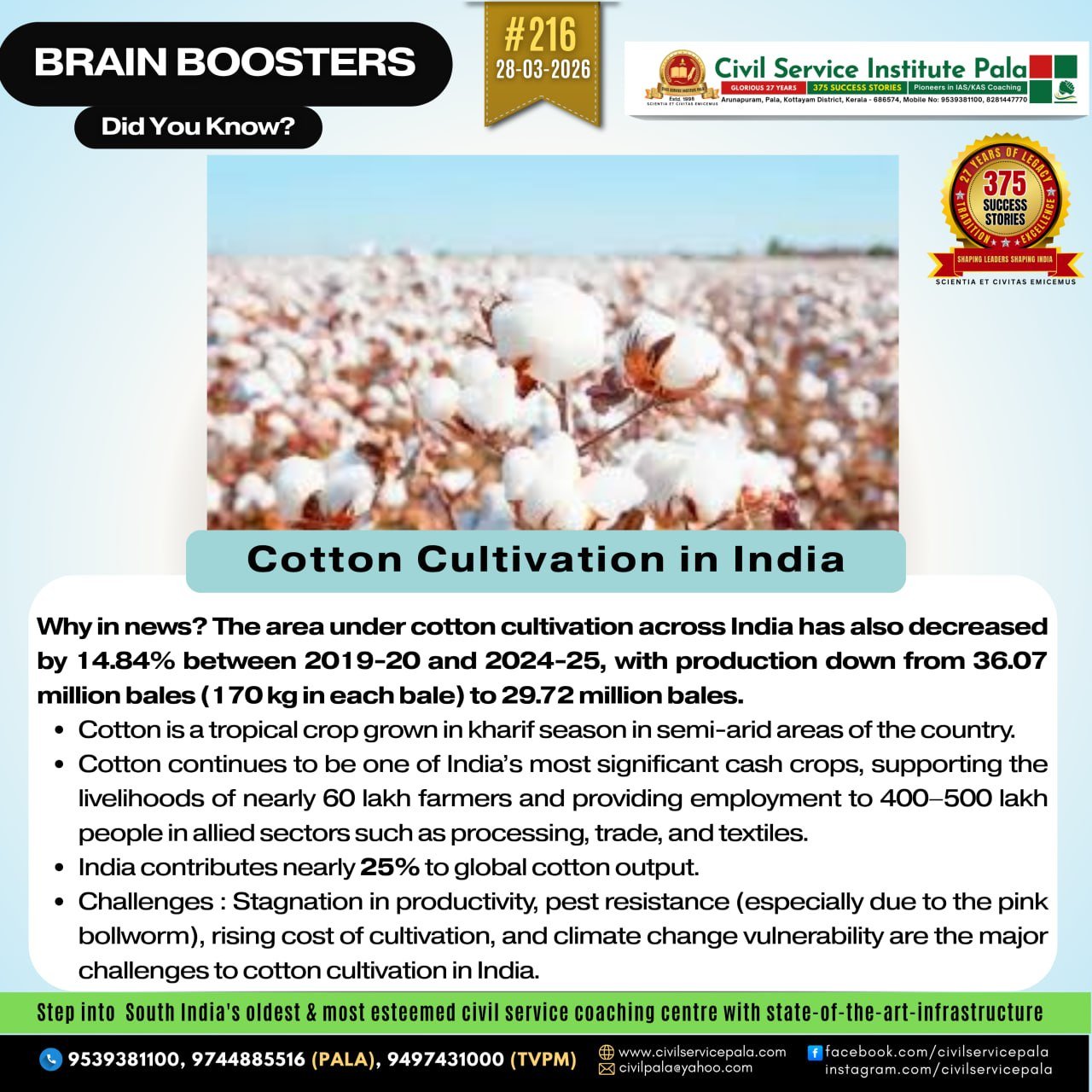
Cotton Cultivation
Why in news? The area under cotton cultivation across India has also decreased by 14.84% between 2019-20 and 2024-25, with production down from 36.07 million bales (170 kg in each bale) to 29.72 million bales.
Cotton
• Cotton is a tropical crop grown in kharif season in semi-arid areas of the country
• India grows both short staple (Indian) cotton as well as long staple (American) cotton called ‘narma’ in north-western parts of the country.
• Cotton requires clear sky during flowering stage.
• Cotton requires deep, fertile, humus-rich, and well-drained soils with good water holding capacity, as it is highly sensitive to waterlogging.
• It grows best in neutral to slightly alkaline soils, with an ideal pH range of 7.0 to 8.0.
• The crop requires moderate temperatures, with 20–30°C for germination, 21–27°C for vegetative growth, and 21–25°C during flowering.
• Cotton can tolerate short periods of high temperatures (up to 43–45°C), but prolonged exposure above 40°C adversely affects growth and yield.
• It is relatively drought-tolerant, though sustained moisture stress can reduce productivity.
• Cotton requires 700–1200 mm of water, depending on climate and crop duration.
• Water requirement is low during early growth (first 60–70 days) and highest during flowering and boll formation stages.
• Irregular or inadequate water supply leads to moisture stress, causing premature flower drop and poor boll development, ultimately reducing yield.
• There are three cotton growing areas, i.e. parts of Punjab, Haryana and northern Rajasthan in north-west, Gujarat and Maharashtra in the west and plateaus of Andhra Pradesh, Karnataka and Tamil Nadu in south.
• Cotton productivity in India is about 447 kg per hectare, significantly lower than other cotton producing countries such as Brazil (1,830 kg/hectare) and the US (1,065 kg/hectare.
• About 67% of Indian cotton is dependent on rainfall, which makes it vulnerable to frequent weather changes.
Present trends
Continued Importance of Cotton in the Agrarian Economy: Cotton continues to be one of India’s most significant cash crops, supporting the livelihoods of nearly 60 lakh farmers and providing employment to 400–500 lakh people in allied sectors such as processing, trade, and textiles.
Sustained Scale of Cultivation and Production : India contributes nearly 25% to global cotton output.
Increasing Role of MSP as a Safety Net: The government has strengthened the role of the Minimum Support Price mechanism as a key policy tool to protect farmers from price volatility, especially during periods when market prices fall below MSP levels.
Enhanced Government Financial Support: The approval of MSP funding amounting to ₹1,718.56 crore for the 2023–24 season reflects the increasing fiscal commitment of the government towards ensuring remunerative prices and income security for cotton farmers.
Expansion of Institutional Procurement Mechanism: The Cotton Corporation of India has been designated as the central nodal agency for MSP operations and continues to expand its procurement role by purchasing Fair Average Quality cotton without any quantitative limits.
Strengthening of Procurement Infrastructure: The establishment of over 508 procurement centres across 152 districts in 11 major cotton-growing states indicates a growing emphasis on improving accessibility and efficiency in procurement operations.
Focus on Price Stabilisation and Market Intervention: MSP operations are increasingly being used as a tool for market intervention to stabilise cotton prices, prevent distress sales, and ensure that farmers receive fair remuneration.
Adoption of Technology in Cotton Procurement: The introduction of digital initiatives such as the Bale Identification and Traceability System (BITS) and the “Cott-Ally” mobile application reflects a broader trend towards improving transparency, traceability, and farmer outreach in the cotton sector. Institutionalisation of Policy Support Mechanisms: The fixation of MSP based on recommendations of the Commission for Agricultural Costs and Prices indicates a structured and institutionalised approach to price support in cotton cultivation.
Challenges
Declining Area Under Cultivation: India has been witnessing a gradual decline in the area under cotton cultivation in recent years, with farmers increasingly shifting towards food crops and other less risky alternatives due to the declining attractiveness of cotton as a cash crop.
Stagnation in Productivity: The productivity of cotton in India has also shown signs of stagnation and decline, as yields that initially improved after the introduction of Bt cotton have now plateaued and, in several regions, fallen significantly, remaining low in comparison to global standards.
Pest Resistance Crisis: A major structural challenge in cotton cultivation is the emergence of pest resistance, particularly the pink bollworm, which has developed resistance to Bt cotton over time, leading to increased pesticide use and substantial yield losses.
Rising Cost of Cultivation: At the same time, the cost of cultivation has risen sharply due to increasing expenses on seeds, fertilisers, diesel, and labour, thereby putting significant pressure on farmers’ profit margins.
MSP and Market Inefficiencies: The issue is compounded by price volatility and inefficiencies in the Minimum Support Price mechanism, as many farmers are unable to realise MSP due to weak procurement systems and quality-based exclusions, resulting in unstable incomes.
Declining Profitability: Consequently, the overall profitability of cotton cultivation has declined, with many farmers experiencing situations where the cost of production exceeds returns, making cotton a low-margin or even loss-making crop.
Shift in Cropping Patterns: This has led to a visible shift in cropping patterns, as farmers diversify towards crops such as paddy, pulses, and oilseeds in search of more stable and assured returns, even when such shifts may not align with agro-climatic suitability.
Climate Change Vulnerability: Cotton cultivation is also increasingly affected by climate change, as the crop is highly sensitive to temperature fluctuations, erratic rainfall, and extreme weather events, all of which exacerbate pest attacks and reduce yield stability.
Regional Imbalance in Cultivation: Regionally, cotton cultivation remains concentrated in specific belts of northern, central, and southern India, but traditional cotton-growing regions, especially in the north, are experiencing sharper declines due to pest infestations and environmental stress.
Impact on Textile Sector: The decline in cotton production has broader economic implications, as cotton is a key raw material for India’s textile industry, and reduced domestic output can lead to increased imports, higher input costs, and pressure on exports and employment.
Impact on Rural Labour: Additionally, cotton being a labour-intensive crop, particularly for manual picking, its decline adversely affects rural employment, especially for women, and contributes to increased migration towards urban areas.
Limited Policy Effectiveness: Although the government has introduced various policy measures such as MSP support, promotion of indigenous varieties, and pest and nutrient management programmes, their impact has remained limited due to implementation gaps and weak market linkages.
Structural Crisis in Cotton Sector: Overall, the cotton sector in India is facing a structural crisis driven by technological fatigue, ecological challenges, rising input costs, market inefficiencies, and policy shortcomings, necessitating comprehensive and region-specific reforms.
(Source : THE HINDU, PIB)
