



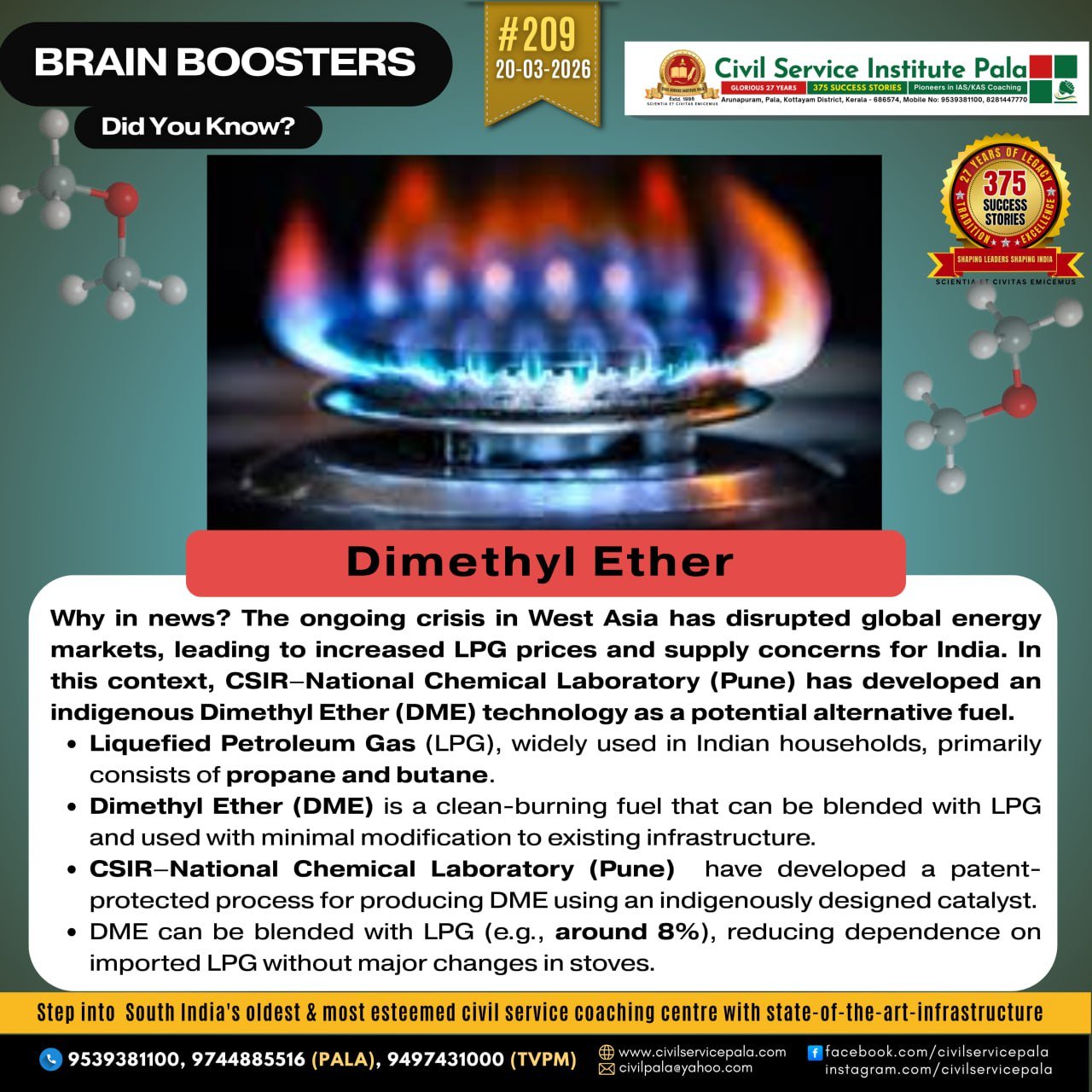
Dimethyl Ether (DME)
Why in News?
• The ongoing crisis in West Asia has disrupted global energy markets, leading to increased LPG prices and supply concerns for India.
• India imports about 65% of its LPG requirement (around 21 million tonnes in 2024), making it vulnerable to external shocks.
• In this context, CSIR–National Chemical Laboratory (Pune) has developed an indigenous Dimethyl Ether (DME) technology as a potential alternative fuel.
Background
• Liquefied Petroleum Gas (LPG), widely used in Indian households, primarily consists of propane and butane.
• Experts highlight that high import dependence exposes India to price volatility and supply disruptions.
• Dimethyl Ether (DME) is a clean-burning fuel that can be blended with LPG and used with minimal modification to existing infrastructure.
Features
• Experts have developed a patent-protected process for producing DME using an indigenously designed catalyst.
• The technology enables efficient conversion of methanol into DME, improving cost-effectiveness and scalability.
• The process operates at around 10 bar pressure, allowing DME to be directly stored and transported in cylinders.
• The technology has already been tested at a semi-pilot scale of around 250 kg per day.
• DME can be blended with LPG (e.g., around 8%), reducing dependence on imported LPG without major changes in stoves.
Raw Material & Production Process
• DME is produced from methanol, which acts as the key intermediate.
• Methanol can be derived from multiple sources such as:
o Coal
o Biomass (agricultural waste)
o Captured carbon dioxide
• Methane (from natural gas) is first converted into syngas (CO + H₂), which is then converted into methanol and subsequently into DME.
• Experts highlight that this makes DME production flexible and compatible with both fossil and renewable feedstocks.
Advantages of DME
• DME is a clean-burning fuel, leading to lower emissions and reduced air pollution.
• It can be produced domestically, enhancing India’s energy security.
• Blending DME with LPG can reduce import dependence in the short term and potentially replace LPG in the long term.
• Experts suggest that DME adoption can save India around ₹9,500 crore annually by reducing LPG imports.
• The fuel is compatible with existing LPG infrastructure, making transition easier.
Challenges
• India currently depends on imported methanol, which may limit immediate scalability.
• The cost of DME production is linked to methanol prices, making affordability dependent on domestic methanol production.
• Large-scale adoption requires infrastructure development and policy support.
Way Forward
• Experts suggest that developing domestic methanol production capacity is crucial for making DME economically viable.
• Gradual blending of DME with LPG can serve as a transitional strategy toward energy self-reliance.
• DME has the potential to become a sustainable and cost-effective alternative fuel, contributing to both energy security and environmental goals.
