



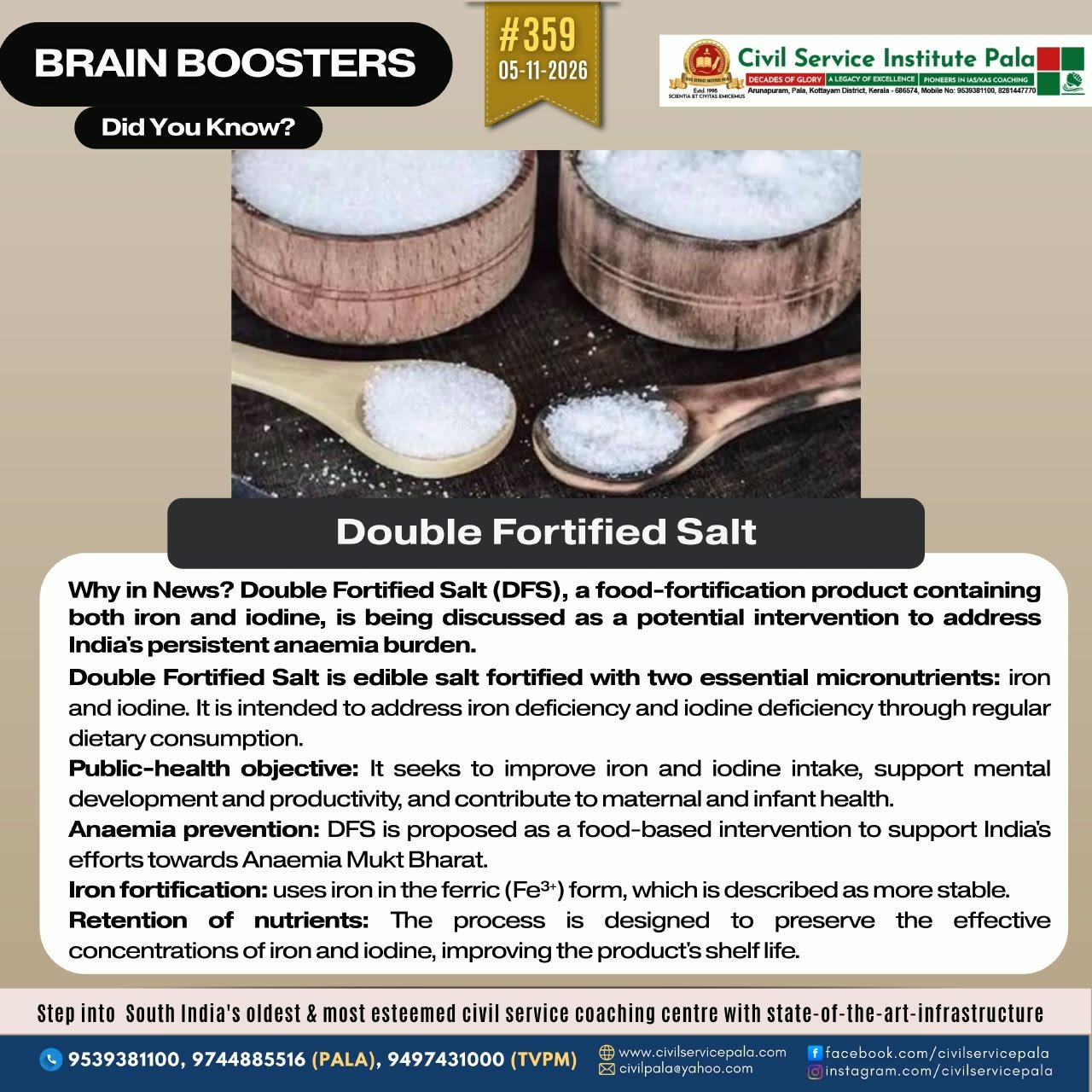
Double Fortified Salt: Can It Help Address India's Anaemia Burden?
Why in News?
Double Fortified Salt (DFS), a food-fortification product containing both iron and iodine, is being discussed as a potential intervention to address India's persistent anaemia burden. Its appeal lies in delivering two essential micronutrients through a commonly consumed food at relatively low cost.
What Is Double Fortified Salt (DFS)?
• Meaning: Double Fortified Salt is edible salt fortified with two essential micronutrients: iron and iodine. It is intended to address iron deficiency and iodine deficiency through regular dietary consumption.
• Public-health objective: It seeks to improve iron and iodine intake, support mental development and productivity, and contribute to maternal and infant health.
• Anaemia prevention: DFS is proposed as a food-based intervention to support India's efforts towards Anaemia Mukt Bharat.
Technical features of DFS
• Iron fortification: The technology developed by CSIR-Central Salt and Marine Chemicals Research Institute (CSIR-CSMCRI) uses iron in the ferric (Fe³⁺) form, which is described as more stable and white in colour.
• Retention of nutrients: The process is designed to preserve the effective concentrations of iron and iodine over an extended period, improving the product's shelf life.
• Appearance and usability: It retains the white colour of ordinary salt and offers better flowability and aesthetic appearance without compromising taste and texture.
• Scalability: The manufacturing process is described as cost-effective and suitable for large-scale production.
• Additional magnesium: The process uses abundantly available bittern as a source of magnesium, providing an additional mineral component.
Efficacy and potential demand
• Human trial: A community-based limited efficacy trial conducted by CSIR-CSMCRI involving 300 adults reportedly found improvements in blood serum iron and iodine levels without observed side effects.
• Production potential: India's iodised salt production was approximately 4.8 million metric tonnes in 2016–17. Considering 10% of this demand, the estimated potential demand for DFS was projected at around 0.5 million metric tonnes annually.
• Affordability: Its use as a commonly consumed food vehicle offers the possibility of delivering micronutrients without requiring people to adopt an entirely new dietary practice.
Why Is Double Fortified Salt Considered a Potential Intervention Against Anaemia?
• Existing anaemia burden: The fifth National Family Health Survey (NFHS-5) found that more than half of women and approximately two-thirds of young children in India were anaemic.
• Micronutrient delivery: DFS provides a means of delivering iron through a widely used food product, potentially improving micronutrient intake among households.
• Convenience: Unlike interventions that require individuals to consume separate supplements, DFS incorporates iron into an existing dietary item.
• Dual fortification: Combining iron and iodine addresses two micronutrient deficiencies through a single food product.
• Potential for wider coverage: Its relatively low cost, scalability and compatibility with ordinary salt consumption make it a possible intervention for population-level nutrition programmes.
However, the convenience of delivering iron through salt does not automatically establish its effectiveness or suitability for universal distribution.
What Are the Concerns Associated with Universal Iron Fortification Through Salt?
A conflict with salt-reduction goals
• Excessive salt consumption: Indians consume, by many estimates, approximately twice the five grams of salt per day recommended by the World Health Organization (WHO).
• Hypertension burden: About one in three adults in India has hypertension, making the reduction of excessive salt consumption an important public-health priority.
• Conflict with NCD targets: India's non-communicable disease action plan commits to a 30% relative reduction in salt intake. Depending on regular salt consumption to deliver iron may work against this objective.
• Unequal nutrient delivery: Salt consumption varies by age, sex and region. Adult men generally consume more salt, while women and young children consume less. Consequently, groups with greater nutritional needs may not necessarily receive adequate iron through DFS.
Risks associated with excessive iron intake
• Iron accumulation: Unlike some other nutrients, the body has no regulated mechanism to excrete excess iron. Iron accumulation can promote oxidative stress and has been linked to metabolic disease.
• Evidence from clinical trials: The 2006 Pemba trial in Tanzania associated iron and folic acid supplementation among children in a malaria-endemic setting with increased hospitalisations and deaths.
• Gut health concerns: A Kenyan trial published in 2015 found that iron-fortified foods shifted infants' gut flora towards pathogenic bacteria and increased diarrhoea.
• Malaria and infection risks: These findings raise concerns about iron interventions in malaria-endemic and poorly sanitised regions, where infection burdens may influence the safety and effectiveness of supplementation.
Concerns relating to haemoglobinopathies
• Thalassaemia: People with thalassaemia, particularly those receiving repeated blood transfusions, are vulnerable to iron overload.
• Sickle cell disease: Sickle cell disease is concentrated in several tribal regions of India and presents additional considerations for iron interventions.
• Screening limitations: Identifying every person at risk before introducing a universally distributed fortified product is difficult. For example, the Public Distribution System (PDS) reaches approximately 800 million people, making individual screening before consumption impractical.
Cumulative iron exposure through multiple programmes
• Existing fortification programmes: Fortified rice is distributed through the PDS, Pradhan Mantri Poshan Shakti Nirman (PM POSHAN) and Integrated Child Development Services (ICDS).
• Iron supplementation: Iron-folic acid tablets are also provided to several population groups through government programmes.
• Risk of overlapping intake: A child or adolescent may receive iron through fortified rice, supplements and potentially DFS at the same time.
• Evidence gap: The cumulative iron intake resulting from overlapping government programmes needs to be assessed before introducing another large-scale fortification intervention.
Why Is Anaemia More Complex Than Iron Deficiency?
• Distinct conditions: Anaemia refers to a condition involving reduced haemoglobin levels, whereas iron deficiency is only one of its possible causes.
• Global pattern: Approximately half of anaemia cases globally are attributed to iron deficiency. The proportion varies across populations.
• Indian evidence: The Comprehensive National Nutrition Survey (2016–18), which examined nutritional biomarkers, found that iron deficiency explained only part of the anaemia observed among Indian children and adolescents.
Other important causes of anaemia
• Other micronutrient deficiencies: Deficiencies of folate and vitamin B12 can cause anaemia and are relevant in populations with limited dietary diversity.
• Infections and inflammation: Chronic inflammation, recurrent infections, malaria and hookworm infections can contribute to anaemia.
• Haemoglobinopathies: Genetic blood disorders such as thalassaemia and sickle cell disease are important causes.
• Overall undernutrition: Inadequate intake of protein and other essential nutrients, including vitamin A, can contribute to poor nutritional health.
• Gender and reproductive factors: Early marriage, pregnancy, adolescent undernutrition and menstrual blood loss can increase the risk of anaemia.
• Measurement limitations: Differences in haemoglobin measurement methods and diagnostic cut-offs can also influence reported anaemia prevalence.
Implication: A single-nutrient intervention cannot adequately address a condition with multiple nutritional, infectious, genetic and social causes.
What Are the Gaps in India's Existing Anaemia Control Strategy?
• Iron-folic acid supplementation: The programme continues to rely substantially on iron-folic acid tablets, despite challenges relating to compliance and gastrointestinal side effects.
• Limited diagnostic capacity: Haemoglobin testing alone cannot establish the underlying cause of anaemia. Routine assessment of ferritin, vitamin B12 and inflammation markers remains limited.
• Dietary affordability: Awareness campaigns such as Eat Right India need to be supported by improved access to diverse and nutritious foods, including eggs, dairy products, green vegetables and millets.
• Monitoring limitations: Digital tracking often focuses on the number of tests conducted and tablets distributed rather than sustained improvements in health outcomes.
• Insufficient attention to underlying causes: Deworming, malaria control, sanitation and water, sanitation and hygiene (WASH) interventions require greater emphasis.
The 7x7x7 approach under Anaemia Mukt Bharat recognises the need for a broader strategy involving multiple interventions and population groups. A universal DFS rollout without addressing these gaps could reinforce an overly narrow approach to a complex public-health problem.
Key Takeaway
Double Fortified Salt offers a potentially affordable and scalable means of delivering iron and iodine through a commonly consumed food. However, its effectiveness depends on iron absorption, dietary patterns and the nutritional needs of different population groups. India's anaemia burden cannot be addressed through a single fortified product. A balanced strategy combining targeted fortification, better diagnostics, dietary diversity, infection control and improved public-health services is essential.
