



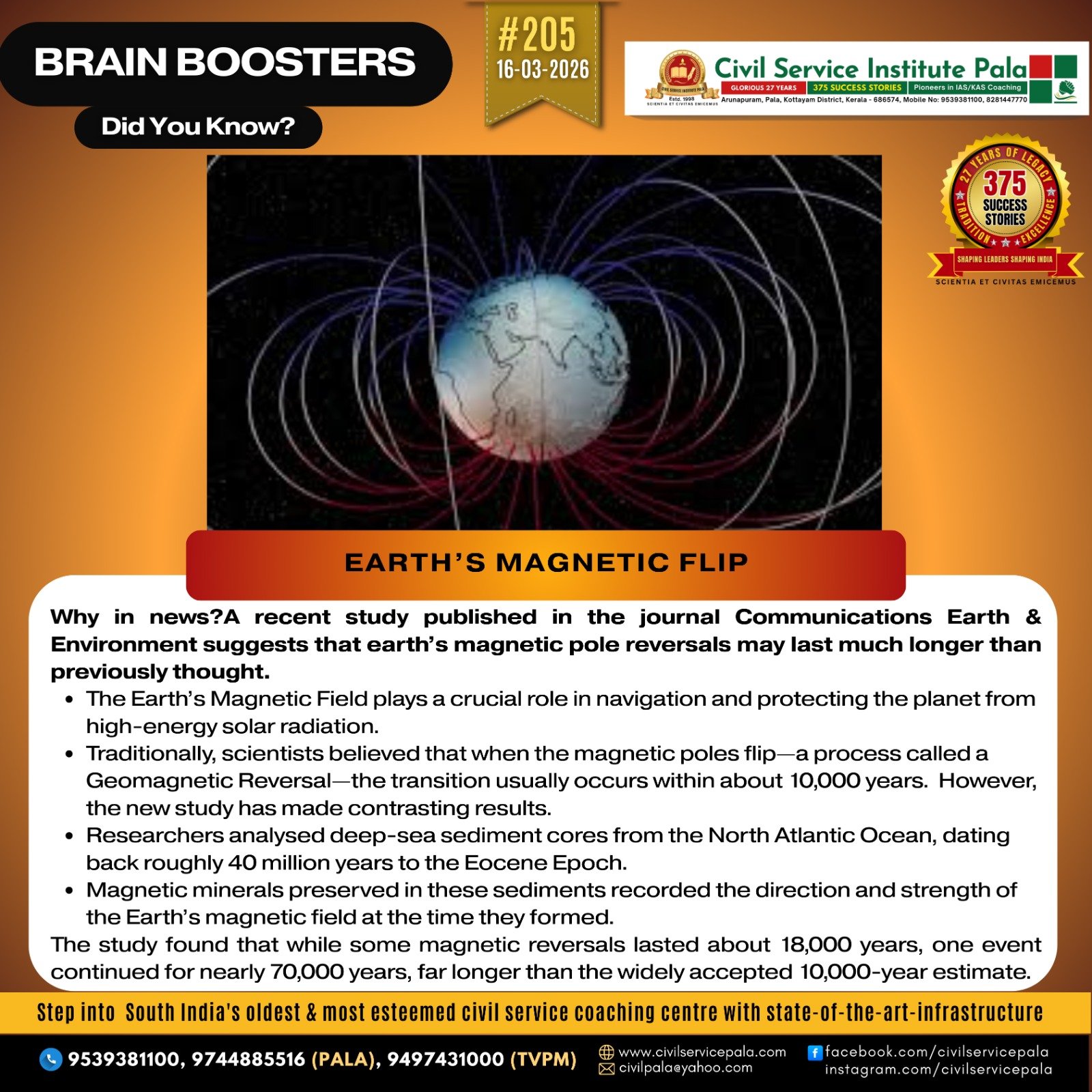
Earth’s Magnetic Flip
The Earth’s Magnetic Field plays a crucial role in navigation and protecting the planet from high-energy solar radiation. Traditionally, scientists believed that when the magnetic poles flip—a process called a Geomagnetic Reversal—the transition usually occurs within about 10,000 years. However, a recent study published in the journal Communications Earth & Environment suggests that some reversals may last much longer than previously thought.
Researchers analysed deep-sea sediment cores from the North Atlantic Ocean, dating back roughly 40 million years to the Eocene Epoch. Magnetic minerals preserved in these sediments recorded the direction and strength of the Earth’s magnetic field at the time they formed. Using X-ray scanning, magnetic measurements, and astronomical dating techniques, the team reconstructed the timing of past reversals.
Based on the recent data, many experts believe the 10,000 year duration is an intrinsic property of the earth’s geodynamo, the process by which the churning of the liquid iron outer core generates the magnetic field.
The study found that while some magnetic reversals lasted about 18,000 years, one event continued for nearly 70,000 years, far longer than the widely accepted 10,000-year estimate. During such reversals, the magnetic field becomes significantly weaker, which could expose the atmosphere and surface life to higher levels of solar radiation for extended periods.
Computer simulations of the Geodynamo suggest that these prolonged reversals are rare but natural occurrences. Scientists believe such long weak-field periods may have influenced ancient environments and potentially affected the evolution of life on Earth.
