



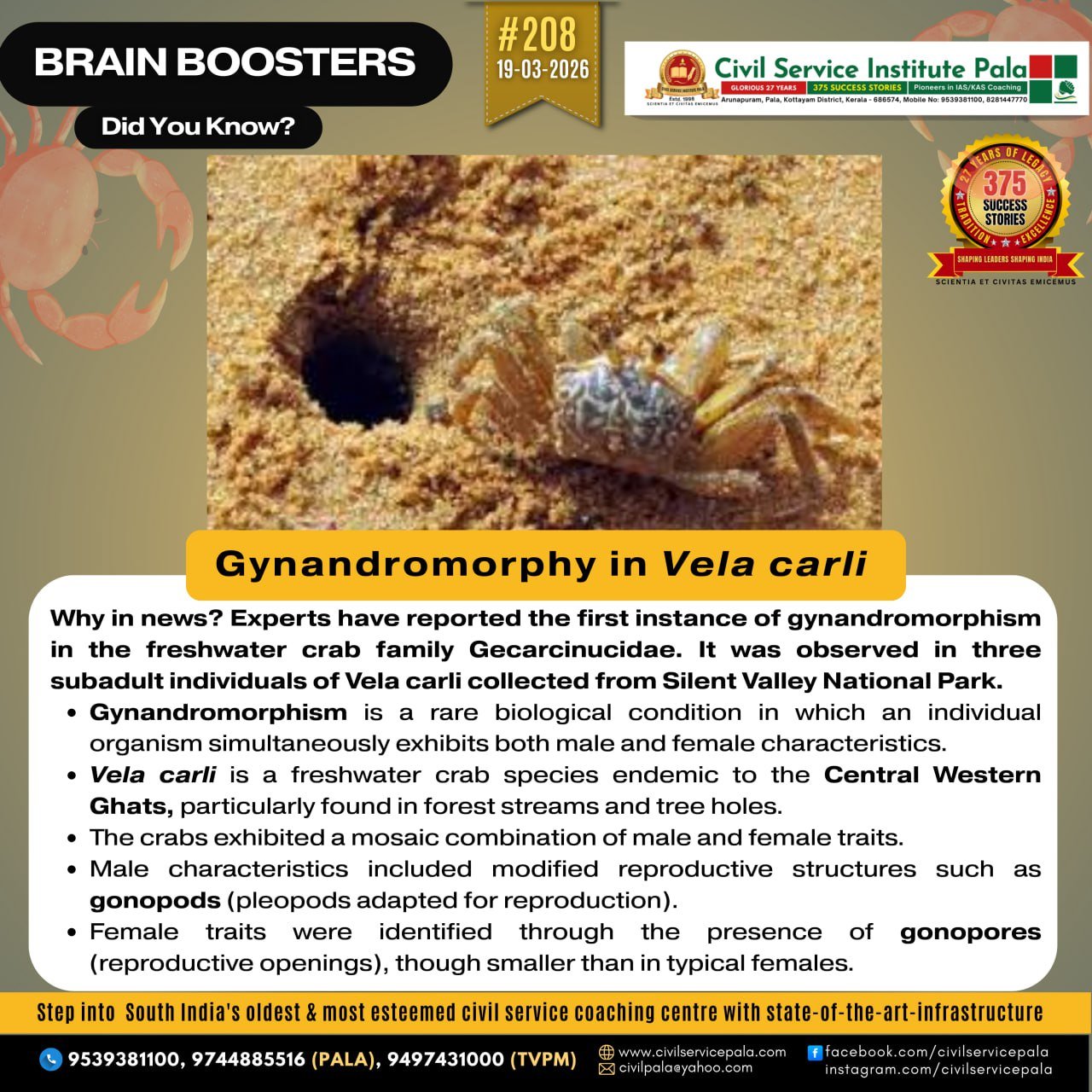
Gynandromorphism
Why in news?
• Experts have reported the first instance of gynandromorphism in the freshwater crab family Gecarcinucidae.
• Gynandromorphism is a rare biological condition in which an individual organism simultaneously exhibits both male and female characteristics.
Vela Carli
• The phenomenon of Gynandromorphism was observed in three subadult individuals of Vela carli collected from Silent Valley National Park.
• Vela carli is a freshwater crab species endemic to the Central Western Ghats, particularly found in forest streams and tree holes.
• This discovery fills a major research gap in understanding sexual differentiation in freshwater crustaceans.
• Brachyuran crabs generally exhibit sexual dimorphism, where males and females show distinct morphological differences, especially in reproductive structures.
Morphological Features Observed
• The crabs exhibited a mosaic combination of male and female traits within the same body.
• Male characteristics included modified reproductive structures such as gonopods (pleopods adapted for reproduction).
• Female traits were identified through the presence of gonopores (reproductive openings), though smaller than in typical females.
• The pleopod structures showed irregular development, with some being male-like, some reduced, and others absent.
• The combination of traits indicates incomplete or mixed sexual development rather than a fully functional dual-sex system.
• Gynandromorphism is not the same as hermaphroditism, as it involves a mosaic of male and female traits rather than fully functional dual reproductive systems.
• This is the first reported case in the freshwater crab family Gecarcinucidae, not in all crustaceans.
Possible Causes
• Experts suggest that the condition is likely due to early developmental mosaicism, where genetic or cellular variation occurs during initial growth stages.
• The habitat of the crabs was relatively undisturbed, indicating that environmental pollution is unlikely to be the cause.
Scientific Significance
• This is the first documented case of gynandromorphism in Gecarcinucidae, making it a significant addition to crustacean biology.
• The findings highlight the complex mechanisms of sexual differentiation in freshwater crabs.
• The study also provides the first detailed description of adult female reproductive traits in Vela carli.
Ecological & Conservation Relevance
• Vela carli has a narrow endemic range in the Western Ghats, making it ecologically sensitive.
• Experts highlight the need for further research on reproductive biology and population dynamics.
• Understanding such anomalies is important for conservation planning in fragile ecosystems like the Western Ghats.
