



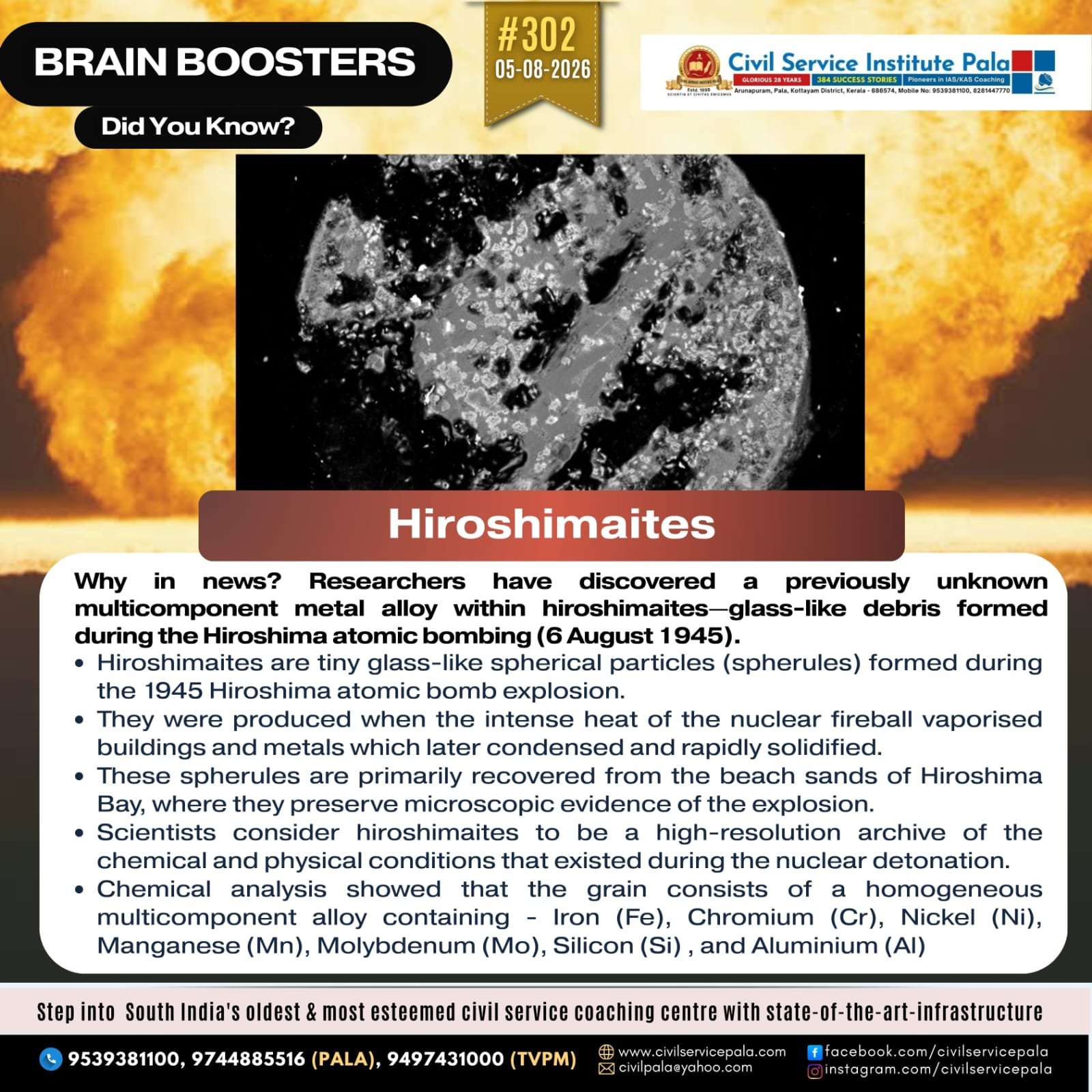
Hiroshimaites
Hiroshimaites
Why in news? Researchers have discovered a previously unknown multicomponent metal alloy within hiroshimaites—glass-like debris formed during the Hiroshima atomic bombing (6 August 1945). The study, published in Science Advances (29 July 2026), demonstrates that nuclear explosions can create entirely new materials under extreme physicochemical conditions.
• Hiroshimaites are tiny glass-like spherical particles (spherules) formed during the 1945 Hiroshima atomic bomb explosion.
• They were produced when the intense heat of the nuclear fireball vaporised buildings and metals which later condensed and rapidly solidified.
• These spherules are primarily recovered from the beach sands of Hiroshima Bay, where they preserve microscopic evidence of the explosion.
• Scientists consider hiroshimaites to be a high-resolution archive of the chemical and physical conditions that existed during the nuclear detonation.
• Chemical analysis showed that the grain consists of a homogeneous multicomponent alloy containing - Iron (Fe), Chromium (Cr), Nickel (Ni), Manganese (Mn), Molybdenum (Mo), Silicon (Si) , and Aluminium (Al)
• The alloy possesses a previously unknown crystal structure, making it a new material not previously identified in nature or synthesised under conventional laboratory conditions.
• Single-crystal X-ray diffraction revealed that the alloy crystallises in the space group P2₁3 with an ordered AlAu₄-type crystal structure, which is an ordered derivative of the β-Mn (beta-manganese) structure.
How was the Alloy Formed?
• The Hiroshima nuclear explosion generated temperatures exceeding 7,000°C, creating an extremely energetic plasma environment.
• At these temperatures, construction steel, aluminium and numerous urban materials completely vaporised, producing a mixed metallic vapour.
• As the fireball expanded, it cooled at an exceptionally rapid rate through a process known as ultrafast quenching.
• During this rapid cooling, the vaporised metallic elements condensed and solidified before they could separate into ordinary mineral phases.
• The rapid, non-equilibrium cooling stabilised a complex alloy that would normally be impossible to form under conventional geological or laboratory conditions.
Scientific Significance
• The discovery demonstrates that high-energy nuclear plasma events can function as natural laboratories capable of producing entirely new materials.
• It provides direct evidence that extreme transient environments can stabilise complex multicomponent metallic phases that cannot easily be synthesised using traditional metallurgical methods.
• The newly discovered alloy shares several characteristics with:
o High-Entropy Alloys (HEAs), which contain multiple principal metallic elements and are valued for their exceptional strength, corrosion resistance and thermal stability.
o Quasicrystals, which possess unusual atomic arrangements that provide unique mechanical and physical properties.
• Such materials are of considerable interest in aerospace, defence, energy and advanced engineering applications.
Importance of Hiroshimaites in Scientific Research
• Hiroshimaites preserve a detailed chemical record of the nuclear fireball, allowing scientists to reconstruct the extreme temperatures, pressures and cooling processes that occurred during the explosion.
• They provide valuable insights into:
o Nuclear explosion physics
o High-temperature plasma chemistry
o Rapid solidification processes
o Formation of exotic minerals and alloys
• The study demonstrates that atomic-blast debris can serve as a unique source for discovering previously unknown materials and understanding matter under extreme conditions.
Key Findings of the Research Paper
• A previously unknown multicomponent alloy has been identified inside a hiroshimaite spherule.
• The alloy formed through condensation from a mixed metallic vapour followed by ultrafast quenching in the expanding nuclear fireball.
• Electron microprobe analysis confirmed a homogeneous composition of Fe–Cr–Ni–Mn–Mo–Si–Al.
• The findings show that nuclear plasma events can stabilise complex metallic phases, making atomic-blast debris a valuable natural laboratory for nonequilibrium alloy formation and materials discovery.
Significance
• Opens new avenues for studying advanced alloys formed under extreme conditions.
• Demonstrates the role of nuclear events in producing previously unknown materials.
• Enhances understanding of rapid solidification and nonequilibrium metallurgy.
• May inspire laboratory techniques for synthesising advanced engineering materials with exceptional mechanical and thermal properties.
• Provides a new perspective on using historical nuclear debris for materials science and condensed matter research.
