



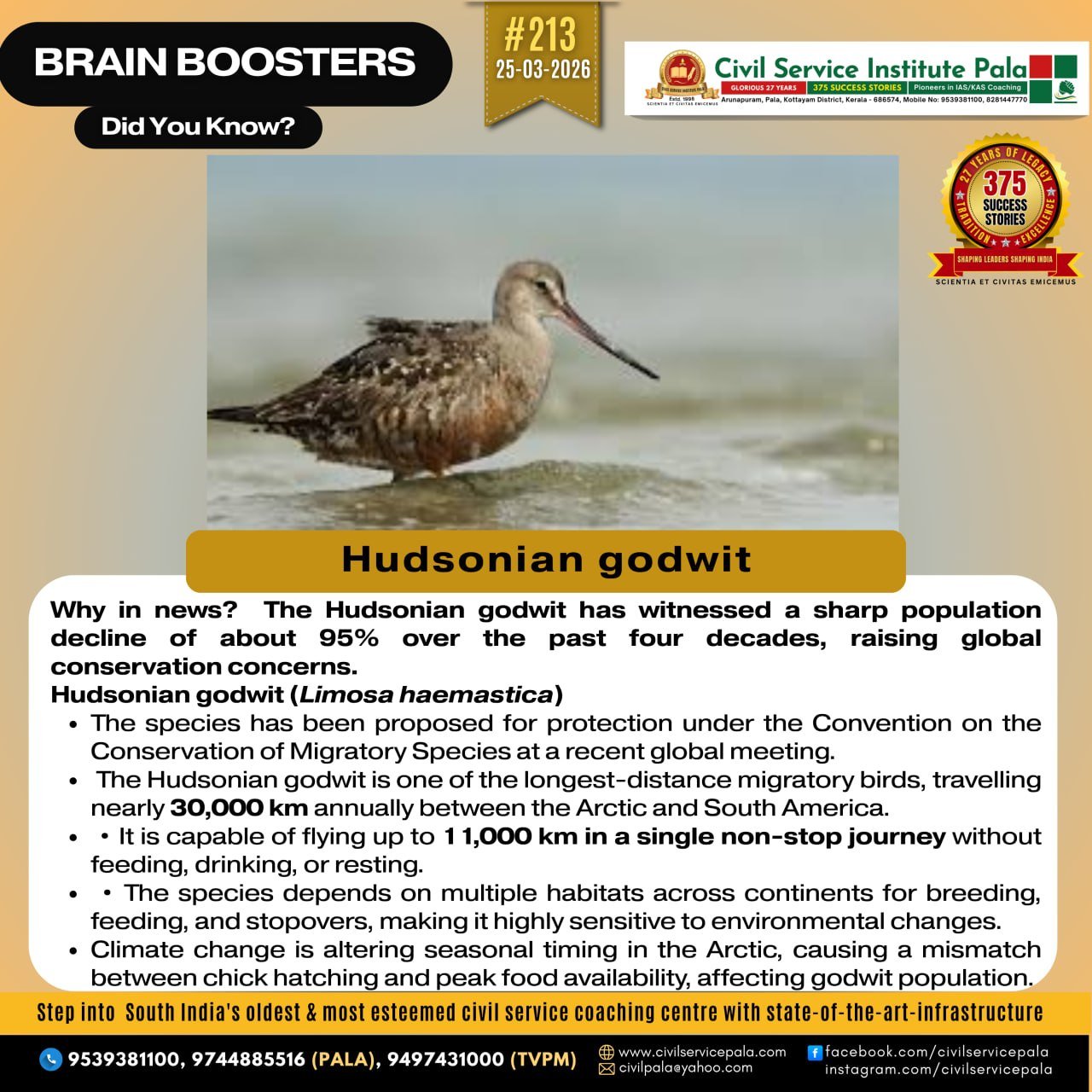
Hudsonian Godwit
Why in News?
* The Hudsonian godwit has witnessed a sharp population decline of about 95% over the past four decades, raising global conservation concerns.
* The species has been proposed for international protection under the Convention on the Conservation of Migratory Species at a recent global meeting.
About Hudsonian Godwit & Migration
Scientific name : Limosa haemastica
IUCN Red List category - Vulnerable
* The Hudsonian godwit is one of the longest-distance migratory birds, travelling nearly 30,000 km annually between the Arctic and South America.
* It is capable of flying up to 11,000 km in a single non-stop journey without feeding, drinking, or resting.
* The species depends on multiple habitats across continents for breeding, feeding, and stopovers, making it highly sensitive to environmental changes.
Habitat of Hudsonian Godwit
* The Hudsonian godwit breeds in the Arctic region, especially in areas where forests change into wet, marshy tundra land.
* These areas are waterlogged and boggy (called muskeg), with plants like mosses, sedges, small shrubs, and scattered trees.
* Such habitats provide safe nesting areas and nearby food sources for the birds.
Habitat During Migration
* While travelling long distances, the bird depends on different types of wet areas to rest and feed.
* These include lakes, flooded fields, wetlands, marshes, and shallow water bodies.
* It also uses coastal areas like mudflats, estuaries, and lagoons, where food is easily available.
* The bird may even stop at high-altitude lakes and temporary river islands, showing its adaptability.
Habitat in South America
* After migration, the bird spends several months in coastal regions of South America, mainly in Argentina and Chile.
* Here, it prefers mudflats, coastal wetlands, lagoons, and marshy areas for feeding.
* Some birds are also found in Brazil and Uruguay, where they use wet grasslands, swamps, and water edges.
Reasons for Population Decline
* Climate change is altering seasonal timing in the Arctic, causing a mismatch between chick hatching and peak food availability.
* Changes in wetlands, agriculture, and land use practices are reducing suitable stopover habitats in regions like North America.
* Expansion of aquaculture and human activity in coastal ecosystems in South America is disrupting feeding grounds.
* Experts highlight that migration timing itself is shifting, indicating disruption in environmental cues required for long-distance migration.
* Since migratory birds depend on multiple regions, ecological disturbances in any one location can affect the entire life cycle.
Convention on Migratory Species (CMS)
* The Convention on the Conservation of Migratory Species is an international treaty focused on conserving migratory animals.
* It aims to protect species that cross national borders through coordinated global action.
* Member countries are required to conserve habitats, remove migration barriers, and cooperate in research and protection efforts.
Conservation Challenges & Significance
* Migratory species like the Hudsonian godwit face multiple simultaneous threats, including climate change, habitat loss, and human interference.
* Experts highlight that such species can adapt to individual environmental changes, but struggle when multiple disruptions occur together.
* Effective conservation requires international cooperation, habitat restoration, and protection of ecological corridors across continents.
