



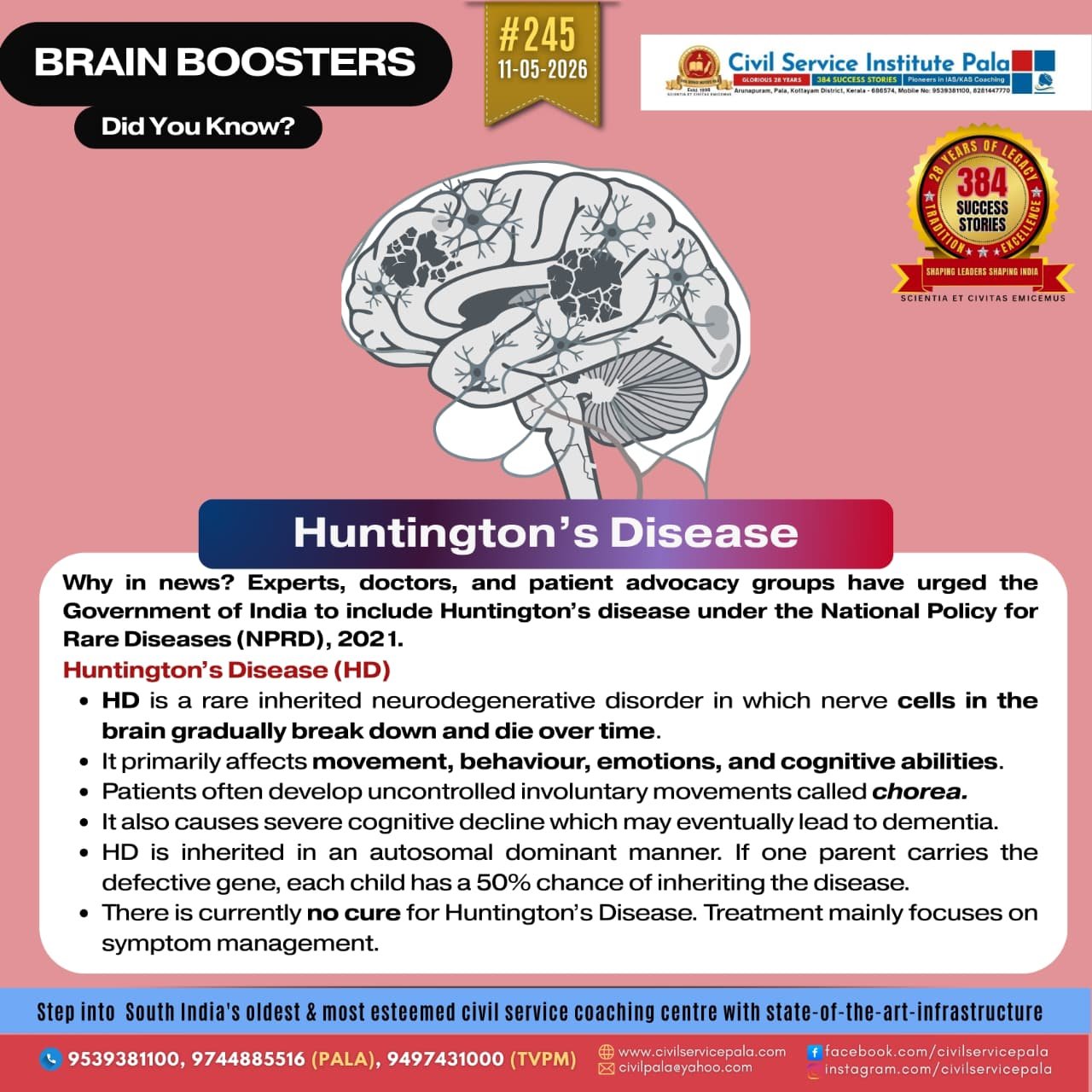
Huntington's Disease
Huntington's Disease Why in News?
Experts, doctors, and patient advocacy groups have urged the Government of India to include Huntington’s disease under the National Policy for Rare Diseases (NPRD), 2021. They argue that official recognition would improve early diagnosis, financial assistance, treatment access, research support, and social protection for affected patients and caregivers.
What is Huntington’s Disease?
Huntington’s Disease (HD) is a rare inherited neurodegenerative disorder in which nerve cells in the brain gradually break down and die over time. The disease primarily affects movement, behaviour, emotions, and cognitive abilities.
It is caused by a mutation in the Huntingtin gene located on chromosome 4. The mutation leads to abnormal repetition of the DNA sequence called CAG repeats. People with 36 or more repeats generally develop the disease.
HD is progressive in nature, meaning symptoms worsen steadily over time. At present, there is no cure or treatment capable of stopping or reversing the disease progression.
Key Features and Symptoms of Huntington’s Disease
Huntington’s Disease affects both the body and mind. Symptoms usually appear during middle age, though juvenile cases can also occur.
Physical Symptoms
Patients often develop:
Uncontrolled involuntary movements called chorea
Muscle stiffness and abnormal posture
Tremors and balance problems
Difficulty in walking, swallowing, speaking, and eating
Weight loss and fatigue
Sleep disorders and seizures in advanced stages
Cognitive Symptoms
The disease gradually affects:
Memory and concentration
Decision-making ability
Judgement and problem-solving skills
Ability to organise thoughts and perform daily activities
Severe cognitive decline may eventually lead to dementia.
Psychological and Behavioural Symptoms
Many patients experience:
Depression
Mood swings
Anxiety and irritability
Social withdrawal
Suicidal thoughts
Psychosis in severe cases
Experts note that depression is often the earliest psychological symptom associated with HD.
Genetic Nature of the Disease
Huntington’s Disease is inherited in an autosomal dominant manner. If one parent carries the defective gene, each child has a 50% chance of inheriting the disease.
This hereditary nature creates serious emotional and social challenges for families because multiple generations may be affected.
Experts have also highlighted the importance of genetic counselling and genetic testing in identifying at-risk individuals and enabling informed family decisions.
Diagnosis and Treatment
Diagnosis generally involves:
Medical and family history assessment
Neurological examination
Brain imaging such as MRI or CT scans
Genetic testing to count CAG repeats
Genetic testing remains the most accurate method of diagnosis.
Treatment
There is currently no cure for Huntington’s Disease. Treatment mainly focuses on symptom management.
Some medicines help control involuntary movements, depression, anxiety, hallucinations, and behavioural disturbances. However, these drugs may produce side effects such as fatigue and reduced concentration.
Supportive care including physiotherapy, psychiatric care, speech therapy, and nutritional support plays an important role in improving quality of life.
Why Experts Want Huntington’s Disease Included under NPRD
Experts argue that inclusion under the National Policy for Rare Diseases is essential because Huntington’s Disease remains:
Underdiagnosed
Poorly understood
Financially burdensome
Socially stigmatized
Key Reasons for Inclusion
1. Lack of Awareness
Many doctors and medical interns are unfamiliar with HD and genetic testing procedures. Experts recommend introducing greater awareness during MBBS training itself.
2. Delayed Diagnosis
Symptoms often appear gradually and may initially resemble psychiatric or neurological disorders, leading to delayed identification.
3. Need for Financial Support
Long-term treatment, supportive therapy, and caregiving impose a heavy financial burden on families. Inclusion under NPRD could enable access to government assistance. 4. Need for a National Registry
India currently lacks reliable prevalence data on Huntington’s Disease. Experts have demanded a national registry that protects patient privacy while helping in policymaking and research.
5. Social Stigma and Caregiver Burden
Patients and caregivers often face discrimination, emotional stress, and isolation. Official recognition under NPRD could improve institutional support and public awareness.
National Policy for Rare Diseases (NPRD), 2021
Ministry of Health and Family Welfare launched the National Policy for Rare Diseases in March 2021 to improve diagnosis, treatment, and research related to rare diseases in India.
Major Features of NPRD
Categorisation of Rare Diseases
Rare diseases are classified into three groups:
Group 1: Diseases amenable to one-time curative treatment
Group 2: Diseases requiring long-term or lifelong treatment with relatively lower cost
Group 3: Diseases where treatment exists but is extremely expensive and requires lifelong therapy
Centres of Excellence (CoEs)
Twelve Centres of Excellence have been identified across India for diagnosis and treatment of rare diseases.
Financial Assistance
Financial support of up to ₹50 lakh per patient is provided for treatment at notified Centres of Excellence.
Research Support
The government established the National Consortium for Research and Development on Therapeutics for Rare Diseases to strengthen research and innovation.
Tax Exemptions
GST and customs duty exemptions are provided on imported drugs used for rare diseases.
Current Coverage
At present, 63 rare diseases are included under NPRD, and more than 1,100 patients have reportedly benefited from the policy.
