



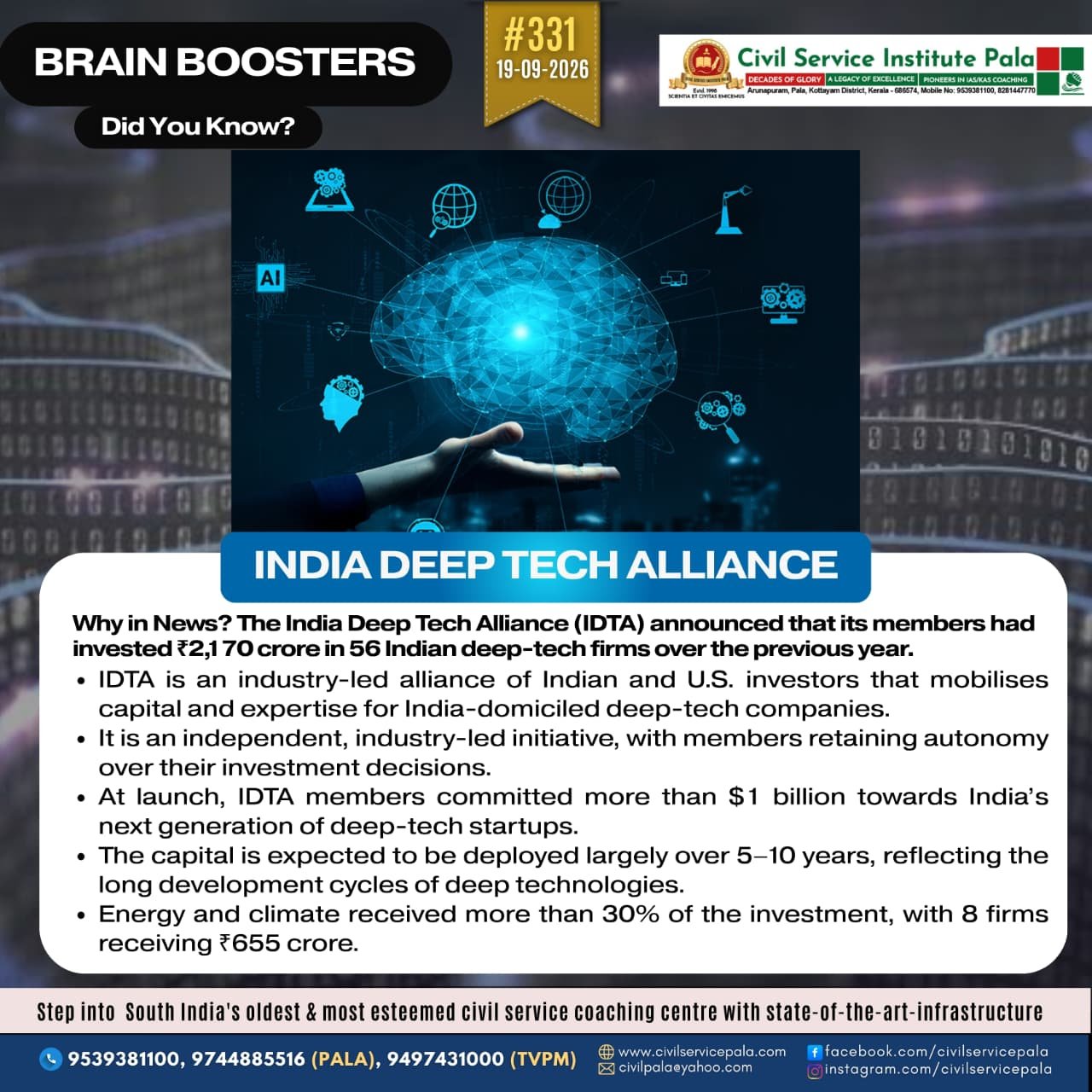
INDIA DEEP TECH ALLIANCE (IDTA)
INDIA DEEP TECH ALLIANCE (IDTA)
Why in News?
The India Deep Tech Alliance (IDTA) announced that its members had invested ₹2,170 crore in 56 Indian deep-tech firms over the previous year, highlighting growing private-sector support for India’s deep-tech ecosystem.
What is Deep Tech?
Deep technology refers to innovations rooted in substantial scientific research or advanced engineering that seek to solve complex problems or create breakthrough technologies.
Unlike conventional startups that may focus on incremental improvements to existing products or services, deep-tech ventures generally work on fundamental scientific or engineering challenges and require longer research and development cycles.
What makes Deep Tech different?
• Science and engineering intensive: Deep-tech ventures are built around advances in areas such as artificial intelligence, quantum technology, biotechnology, robotics, space and advanced energy technologies.
• Long R&D cycles: These ventures often require 5–10 years of research and development before their technologies become commercially viable.
• High upfront investment: Significant capital is often required before the technology generates revenue because the primary challenge is developing and validating the underlying technology.
• Lab-to-market transition: The central challenge is converting scientific discoveries or advanced engineering solutions into commercially viable products and services.
Examples of Deep-Tech Applications
Deep-tech ventures can include technologies such as:
• Quantum processors based on advances in quantum science.
• Synthetic biology for applications such as sustainable agriculture.
• Fusion energy technologies.
• Advanced space technologies and launch systems.
• AI-based scientific applications, including technologies capable of solving complex biological or engineering problems.
Why does Deep Tech need specialised support?
Deep-tech companies differ from many conventional startups because their technologies require long development periods, specialised expertise and substantial capital before commercial returns emerge.
Therefore, their growth depends not only on financial investment but also on technical expertise, mentorship, networks and collaboration between researchers, investors, industry and government.
What is the India Deep Tech Alliance (IDTA)?
The India Deep Tech Alliance (IDTA) is an industry-led alliance of leading U.S. and Indian investors that seeks to mobilise capital and expertise to build India-domiciled deep-tech companies.
It provides a platform through which investors and corporate partners can:
• Share investment pipelines and technical knowledge.
• Conduct technical due diligence.
• Co-invest in promising deep-tech companies.
• Provide capital, mentorship and network access to Indian startups and scale-ups.
• Engage government stakeholders through a unified channel on matters related to the RDI Scheme.
IDTA and the RDI Scheme
The Government of India has approved the Research, Development and Innovation (RDI) Scheme with a ₹1 lakh crore corpus to support and scale strategic technologies.
The IDTA is an independent, industry-led initiative that seeks to complement the RDI Scheme by coordinating private-sector investment, technical expertise and industry participation.
How does IDTA operate?
IDTA does not function as a conventional pooled investment fund.
• No central pool of money: There is no single IDTA fund or central investment vehicle.
• Independent investment decisions: Individual member firms retain full autonomy over their funds, investment strategies and decisions.
• Shared collaboration: Members can share pipelines, conduct technical due diligence and co-invest.
• Government engagement: Members use a unified channel to engage with government stakeholders on the RDI Scheme.
• Support beyond capital: Members can provide mentorship and network access to startups and scale-ups.
Recent Investment Commitments
At launch, IDTA members had committed more than $1 billion towards India's next generation of deep-tech startups.
The expected deployment period is largely 5–10 years, reflecting the long development cycles typically associated with deep technologies.
More recently, IDTA members announced ₹2,170 crore invested in 56 Indian deep-tech firms over the previous year.
These investments were made independently by individual IDTA members according to their respective investment strategies and processes.
Sectoral Distribution of Recent Investments
• Energy and climate: Received more than 30% of the capital, with 8 firms receiving ₹655 crore.
• Quantum, robotics and space: Received a nearly similar share of investment, distributed among 21 companies.
• Artificial Intelligence: Received nearly 30%, with 16 firms receiving ₹639 crore.
This indicates the concentration of private investment in strategically important technology sectors.
INDIA’S APPROACH TO DEEP TECH
Why does India need a Deep-Tech Policy?
Deep-tech startups are built on novel scientific or engineering knowledge, often combining multiple disciplines. They involve high technical uncertainty, substantial capital requirements and long development timelines, making conventional startup support mechanisms insufficient on their own.
India’s approach therefore focuses on creating an ecosystem supported by strategic incentives, patient capital and robust intellectual property protection.
The broader objective is to strengthen India’s transition from being primarily a technology consumer to a global “Product Nation”, with startups acting as drivers of frontier innovation and a knowledge-driven economy.
National Deep Tech Startup Policy (NDTSP)
The National Deep Tech Startup Policy (NDTSP) seeks to address systemic challenges faced by deep-tech startups through targeted policy interventions and create an enabling environment for innovation-led growth.
The initiative followed a recommendation of the Prime Minister’s Science, Technology & Innovation Advisory Council (PM-STIAC) in July 2022 to develop a dedicated policy framework for India’s deep-tech startup ecosystem.
Four Pillars of the NDTSP
The policy framework is anchored on four broad objectives:
1. Ensuring the Security of India’s Economic Future by strengthening the country’s capacity to develop and commercialise frontier technologies.
2. Facilitating a Seamless Transition to a Knowledge-Driven Economy by promoting innovation based on scientific and technological capabilities.
3. Bolstering National Capability and Sovereignty through the Atmanirbhar Bharat Imperative by strengthening domestic technological capabilities and reducing strategic dependence.
4. Fostering Ethical Innovation by ensuring that technological advancement is accompanied by responsible and ethical innovation.
How was the NDTSP Developed?
The policy was designed through a multi-stakeholder institutional process involving government, industry and academia.
NDTSP Consortium
A high-level NDTSP Consortium, chaired by Prof. Ajay Kumar Sood, Principal Scientific Adviser to the Government of India, was established to guide the policy direction.
It brought together industry bodies such as FICCI, CII, and NASSCOM along with government stakeholders including DPIIT, MeitY, Department of Science and Technology (DST), ISRO, NSCS, and DRDO
Working Group
A dedicated Working Group, chaired by Dr. Parvinder Maini, Scientific Secretary, Office of the Principal Scientific Adviser, was constituted under the Consortium to undertake detailed policy design.
It incorporated inputs from stakeholders across government, industry and academia.
Role of the Office of the Principal Scientific Adviser
The Office of the Principal Scientific Adviser (OPSA) functioned as the central coordinating and drafting body. Its responsibilities included:
• Leading the drafting and iterative redrafting of the policy.
• Designing the overall policy architecture and thematic structure.
• Conducting multi-stakeholder consultations and synthesising inputs.
• Facilitating inter-ministerial coordination.
• Aligning the strategic vision with implementable policy measures.
Consultation and Drafting
Multiple rounds of consultations were conducted with industry, government agencies and domain experts, with feedback incorporated into successive versions of the policy.
In October 2023, the OPSA consolidated stakeholder inputs and finalised Version 5.0 of the draft NDTSP, which was formally shared with DPIIT for further policy progression and adoption.
