



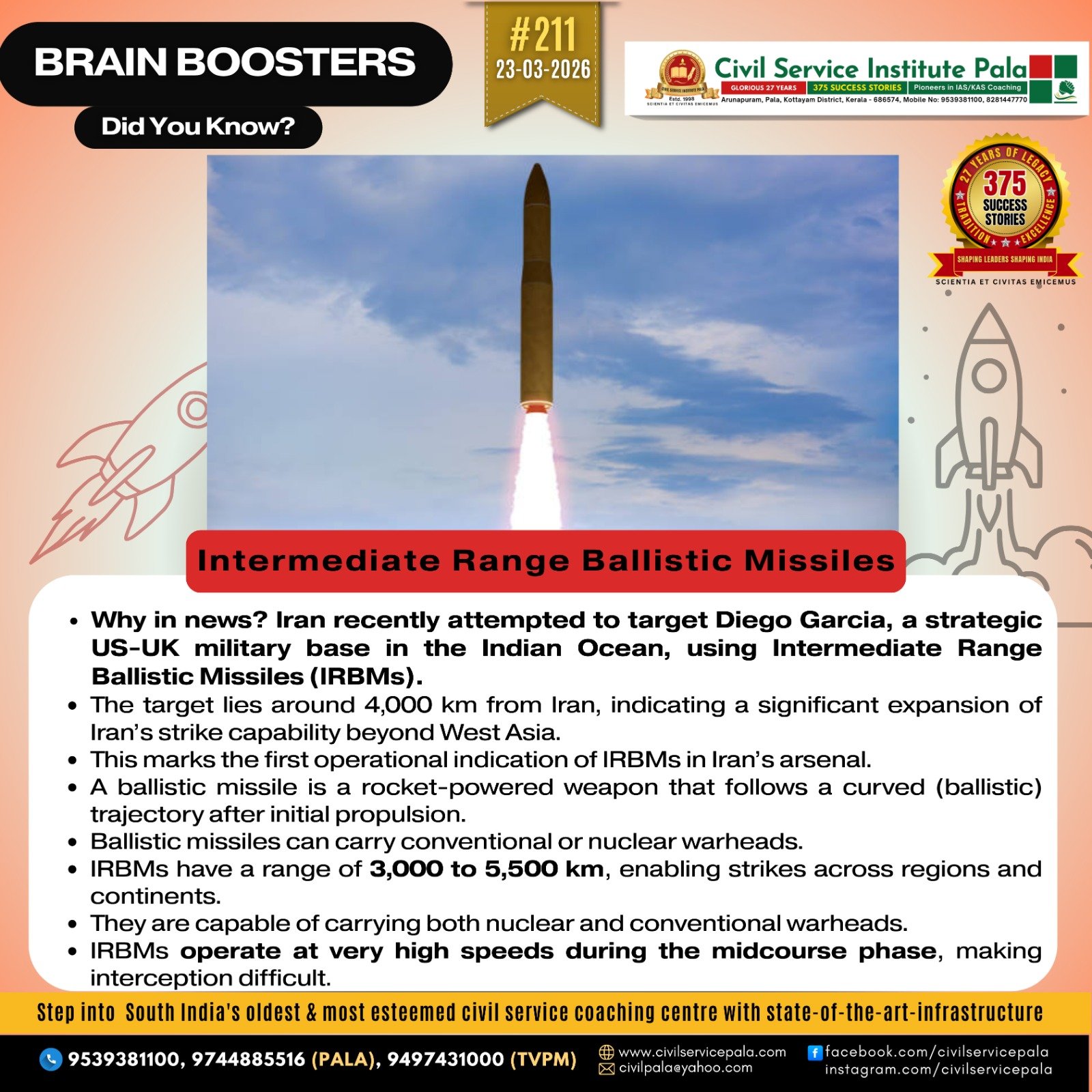
Intermediate Range Ballistic Missiles
Why in news? Iran recently attempted to target Diego Garcia, a strategic US-UK military base in the Indian Ocean, using Intermediate Range Ballistic Missiles (IRBMs).
• The target lies around 4,000 km from Iran, indicating a significant expansion of Iran’s strike capability beyond West Asia.
• This marks the first operational indication of IRBMs in Iran’s arsenal, raising global security concerns.
Ballistic missile
• • A ballistic missile is a rocket-powered weapon that follows a curved (ballistic) trajectory after initial propulsion.
• • It is powered during the initial boost phase, after which it travels unpowered and descends toward the target.
• • Ballistic missiles can carry conventional or nuclear warheads.
Classification of Ballistic Missiles (by Range)
• Short-Range Ballistic Missiles (SRBMs) have a range of less than 1,000 km and are used for tactical purposes.
• Medium-Range Ballistic Missiles (MRBMs) have a range of 1,000–3,000 km and are used in regional conflicts.
• Intermediate-Range Ballistic Missiles (IRBMs) have a range of 3,000–5,500 km and bridge the gap between regional and global strike capabilities.
• Intercontinental Ballistic Missiles (ICBMs) have a range of more than 5,500 km and are used for long-distance strategic deterrence.
Intermediate-Range Ballistic Missiles (IRBMs): Key Features
• IRBMs have a range of 3,000 to 5,500 km, enabling strikes across regions and continents.
• They are capable of carrying both nuclear and conventional warheads.
• IRBMs operate at very high speeds during the midcourse phase, making interception difficult.
• They provide a strategic advantage by extending reach without requiring intercontinental capability.
Indian Missiles
• The Agni-IV is an Indian solid-fueled intermediate-range ballistic missile (IRBM) with a range of up to 4,000 km.
• The Agni-III is an Indian intermediate-range ballistic missile (IRBM) with a range of 3,000 – 3,500 km.
