



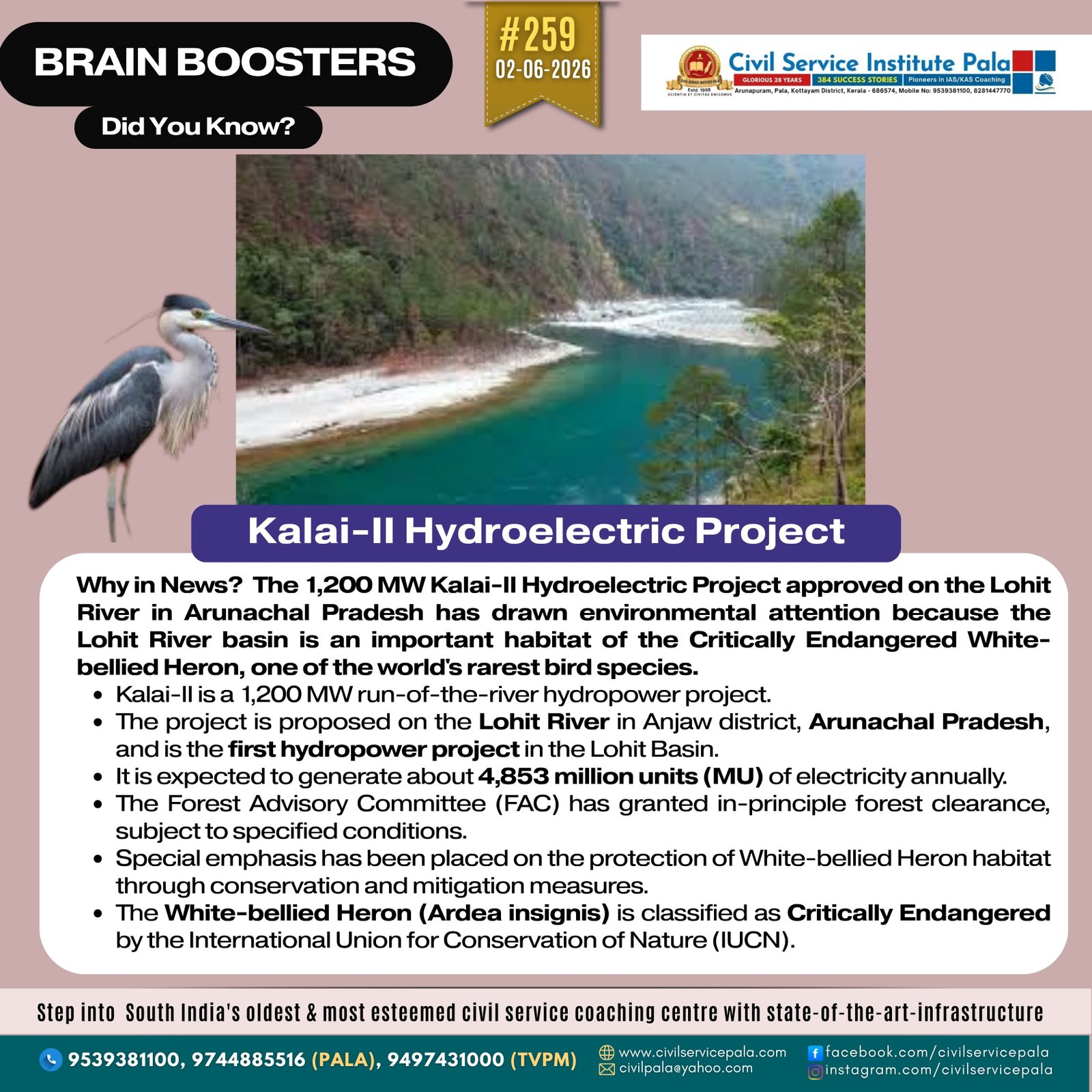
Kalai-II Hydroelectric Project
Why in News? The 1,200 MW Kalai-II Hydroelectric Project approved on the Lohit River in Arunachal Pradesh has drawn environmental attention because the Lohit River basin is an important habitat of the Critically Endangered White-bellied Heron, one of the world's rarest bird species
Kalai-II Hydroelectric Project
Kalai-II is a 1,200 MW run-of-the-river hydropower project proposed on the Lohit River in Arunachal Pradesh.
The project is located in Anjaw district, a strategically important border district adjoining China.
It is the first hydropower project in the Lohit Basin.
The project will be implemented through a Joint Venture between THDC India Limited and the Government of Arunachal Pradesh.
The estimated project cost is about ₹14,100 crore and the expected completion period is 78 months.
Importance of the Project
The project is expected to generate about 4,853 million units (MU) of electricity annually.
It will strengthen electricity supply in Arunachal Pradesh and contribute to national peak-demand management.
Hydropower from the project can support grid balancing and renewable energy integration.
The project is expected to improve road, bridge, and transmission infrastructure in remote border areas.
The state will receive 12% free power and an additional 1% free power for the Local Area Development Fund (LADF).
Environmental Concerns
The project requires diversion of nearly 870 hectares of forest land, including significant submergence areas.
The project falls within a high-conservation-value forest landscape.
Forest loss and habitat fragmentation may affect wildlife movement and ecological connectivity.
Increased submergence may disrupt migration routes of animals across the Lohit River valley.
Government Safeguards
The Forest Advisory Committee (FAC) has granted in-principle forest clearance subject to conditions.
The FAC has directed preparation of a wildlife management and biodiversity conservation plan.
Special emphasis has been placed on protection of White-bellied Heron habitat.
Compensatory afforestation has been mandated as part of the clearance process.
White-bellied Heron (Ardea insignis)
Background & Conservation Status
The White-bellied Heron is one of the rarest bird species in the world.
It is classified as Critically Endangered by the International Union for Conservation of Nature.
Fewer than 60 individuals are estimated to survive globally.
Its present range is limited to India, Bhutan, Myanmar, and China.
Key Identification Features
It is the second-largest living heron species.
The bird has a grey-brown body, white underparts, and a massive bill.
It is generally solitary and prefers undisturbed habitats.
Habitat and Distribution
The species is primarily associated with large rivers having sand or gravel bars.
It inhabits riverine ecosystems adjoining subtropical and tropical forests.
It occurs from lowland river valleys to elevations of about 1,500 metres.
In India, Arunachal Pradesh is the most important stronghold for the species.
The Lohit River basin and the Namdapha Tiger Reserve region are critical habitats.
Major Threats
Habitat loss due to infrastructure development remains the most significant threat.
Human disturbance from roads, fishing, agriculture, and riverbank activities affects breeding and feeding behaviour.
Hunting and ecosystem degradation have contributed to population decline.
Breeding success remains extremely low, further increasing extinction risk.
The species has already lost a significant portion of its historical habitat across northeastern India.
Conservation Concerns Linked to Kalai-II
Wildlife researchers have reported sightings of the species along stretches of the Lohit River.
Habitat alteration and river regulation may affect feeding, nesting, and movement patterns.
The project area lies within a landscape considered ecologically important for the bird's survival in India.
Conservationists stress that long-term monitoring and habitat protection measures are necessary.
