



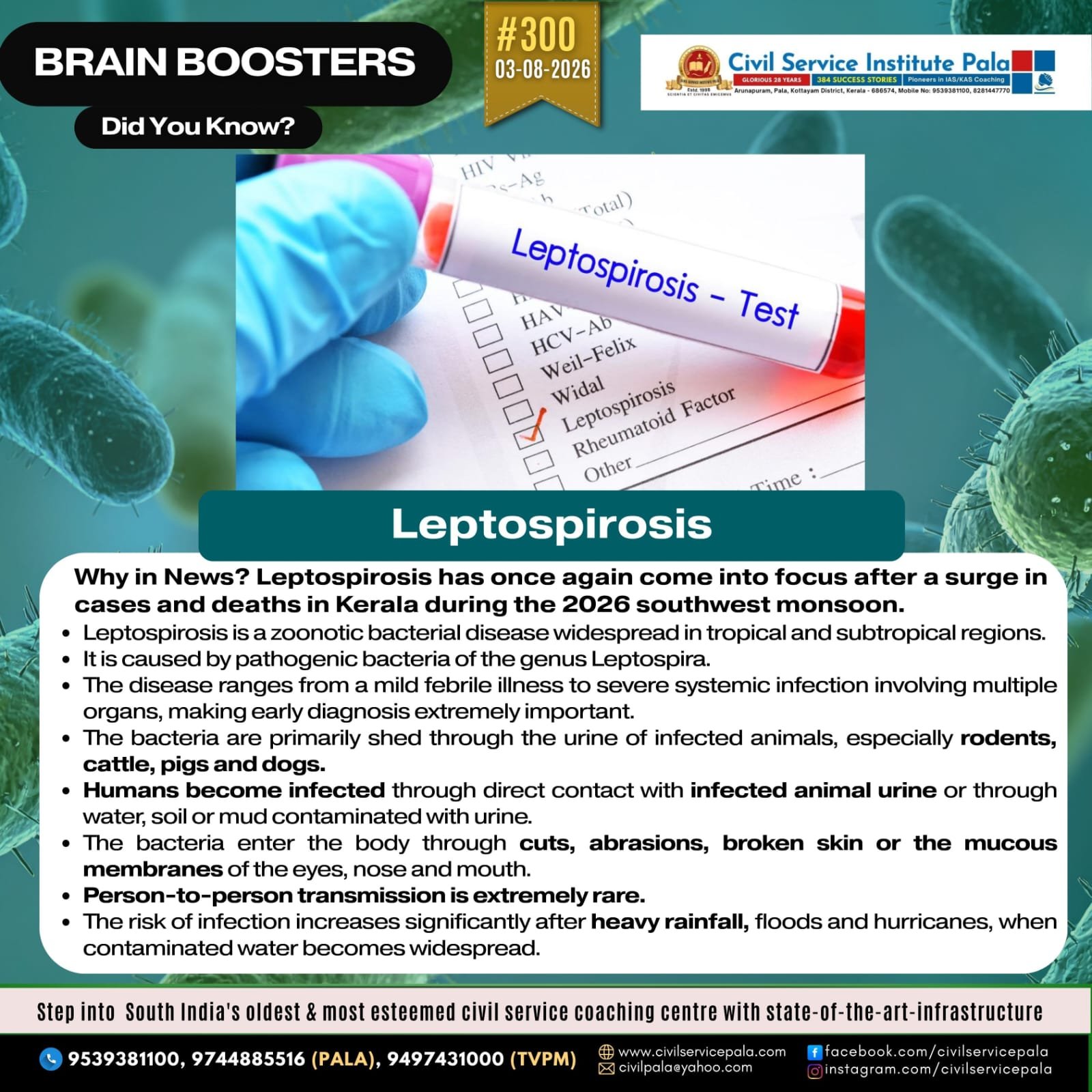
Leptospirosis
Leptospirosis
Why in News?
Leptospirosis has once again come into focus after a surge in cases and deaths in Kerala during the 2026 southwest monsoon. The disease claimed around 50 lives in July 2026 alone, reinforcing concerns over its high mortality and the need for early diagnosis and prevention.
What is Leptospirosis?
• Leptospirosis is a zoonotic bacterial disease caused by pathogenic bacteria of the genus Leptospira.
• It affects both humans and animals and is one of the most widespread zoonotic diseases in tropical and subtropical regions.
• The disease ranges from a mild febrile illness to severe systemic infection involving multiple organs, making early diagnosis extremely important.
Transmission
• The bacteria are primarily shed through the urine of infected animals, especially rodents, cattle, pigs and dogs.
• Humans become infected through direct contact with infected animal urine or through water, soil or mud contaminated with urine.
• The bacteria enter the body through cuts, abrasions, broken skin or the mucous membranes of the eyes, nose and mouth.
• Person-to-person transmission is extremely rare.
• The risk of infection increases significantly after heavy rainfall, floods and hurricanes, when contaminated water becomes widespread.
Why is Kerala a Hotspot?
• Kerala's heavy monsoon rainfall, frequent flooding, high humidity and year-round moisture create ideal environmental conditions for the survival of Leptospira bacteria.
• Large rodent populations and other animal reservoir hosts live in close proximity to human settlements and agricultural fields, increasing the chances of environmental contamination.
• Agricultural activities such as paddy cultivation, pineapple farming, canal cleaning and other manual labour expose workers to contaminated water and soil.
• Although leptospirosis is endemic in several Indian States, Kerala's extensive surveillance, wider diagnostic facilities and comprehensive reporting system also contribute to its higher reported disease burden.
High-Risk Groups
• Traditionally, leptospirosis has been regarded as an occupational disease affecting:
o Farmers and agricultural labourers
o Dairy workers
o Sanitation and cleaning workers
o Canal and drainage workers
o Construction workers
• Home gardening without protective equipment has also emerged as an important source of infection in urban areas.
• According to Kerala Health Department data, manual labourers account for the largest proportion of leptospirosis deaths, followed by agricultural workers and homemakers engaged in gardening.
• Early diagnosis remains difficult because the initial symptoms closely resemble those of many other tropical fevers.
• Conventional antibody-based tests such as ELISA often fail to provide confirmatory results during the early stage of infection.
• PCR (Polymerase Chain Reaction) enables earlier detection and has been introduced in Kerala, although its availability remains limited across all districts.
• Early clinical suspicion is therefore considered as important as laboratory confirmation.
Prevention and Treatment
• Early administration of antibiotics, particularly Doxycycline, remains the cornerstone of both prevention and treatment.
• Kerala recommends chemoprophylaxis with Doxycycline (200 mg twice weekly) for individuals belonging to high-risk occupational groups.
• When started early, Doxycycline can prevent bacterial multiplication and significantly reduce disease severity.
• Public health authorities also recommend:
o Wearing protective boots and gloves while working in contaminated environments.
o Avoiding direct contact with floodwater and contaminated soil.
o Strengthening awareness campaigns among vulnerable occupational groups.
o Prompt medical consultation when fever develops after exposure to contaminated water.
Kerala's Public Health Strategy
• The State emphasises early clinical suspicion among primary healthcare providers, particularly in patients presenting with fever, muscle pain and a history of exposure to contaminated environments.
• Preventive chemotherapy with Doxycycline continues to be a major strategy for reducing disease burden among high-risk populations.
• Recent expert recommendations include:
o Targeted awareness campaigns for vulnerable occupational groups.
o Wider distribution of protective gear such as gumboots and gloves.
o Improved access to molecular diagnostic facilities.
o Strengthening emergency management capacity at secondary care hospitals to reduce mortality.
Significance
• Leptospirosis remains one of the most important climate-sensitive zoonotic diseases, with outbreaks closely linked to flooding and extreme rainfall events.
• Kerala's experience highlights the growing importance of integrating public health, environmental management and occupational safety under the One Health approach, recognising the interconnected health of humans, animals and the environment.
