



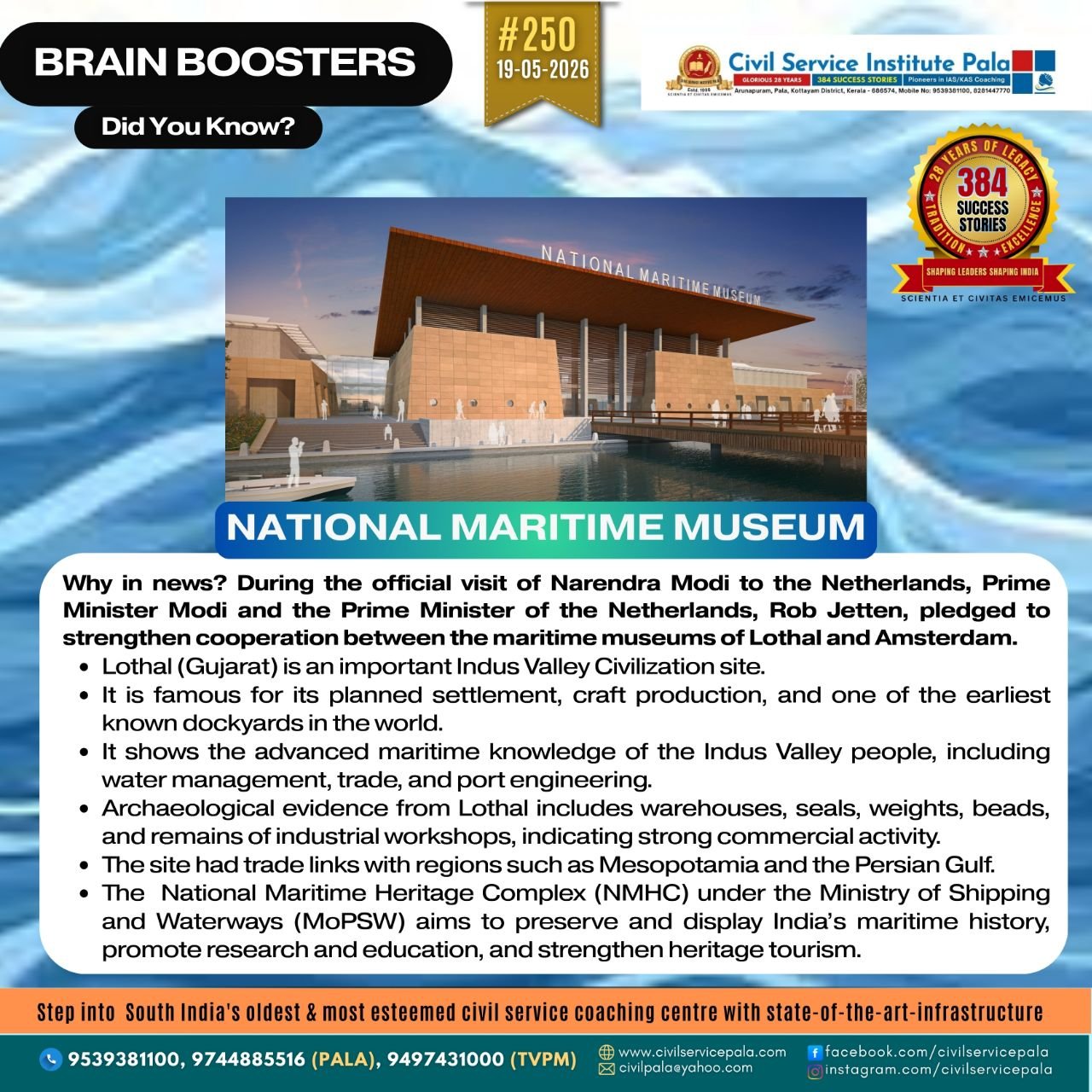
National Maritime Museum
Why in News?
During the official visit of Narendra Modi to the Netherlands on 16–17 May 2026, Prime Minister Modi and the Prime Minister of the Netherlands, Rob Jetten, pledged to strengthen cooperation between the maritime museums of Lothal and Amsterdam.
The collaboration aims to promote research, preservation, exhibitions, and public awareness relating to maritime heritage, navigation history, and ancient trade networks.
National Maritime Heritage Complex (NMHC), Lothal
The Government of India, through the Ministry of Ports, Shipping and Waterways (MoPSW), has developed the National Maritime Heritage Complex (NMHC) at Lothal in Gujarat.
The project seeks to showcase India’s maritime history spanning nearly 4,500 years, from the Indus Valley Civilization to modern maritime development.
Lothal was selected because it contains one of the world’s earliest known man-made dockyards discovered during excavations in 1957.
NMHC aims to preserve archaeological heritage and create a world-class cultural and educational space.
Heritage tourism is another major benefit of the NMHC.
A large-scale project at Lothal can attract domestic and international visitors, generate employment, and support local businesses.
It can also improve infrastructure in the surrounding region, including roads, hospitality services, and cultural facilities. In this way, heritage becomes linked to economic development.
Significance of Lothal
· Lothal is located in Gujarat and is among the most important Harappan settlements discovered in India.
· Its importance lies in the fact that it demonstrates the sophistication of the Indus Valley Civilization in planning, trade, engineering, and craft production.
· The site is especially famous for what is widely described as one of the earliest known dockyards, suggesting that the Harappans possessed advanced knowledge of tidal movements, drainage, and port-related infrastructure.
· Lothal allows a direct link between ancient urbanism and modern maritime policy as it shows that India’s engagement with the sea is not a recent phenomenon but a long civilizational tradition.
Historical Background
· Lothal was part of the broader Harappan world that flourished during the Mature Harappan phase.
· Archaeological findings suggest that the site was occupied roughly between 2400 BCE and 1900 BCE.
· It was a planned settlement with well-defined streets, drainage systems, residential areas, workshops, and storage structures.
· The site was brought to wide scholarly attention through excavations conducted by the Archaeological Survey of India in the mid-20th century.
· These excavations revealed a settlement that was strategically located and economically dynamic.
· The discovery of its dockyard transformed scholarly understanding of ancient Indian maritime capabilities.
· It indicated that Harappan settlements were not isolated inland centres but were integrated into wider trade and communication networks.
Geographic and Strategic Location
· Lothal’s location in the semi-arid region of Gujarat gave it strategic access to routes connecting inland production zones with coastal and maritime trade.
· Its proximity to waterways and its connection to the Arabian Sea made it suitable for commerce and transport.
· The strategic location also suggests an advanced understanding of geography and environmental adaptation.
· In an area vulnerable to flooding and changing water channels, the Harappans developed structures that helped manage seasonal and tidal variations.
· Evidence from Lothal’s urban planning shows that ancient settlements were shaped by practical engineering responses to environmental constraints.
Maritime Trade and External Contacts
· Lothal’s significance is closely tied to trade.
· Archaeological evidence such as seals, weights, beads, and industrial remains suggests that the settlement was involved in extensive exchange networks. · Scholars generally associate Harappan trade with regions such as Mesopotamia, the Persian Gulf, and other parts of West Asia.
· References in Mesopotamian records to “Meluhha” are often linked to the Indus Valley Civilization, reinforcing the idea of long-distance commerce.
· Lothal shows that India’s interaction with the wider world was maritime as well as continental.
· Trade would have involved not only goods but also ideas, technologies, cultural practices, and possibly religious influences.
· Lothal illustrates the civilizational role of the sea as a medium of contact and exchange.
Craft Production and Economy
· Lothal had a crucial role as a craft production centre.
· Excavations have revealed evidence of bead-making, shell cutting, pottery production, and metalworking.
· These activities indicate a diversified economy in which agriculture, industry, and trade were linked together.
· The production of carnelian and agate beads is particularly significant because such items were highly valued and widely traded across Harappan settlements and beyond.
Urban Planning and Administration
· Lothal displayed several features associated with Harappan urbanism, including grid-like streets, drainage channels, residential blocks, and raised structures.
· The uniformity of bricks and the use of standardized weights point to administrative regulation and economic discipline.
· These features are important for understanding the broader nature of the Indus Valley Civilization.
· Lothal’s urban layout therefore contributes to the argument that Harappan society was highly organized, technically skilled, and collectively managed.
Water Management and Engineering
· Water management is one of the strongest themes associated with Lothal.
· The site reflects the Harappan ability to respond to flood risks, tidal variation, and drainage needs.
· Elevated platforms, drains, embankments, and reservoirs point to a society that understood the need to control water rather than merely live with it.
· The engineering lessons of Lothal are relevant even today.
· Modern urban India continues to face problems related to drainage, flooding, and waterlogged settlements.
· Lothal therefore provides a powerful historical example of how ancient societies developed practical responses to environmental stress.
Cultural and Ritual Life
· Lothal also offers evidence of ritual and symbolic life.
· Fire altars and seals found at the site suggest that religion and ritual were part of everyday Harappan life.
· Animal motifs, including bulls and other symbolic figures, are common on seals and may have had social or religious meanings
