



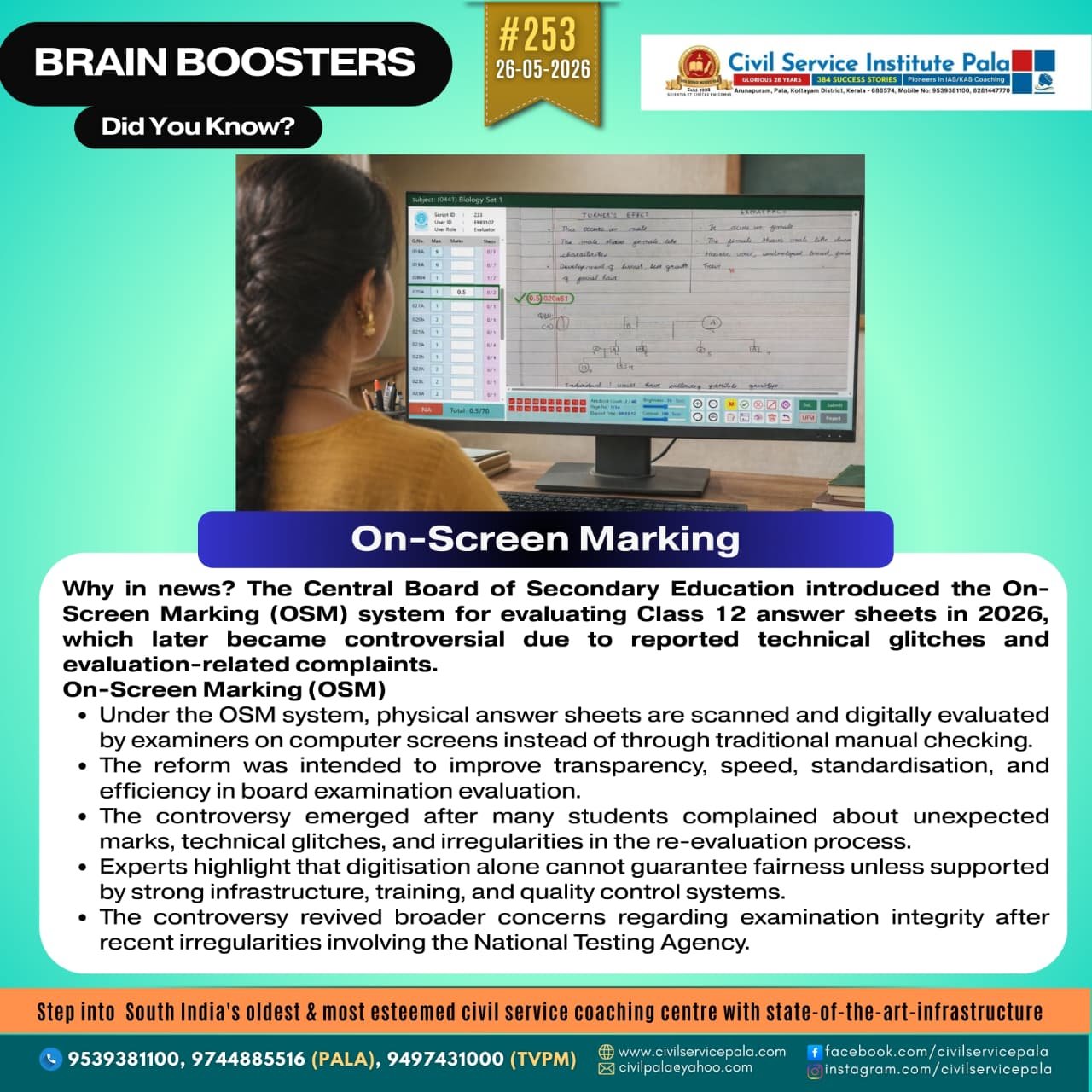
On-Screen Marking (OSM)
On-Screen Marking (OSM)
Under the OSM system, physical answer sheets are scanned and digitally evaluated by examiners on computer screens instead of through traditional manual checking.
The reform was intended to improve transparency, speed, standardisation, and efficiency in board examination evaluation.
The controversy emerged after large numbers of students complained about unexpected marks, technical glitches, and irregularities in the re-evaluation process.
Experts highlight that digitisation alone cannot guarantee fairness unless supported by strong infrastructure, training, and quality control systems.
Key Facts
· Central Board of Secondary Education functions under the Ministry of Education.
· Around 98 lakh answer books were reportedly scanned and digitally evaluated under the OSM system.
· Experts estimate that nearly 1.96 crore pages were scanned during the evaluation process.
· More than 68,000 answer books reportedly required rescanning because of poor image quality.
· Over 13,500 answer books were reportedly pulled for manual rechecking.
· Class 12 pass percentage reportedly declined to 85.20% in 2026.
Challenges
Students reported discrepancies between expected and awarded marks, especially in descriptive subjects requiring interpretive evaluation.
Several students allegedly received incorrect or mismatched answer sheets during the re-evaluation process.
Poor scan quality reportedly affected readability of answer scripts, raising concerns regarding evaluation accuracy.
Experts suggest that prolonged screen-based checking can lead to evaluator fatigue and missed answers.
The re-evaluation portal reportedly faced repeated crashes, login failures, payment issues, and download errors due to heavy traffic.
Teachers had reportedly warned earlier that evaluators lacked adequate structured training for the OSM system.
The controversy exposed weaknesses in digital governance, risk anticipation, and grievance redressal mechanisms.
Experts highlight that weakening moderation systems may increase inconsistency in marking standards.
