



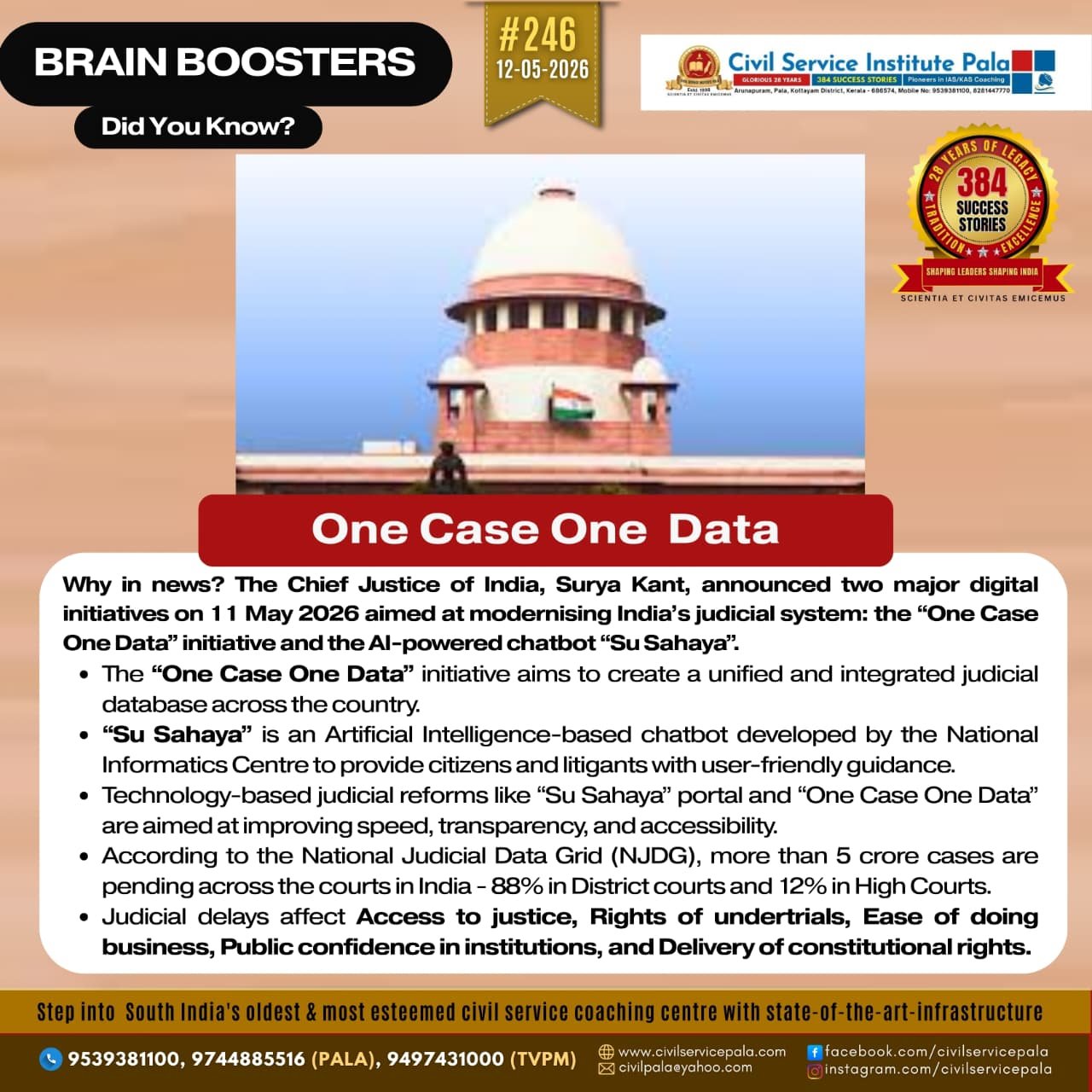
One Case One Data
Why in News?
The Chief Justice of India Surya Kant on 11 May 2026 announced two major digital initiatives aimed at modernising India’s judicial system “One Case One Data” Initiative and the “Su Sahaya” AI-powered Chatbot.
These initiatives seek to strengthen judicial efficiency, improve access to justice, and deepen the ongoing digital transformation under the e-Courts Mission Mode Project.
The development gains significance in the backdrop of India’s growing judicial pendency and increasing emphasis on technology-driven governance reforms.
India’s Judicial Pendency Crisis
· India’s judiciary continues to face a severe backlog of cases across all levels of courts.
· According to the National Judicial Data Grid (NJDG), more than 5 crore cases are pending across Indian courts. Of these:
· Around 88% of pending cases are in district courts.
· About 12% are pending in High Courts.
· The Supreme Court accounts for only a very small share of overall pendency.
As of May 2026, the Supreme Court alone had more than 93,000 pending cases, reflecting a significant increase over recent years.
Judicial delays directly affect Access to justice, Rights of undertrials, Ease of doing business, Public confidence in institutions, and Delivery of constitutional rights.
India also suffers from a low judge-population ratio of roughly 19 judges per million people, which is far below countries such as the United States and China.
In this context, technology-based judicial reforms are increasingly viewed as essential for improving speed, transparency, and accessibility of courts.
One Case One Data Initiative
· The “One Case One Data” initiative aims to create a unified and integrated judicial database across the country.
· The initiative seeks to connect data across judicial hierarchy of the country – from the supreme courts to the taluk courts into a single interconnected digital framework.
· The idea is to ensure that one case carries one unified digital identity and information trail across the judicial system.
Key Objectives
The initiative aims to:
Streamline case management
Reduce duplication and procedural delays
Improve coordination between different courts
Enable better tracking of cases
Create efficient judicial workflows
Strengthen transparency and accountability
By integrating data from courts at multiple levels, the judiciary aims to create a more efficient case management ecosystem.
This initiative represents an important step toward building a digitally integrated justice delivery system in India.
Su Sahaya: AI-Powered Judicial Assistance Chatbot
The Supreme Court also launched “Su Sahaya”, an Artificial Intelligence-based chatbot integrated with the Supreme Court website.
The chatbot has been developed by the National Informatics Centre (NIC) in collaboration with the Supreme Court Registry.
Purpose of Su Sahaya : The chatbot is designed to provide citizens and litigants with:
Front-end guidance
Information regarding court services
Assistance in accessing Supreme Court procedures
User-friendly digital interaction
The initiative aims to simplify access to judicial services, especially for ordinary litigants unfamiliar with legal procedures.
Importance
Su Sahaya reflects the growing role of Artificial Intelligence in governance and public administration.
The chatbot can:
Reduce dependence on manual assistance
Improve accessibility
Save time for litigants
Increase efficiency in information delivery
Support citizen-centric governance
It also reflects the judiciary’s effort to make justice delivery more technology-enabled and accessible.
