



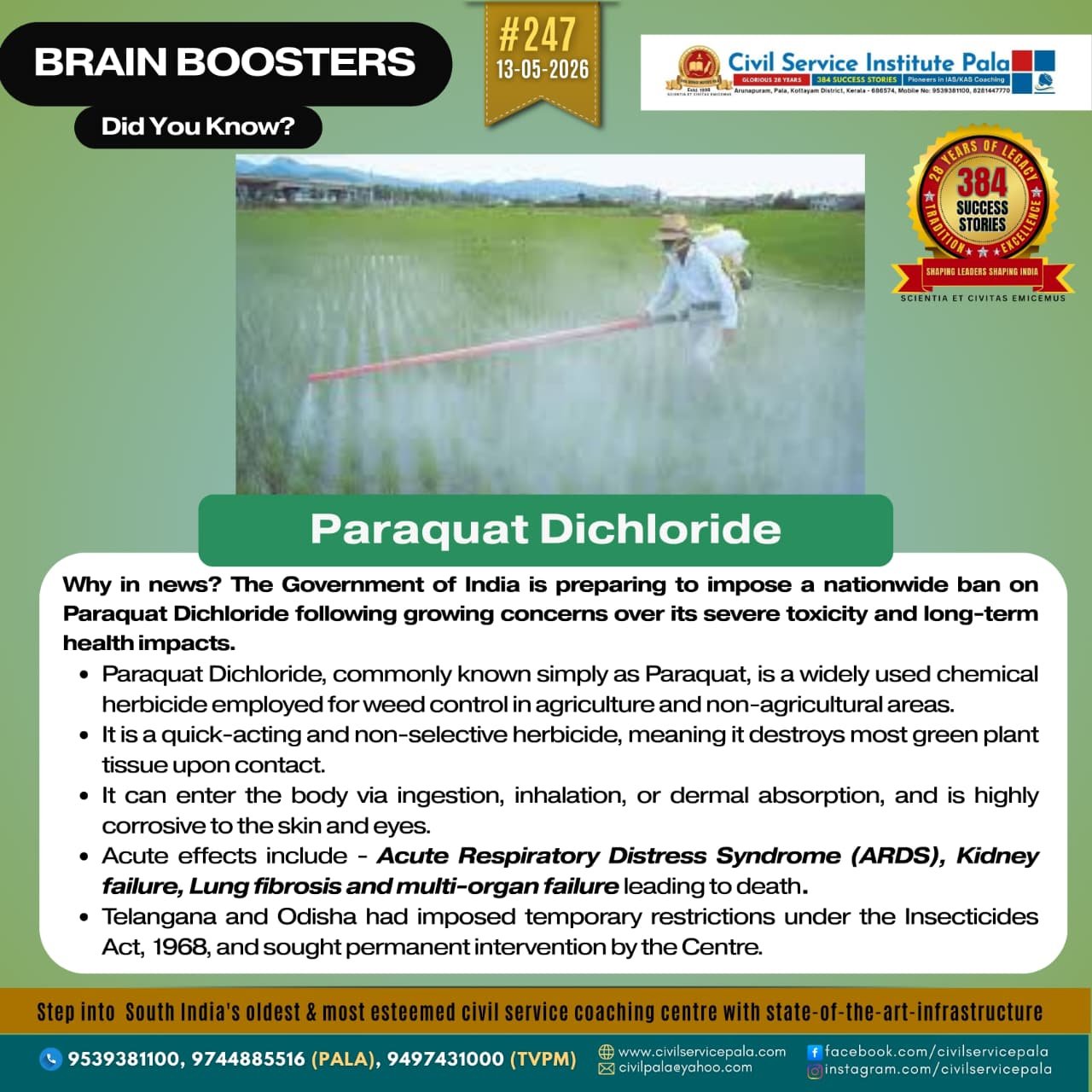
Paraquat Dichloride
Paraquat Dichloride
Why in News?
The Government of India is preparing to impose a nationwide ban on Paraquat Dichloride following growing concerns over its severe toxicity and long-term health impacts. An expert committee consisting of doctors and agricultural scientists reportedly recommended a complete prohibition after reviewing evidence linking the herbicide to fatal poisoning, kidney failure, lung fibrosis, and neurological disorders such as Parkinson’s disease.
What is Paraquat Dichloride?
Paraquat Dichloride, commonly known simply as Paraquat, is a widely used chemical herbicide employed for weed control in agriculture and non-agricultural areas. It is a quick-acting and non-selective herbicide, meaning it destroys most green plant tissue upon contact.
It is chemically known as N,N-dimethyl-4,4-bipyridinium dichloride and belongs to a group of compounds called viologens.
One of the most popular commercial formulations of Paraquat is sold under the trade name Gramoxone.
Toxicity and health impacts (already good; just tighten)
Paraquat is considered one of the most toxic herbicides in use; even a small oral dose can be fatal, and there is no specific antidote.
It can enter the body via ingestion, inhalation, or dermal absorption, and is highly corrosive to the skin and eyes.
Health Impact
Acute effects include:
Acute Respiratory Distress Syndrome (ARDS)
Kidney failure
Lung fibrosis and multi‑organ failure
Death, which may occur even weeks after exposure due to delayed pulmonary damage.
Chronic impacts
Medical studies and expert panels have increasingly associated Paraquat exposure with severe health complications including:
Lung fibrosis
Chronic kidney damage
Neurological disorders such as Parkinson’s disease
A study published in the The National Medical Journal of India described Paraquat as a “highly toxic compound” capable of causing severe illness and death through multiple exposure pathways.
Ecological Impact
Studies have shown that Paraquat also poses serious ecological risks.
A 2019 draft ecological risk assessment by the United States Environmental Protection Agency identified potential threats to:
Mammals
Birds
Terrestrial plants
Algae
Invertebrates
Because it is non-selective, it can damage surrounding vegetation and disturb ecological balance if improperly used.
Global regulatory context
Paraquat is banned or heavily restricted in several countries (including China, the EU, Switzerland, the UK, and others) due to safety and environmental concerns, while it remains registered in some others (e.g., the USA) under strict usage conditions.
Indian Context
Earlier, Telangana and Odisha had imposed temporary restrictions under the Insecticides Act, 1968, and sought permanent intervention by the Centre.
The Insecticides Act 1968
· It empowers the Central or State Government to prohibit the sale, distribution or use of an insecticide if that insecticide is found likely to pose a risk to human beings or animals.
· The Central Government or the State Government may temporarily prohibit the sale, distribution or use of an insecticide for up to 60 days (extendable by 30 days) pending investigation if it is likely to pose risk to humans or animals.
· After investigation, the Central Government may pass appropriate orders, including refusal of registration or cancellation of the certificate of registration of the insecticide.
