



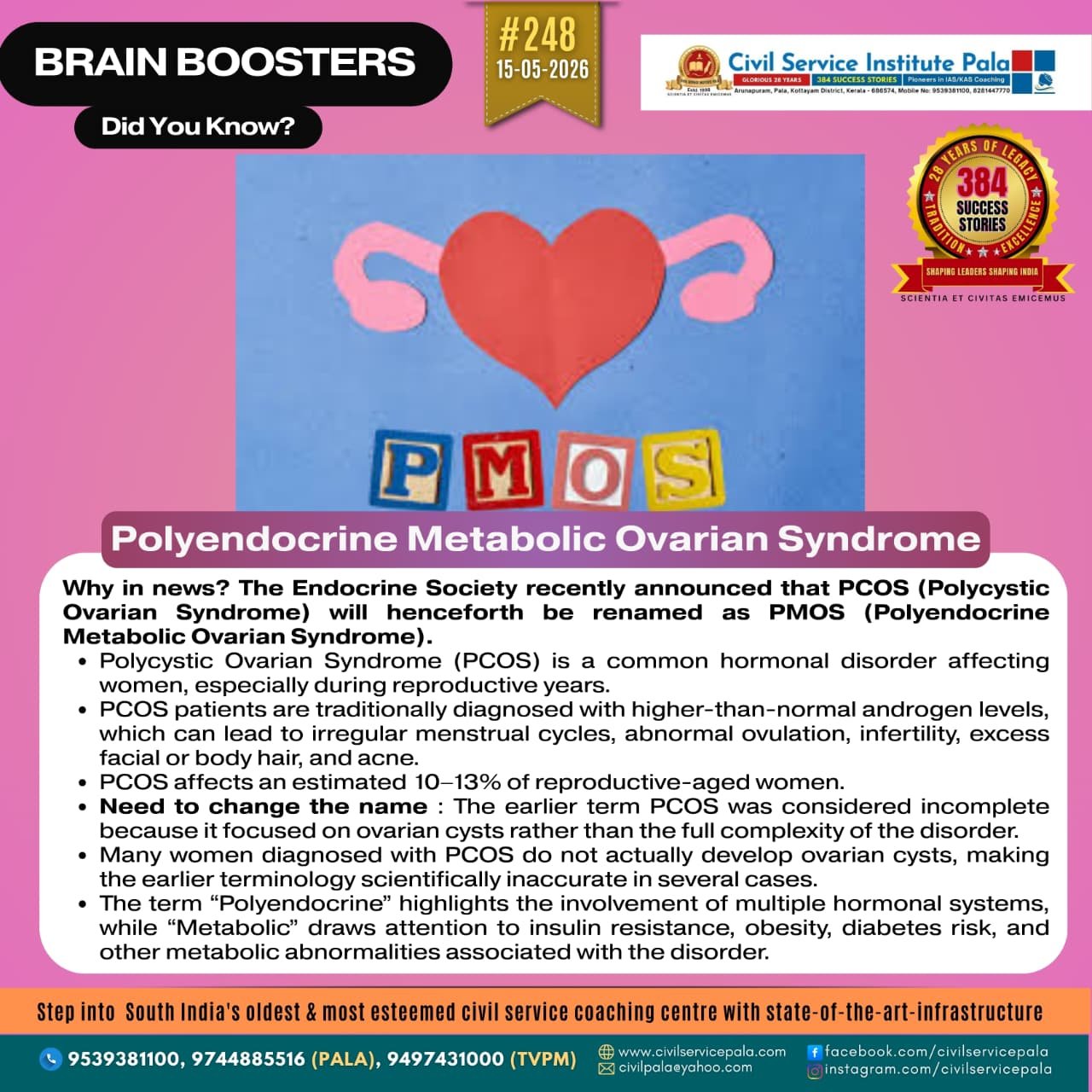
Polyendocrine Metabolic Ovarian Syndrome (PMOS)
Why in News?
The Endocrine Society recently announced that PCOS (Polycystic Ovarian Syndrome) will henceforth be renamed as PMOS (Polyendocrine Metabolic Ovarian Syndrome).
The decision followed a long global consensus process involving endocrinologists, researchers, and women’s health experts. The change was welcomed by many experts because the earlier term “PCOS” was considered medically incomplete and misleading.
What is Polycystic Ovarian Syndrome
• Polycystic Ovarian Syndrome (PCOS) is a common hormonal disorder affecting women, especially during reproductive years.
• PCOS patients have higher than normal androgen levels that leads to irregular menstrual cycles, abnormal ovulation, infertility, excess facial or body hair and/or acne.
• PCOS affects an estimated 10–13% of reproductive-aged women.
• PCOS is the most common cause of anovulation among women globally and a leading cause of infertility.
• PCOS runs in families but can cause a range of different symptoms and affect women in different ways. PCOS is a chronic metabolic condition that persists beyond the reproductive years.
• Women with PCOS are at higher risk for a variety of longer-term health problems that affect physical and emotional well-being compared to women without PCOS, including insulin resistance, type 2 diabetes mellitus and obesity.
Misconceptions regarding PCOS
PCOS was traditionally associated mainly with Ovarian cysts, Irregular menstruation and Fertility-related problems.
However, experts increasingly recognised that the condition extends far beyond reproductive abnormalities and also involves:
• Hormonal imbalance
• Metabolic dysfunction
• Insulin resistance
• Obesity
• Diabetes risk
• Cardiovascular complications
• Mental health impacts
The condition affects nearly 170 million women globally during their reproductive years.
Why was PCOS renamed as PMOS?
• The earlier term Polycystic Ovarian Syndrome (PCOS) was considered medically incomplete because it focused mainly on ovarian cysts rather than the full complexity of the disorder.
• Experts observed that many women diagnosed with PCOS do not actually develop ovarian cysts, making the earlier terminology scientifically inaccurate in several cases.
• Doctors and researchers also pointed out that the condition is not limited to the ovaries or reproductive system alone, but instead affects multiple hormonal and metabolic systems in the body.
• To reflect this broader medical understanding, the Endocrine Society proposed the new name Polyendocrine Metabolic Ovarian Syndrome (PMOS).
• The term “Polyendocrine” highlights the involvement of multiple hormonal systems, while “Metabolic” draws attention to insulin resistance, obesity, diabetes risk, and other metabolic abnormalities associated with the disorder.
• The revised terminology therefore presents ovarian dysfunction as only one component of a larger systemic condition affecting overall health.
Objectives Behind the Name Change
• The new terminology aims to improve medical diagnosis by encouraging doctors to evaluate hormonal and metabolic health alongside reproductive symptoms.
• The change is also intended to increase public awareness about the broader health implications of the disorder beyond fertility-related concerns.
• Experts believe that the revised terminology can improve research priorities by encouraging deeper scientific investigation into endocrine and metabolic dysfunction.
• The renaming is expected to support better healthcare policies and more comprehensive treatment approaches for affected women.
• Medical professionals also hope that the change will reduce confusion and improve communication between patients and healthcare providers.
Significance of the New Terminology
Broader Medical Understanding
• The term PMOS recognises the condition as a systemic disorder rather than only a reproductive abnormality.
• This broader framework encourages doctors to adopt a multidisciplinary approach involving endocrinology, nutrition, metabolic medicine, mental health, and reproductive healthcare.
• The revised understanding also reflects the growing scientific recognition that hormonal disorders are often interconnected with lifestyle and metabolic health.
Reduction of Social Stigma
• Over time, PCOS became strongly associated in public perception with infertility, pregnancy complications, and reproductive failure.
• This created anxiety, emotional distress, and social stigma for many women diagnosed with the condition.
• Experts believe that the new terminology shifts attention away from fertility alone and towards overall physical and metabolic health.
• The change is therefore expected to reduce the social pressure and psychological burden associated with the disorder.
Better Clinical Diagnosis
• Doctors have highlighted that the earlier PCOS framework frequently resulted in misdiagnosis, overdiagnosis, and self-diagnosis.
• The PMOS framework encourages more comprehensive testing involving hormone assays, blood sugar levels, insulin resistance testing, lipid profile analysis, and metabolic screening.
• This broader diagnostic approach is expected to improve treatment precision and reduce inappropriate clinical classification.
• Experts also emphasise that menstrual irregularities during adolescence should not automatically be labelled as PCOS without proper endocrine and metabolic assessment.
Metabolic and Endocrine Dimensions of PMOS
• Medical experts now recognise that PMOS is closely associated with insulin resistance, obesity, dyslipidemia, pre-diabetes, type 2 diabetes, and other metabolic disorders.
• The condition therefore affects long-term health and is not confined to reproductive years alone.
• Paediatric endocrinologists have particularly stressed that adolescent hormonal variations can sometimes be normal developmental changes rather than signs of disease.
• This has increased the importance of accurate hormonal evaluation before diagnosis.
• Treatment strategies are now increasingly focused on lifestyle modification, healthy diet, regular exercise, hormonal regulation, metabolic correction, and case-specific medication.
• Experts argue that long-term preventive healthcare and metabolic management are becoming central components of treatment.
Global Implementation Process
• According to an article published in The Lancet, the transition from PCOS to PMOS follows a structured global implementation framework.
• The implementation process includes academic dissemination, updating medical textbooks and resources, integrating the terminology into healthcare systems, and conducting professional awareness programmes.
• The revised terminology is expected to be formally incorporated into international medical guidelines by 2028.
• Medical associations and professional societies across countries are expected to play an important role in spreading awareness regarding the new classification.
