



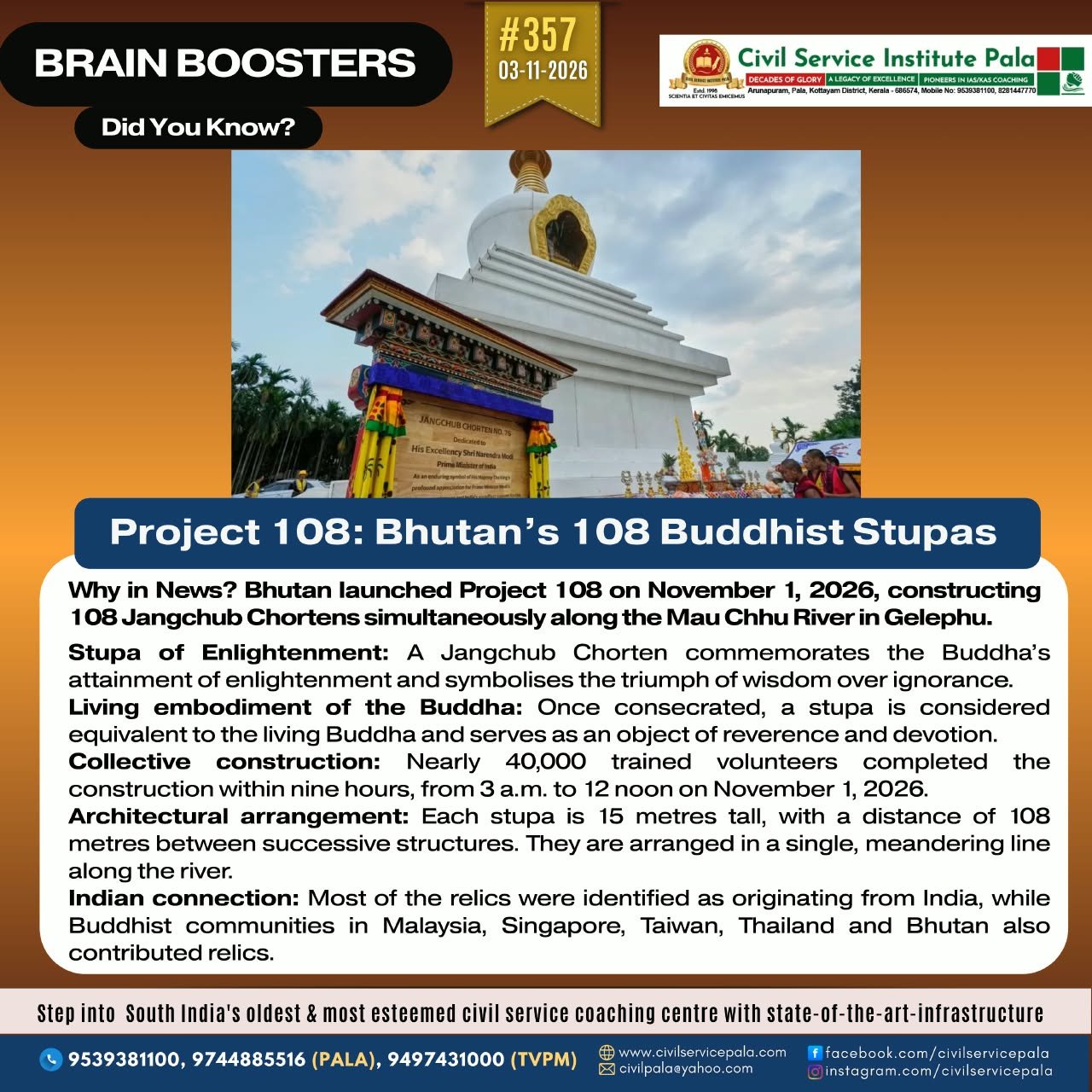
Project 108: Bhutan’s 108 Buddhist Stupas and Their Significance
Why in News?
Bhutan launched Project 108 on November 1, 2026, constructing 108 Jangchub Chortens (Stupas of Enlightenment) simultaneously along the Mau Chhu River in Gelephu. Nearly 40,000 trained volunteers participated in the nine-hour initiative, which highlights Bhutan’s Buddhist heritage, collective national identity and developmental vision for the Gelephu Mindfulness City (GMC). The project also reflects the cultural and strategic partnership between India and Bhutan.
What Are the Key Features of Project 108?
• Location: The 108 stupas were constructed along a 12-km stretch of the Mau Chhu River in Gelephu, approximately 240 km south-southeast of Thimphu and near Assam’s Chirang district.
• Collective construction: Nearly 40,000 trained volunteers completed the construction within nine hours, from 3 a.m. to 12 noon on November 1, 2026.
• Architectural arrangement: Each stupa is 15 metres tall, with a distance of 108 metres between successive structures. They are arranged in a single, meandering line along the river.
• Construction materials: The structures use steel and other improvised building materials, departing from the traditional use of stone and earth in stupa construction.
• International participation: Individuals, families, communities and institutions from different parts of the world contributed to the initiative. Each stupa is estimated to cost approximately $200,000.
What Is the Buddhist Significance of the Jangchub Chortens?
Symbolism of the Jangchub Chorten
• Stupa of Enlightenment: A Jangchub Chorten commemorates the Buddha’s attainment of enlightenment and symbolises the triumph of wisdom over ignorance.
• Living embodiment of the Buddha: Once consecrated, a stupa is considered equivalent to the living Buddha and serves as an object of reverence and devotion.
Sacred relics and the concept of Zung
• Relics of enlightened beings: Relics of the Buddha, enlightened saints and revered lamas, mostly consisting of bones and hair, were placed inside the stupas.
• Indian connection: Most of the relics were identified as originating from India, while Buddhist communities in Malaysia, Singapore, Taiwan, Thailand and Bhutan also contributed relics.
• Meaning of Zung: The relics form part of the zung, which represents the living embodiment of the Buddha’s enlightened body, speech and mind.
• Other sacred contents: The zung also includes Buddhist paintings (thangkhas), statues, precious stones, mantra scrolls and dharanis.
Why is the number 108 significant?
• Spiritual completeness: In Vajrayana Buddhism, 108 represents spiritual completeness, cosmic balance and the purification of karma.
• Buddhist traditions: Its significance is reflected in the 108 volumes of the Kangyur in certain Tibetan Buddhist traditions, the 108 beads of a prayer mala and the practice of circumambulating sacred sites 108 times.
• Hindu traditions: The number also holds religious significance in Hinduism, which recognises 108 Upanishads and associates it with the names of deities and the practice of Surya Namaskar.
How Does Project 108 Strengthen India–Bhutan Relations?
• Recognition of India's support: Bhutan’s King Jigme Khesar Namgyel Wangchuck dedicated Stupa Number 76 to Indian Prime Minister Narendra Modi as a gesture of appreciation for India’s support for the Gelephu Mindfulness City project. The number corresponds to the Prime Minister’s age at the time of the dedication.
• India’s participation: Parliamentary Affairs Minister Kiren Rijiju represented India at the event and highlighted the deep spiritual and civilisational connections between the two countries.
• Shared Buddhist heritage: The presence of Buddhist relics of Indian origin reinforces the historical and spiritual links between India and Bhutan, with Buddhism serving as an important cultural bridge.
• Developmental cooperation: India's support for the Gelephu project reflects the developmental dimension of bilateral relations and complements cooperation in hydropower, connectivity, security and economic development.
• Neighbourhood First Policy: The initiative illustrates India’s engagement with its immediate neighbourhood through development partnerships, cultural connections and respect for Bhutan’s sovereign developmental priorities.
Why Is Gelephu Mindfulness City Important for Bhutan?
• Vision of a global economic hub: King Wangchuck envisions Gelephu Mindfulness City as a spirituality-driven global economic hub that combines Bhutan’s cultural and spiritual identity with new economic opportunities.
• Strategic location: Its proximity to Assam makes regional connectivity and cross-border economic cooperation important to the proposed city’s development.
• Integrating heritage with development: Project 108 reflects Bhutan’s attempt to incorporate its Buddhist heritage and national values into its future economic development.
• Collective national participation: The involvement of approximately 40,000 volunteers demonstrates the mobilisation of citizens across generations and social groups towards a common national objective.
• National resilience: The King described the initiative as a test of national character. He emphasised that the collective spirit demonstrated through the project could help Bhutan face natural calamities, economic crises and other challenges.
Why Was November 1 Chosen for Project 108?
The date carried multiple religious and national associations for Bhutan:
• Lord Buddha’s Descending Day: November 1 is observed as Lord Buddha’s Descending Day.
• Mother’s Day: The date is also observed as Mother’s Day in Bhutan.
• Royal significance: It marked the 18th coronation anniversary of King Jigme Khesar Namgyel Wangchuck.
The convergence of these occasions gave Project 108 additional religious, cultural and national significance.
Way Forward
• Strengthen cultural cooperation: India and Bhutan can expand collaboration in Buddhist heritage conservation, cultural preservation, tourism and people-to-people exchanges.
• Promote sustainable development: Gelephu Mindfulness City can create opportunities for economic development and regional connectivity while preserving Bhutan’s cultural identity.
• Enhance regional cooperation: The project can support stronger cross-border economic and cultural connections between Bhutan and neighbouring Indian regions.
• Leverage shared heritage: India and Bhutan can use their historical and spiritual connections to deepen mutual understanding and strengthen bilateral relations.
