



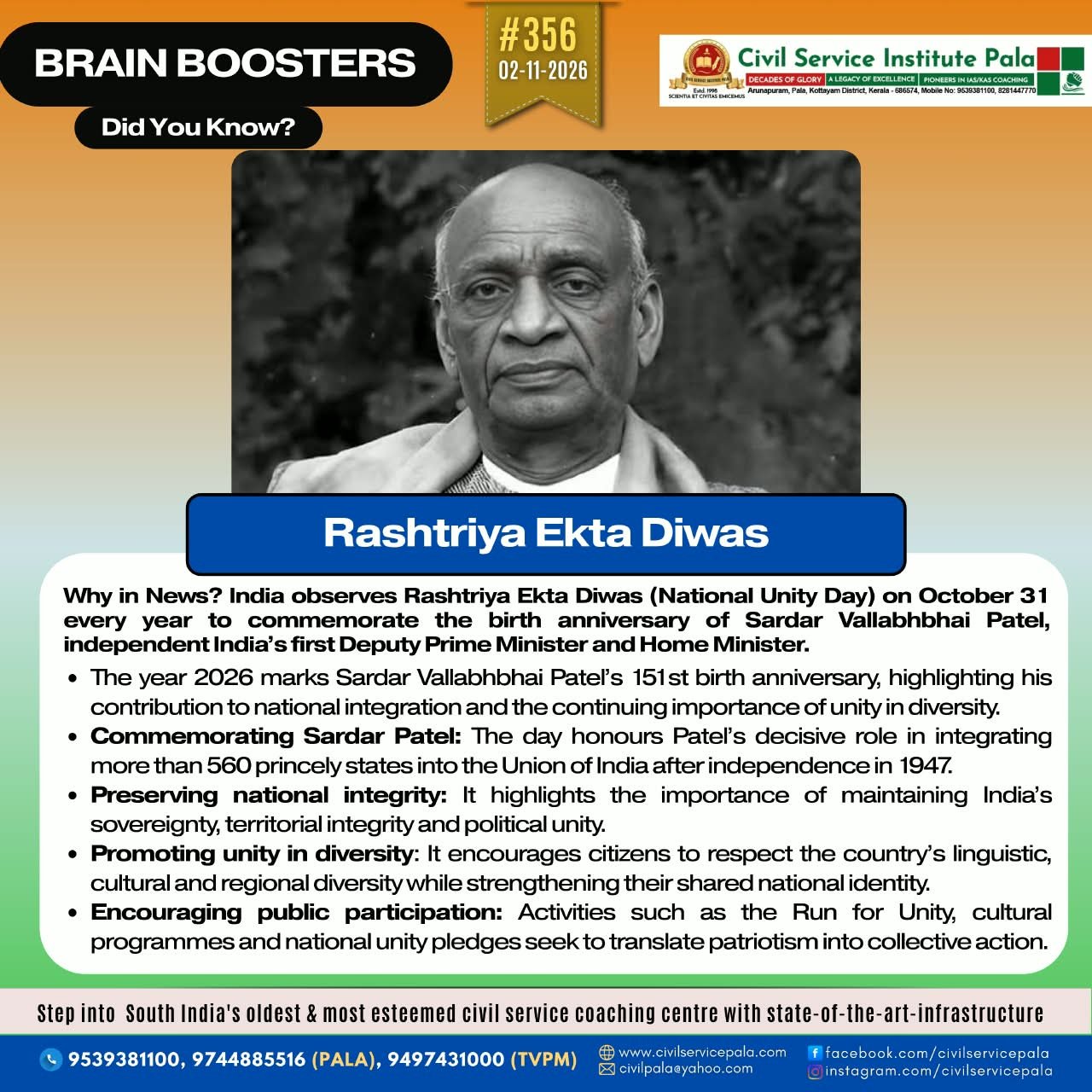
Rashtriya Ekta Diwas: Celebrating National Unity and India’s Diversity
Why in News?
India observes Rashtriya Ekta Diwas (National Unity Day) on October 31 every year to commemorate the birth anniversary of Sardar Vallabhbhai Patel, independent India’s first Deputy Prime Minister and Home Minister. The year 2026 marks his 151st birth anniversary, highlighting his contribution to national integration and the continuing importance of unity in diversity.
Why Is Rashtriya Ekta Diwas Celebrated?
• Commemorating Sardar Patel: The day honours Patel’s decisive role in integrating more than 560 princely states into the Union of India after independence in 1947.
• Preserving national integrity: It highlights the importance of maintaining India’s sovereignty, territorial integrity and political unity.
• Promoting unity in diversity: It encourages citizens to respect the country’s linguistic, cultural and regional diversity while strengthening their shared national identity.
• Encouraging public participation: Activities such as the Run for Unity, cultural programmes and national unity pledges seek to translate patriotism into collective action.
Background: The Government of India first observed Rashtriya Ekta Diwas in 2014 to recognise Patel’s contribution to nation-building. The observance reinforces the idea that national unity requires continuous commitment rather than being a permanently settled achievement.
Sardar Vallabhbhai Patel and India’s National Integration
Role in integrating princely states
• Political challenge after independence: The Indian Independence Act, 1947, allowed princely states to decide whether to accede to India or Pakistan or remain independent. This created the possibility of political fragmentation.
• Integration of over 560 princely states: As the first Deputy Prime Minister and Home Minister, Patel led the process of bringing these states into the Indian Union through the States Department.
• Diplomacy and firmness: He combined negotiations, persuasion and, where necessary, firm administrative measures to prevent the fragmentation of the country.
• Sensitive cases: Junagarh, Hyderabad and Jammu and Kashmir presented particularly difficult challenges during the integration process.
• Foundation of a united republic: His efforts secured the political and territorial consolidation of India and helped establish the foundations of a united democratic republic.
Strengthening administrative unity
• All India Services: Patel supported the creation and continuation of the All India Services, describing them as the country's Steel Frame. He viewed a strong administrative structure as essential for maintaining national unity and integrity.
Patel’s vision of unity was not uniformity. It recognised that India's strength lay in bringing together diverse regions and communities through a shared sense of belonging.
Ek Bharat Shreshtha Bharat: Institutionalising Unity in Diversity
• Launch: Prime Minister Narendra Modi announced the Ek Bharat Shreshtha Bharat (EBSB) initiative on October 31, 2015, during the observance of Patel’s 140th birth anniversary.
• Core objective: It seeks to strengthen emotional bonds among citizens through structured cultural, linguistic and educational exchanges between States and Union Territories.
• Mutual understanding: The initiative encourages people to learn about the languages, traditions, food, art and practices of other regions.
• National integration: It promotes lasting partnerships, mutual learning and the sharing of best practices across States and Union Territories.
• Sustained engagement: By organising activities throughout the year, EBSB extends the message of Rashtriya Ekta Diwas beyond a single annual observance.
Major activities under EBSB
• Bhasha Sangam App: Encourages citizens to learn more than 100 commonly used sentences in 22 Indian languages.
• Student exchanges: Yuva Sangam and EBSB Clubs in schools and universities facilitate interaction among young people from paired States.
• Cultural showcases: Cultural programmes and food festivals provide opportunities to experience the traditions of other regions.
• Kashi Tamil Sangamam: Celebrates the cultural and spiritual connections between Kashi and Tamil Nadu through exchanges involving language, art and traditions.
• Digital engagement: The My Bharat Digital Portal and EBSB quiz competitions encourage citizens to learn about India's cultural diversity and national identity.
• EBSB Portal: The official portal documents inter-State cultural exchanges, youth activities and campaigns conducted under the initiative. Its EBSB Wall highlights monthly activities promoting India's diversity and collective identity.
How Do Culture and Tourism Strengthen National Unity?
• Domestic tourism: Campaigns such as Dekho Apna Desh and the upgraded Incredible India digital platform encourage Indians to explore different parts of their own country.
• Regional exposure: Visits to destinations such as the Golden Temple in Punjab, the backwaters of Kerala, Assam's tea gardens and Rajasthan's deserts help citizens appreciate regional diversity.
• Tourism growth: Domestic tourism crossed 294 crore visits in 2024, reflecting increased travel and exploration within the country.
• Livelihood generation: Schemes such as Swadesh Darshan and PRASHAD support tourism infrastructure and local economic opportunities.
• People-to-people connections: Homestays, local crafts and cultural experiences enable visitors and local communities to interact, creating social and economic links across regions.
What Are the Challenges to National Unity?
• Regionalism: Excessive regional identification can weaken the broader sense of national belonging.
• Cultural and linguistic divides: Limited awareness of other communities and their traditions can reinforce stereotypes and social distance.
• Indifference towards diversity: A lack of meaningful interaction can prevent citizens from appreciating the country's shared heritage.
• Uneven participation: The benefits of cultural exchanges and tourism need to reach different regions and communities to strengthen a genuinely inclusive national identity.
Way Forward
• Strengthen cultural exchanges: Expand inter-State educational, linguistic and cultural programmes, particularly among students and young people.
• Promote inclusive heritage: Ensure that the cultural traditions of all regions receive adequate recognition in national institutions and public programmes.
• Encourage domestic tourism: Improve access to regional destinations and support local livelihoods through sustainable tourism initiatives.
• Strengthen public participation: Encourage citizens, educational institutions and civil society organisations to participate in activities promoting national integration.
• Reinforce constitutional values: Promote mutual respect, fraternity and a shared commitment to the sovereignty and integrity of India.
