



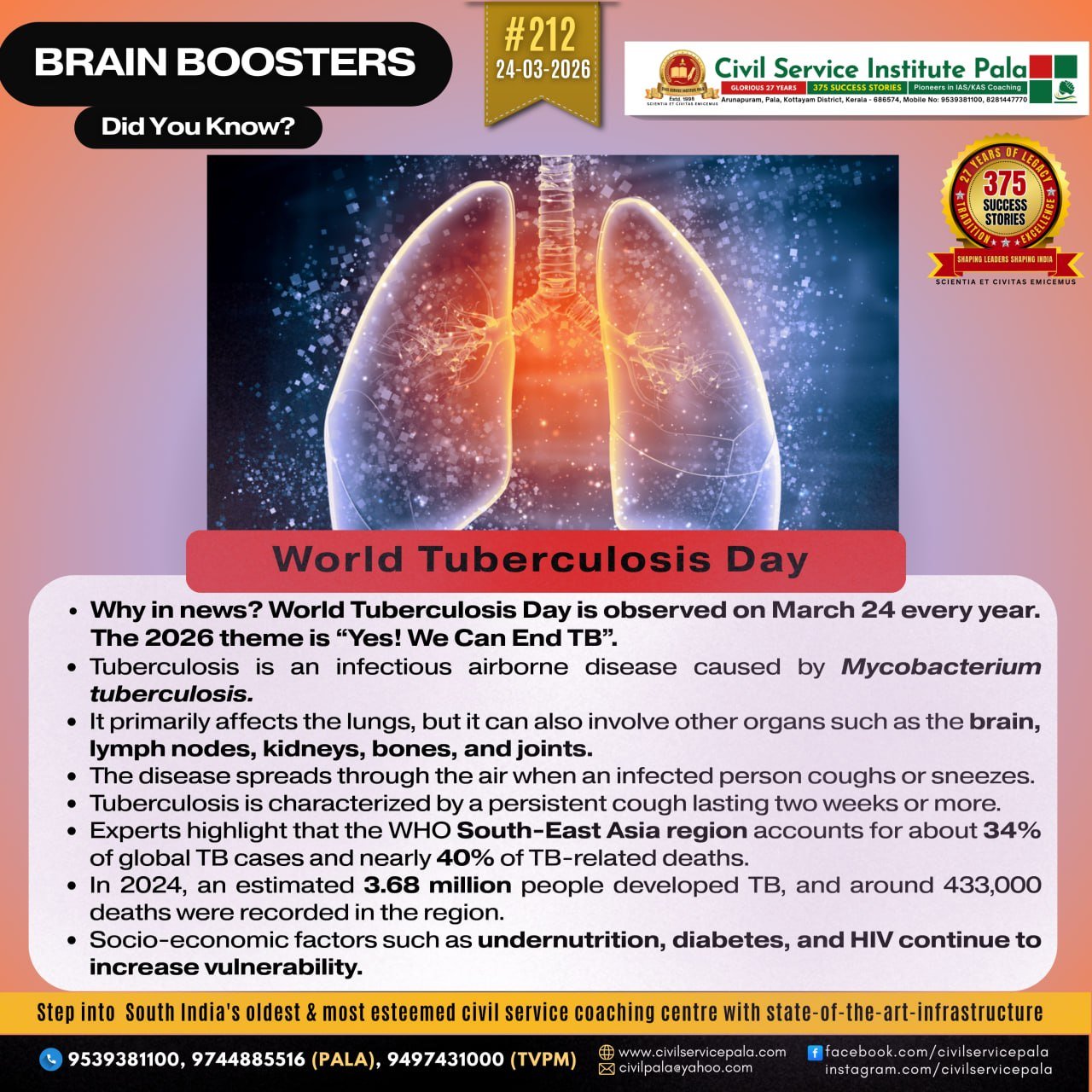
Tuberculosis
Tuberculosis
• Tuberculosis is an infectious airborne disease caused by Mycobacterium tuberculosis.
• It primarily affects the lungs, but it can also involve other organs such as the brain, lymph nodes, kidneys, bones, and joints.
• The disease spreads through the air when an infected person coughs or sneezes.
• Transmission usually requires close and prolonged contact, and TB does not spread through touch.
Symptoms of TB
• Tuberculosis is characterized by a persistent cough lasting two weeks or more.
• Patients may experience persistent fever and night sweats.
• It can lead to coughing up blood or sputum.
• Other symptoms include weight loss, fatigue, loss of appetite, and chest pain.
Global & Regional Burden
• Experts highlight that the WHO South-East Asia region accounts for about 34% of global TB cases and nearly 40% of TB-related deaths.
• In 2024, an estimated 3.68 million people developed TB, and around 433,000 deaths were recorded in the region.
• The region has achieved a 23% reduction in TB deaths and a 16% decline in incidence since 2015, which is higher than the global average decline.
• Treatment coverage has expanded to over 85%, with more than 3.1 million people receiving treatment in 2024.
Challenges
• Experts suggest that the region remains off track to meet global End TB targets.
• Drug-resistant TB (MDR/RR-TB) remains a major concern, with about 150,000 cases annually.
• Socio-economic factors such as undernutrition, diabetes, and HIV continue to increase vulnerability.
• Around 44% of TB-affected households face catastrophic health expenditures, highlighting economic burden.
Way Forward
• Experts emphasize the need to accelerate reduction in TB incidence and deaths through integrated primary healthcare systems.
• There is a need to close detection and treatment gaps, especially for drug-resistant TB, using rapid diagnostics.
• Addressing social determinants such as nutrition, diabetes, and HIV is critical to reduce transmission.
• Adoption of new technologies such as AI can improve access to diagnosis and treatment.
Historical Background
• Tuberculosis was discovered by Robert Koch in 1882, who identified the causative bacterium.
• The disease has existed for millions of years and was known by different names in history.
• It was referred to as:
o Phthisis in ancient Greek
o Tabes in Latin
o Scrofula during the Middle Ages
o White plague in the 1700s
o Consumption in the 1800s
• The term “tuberculosis” was coined in 1834, and the concept of latent TB infection was introduced in 1909.
