



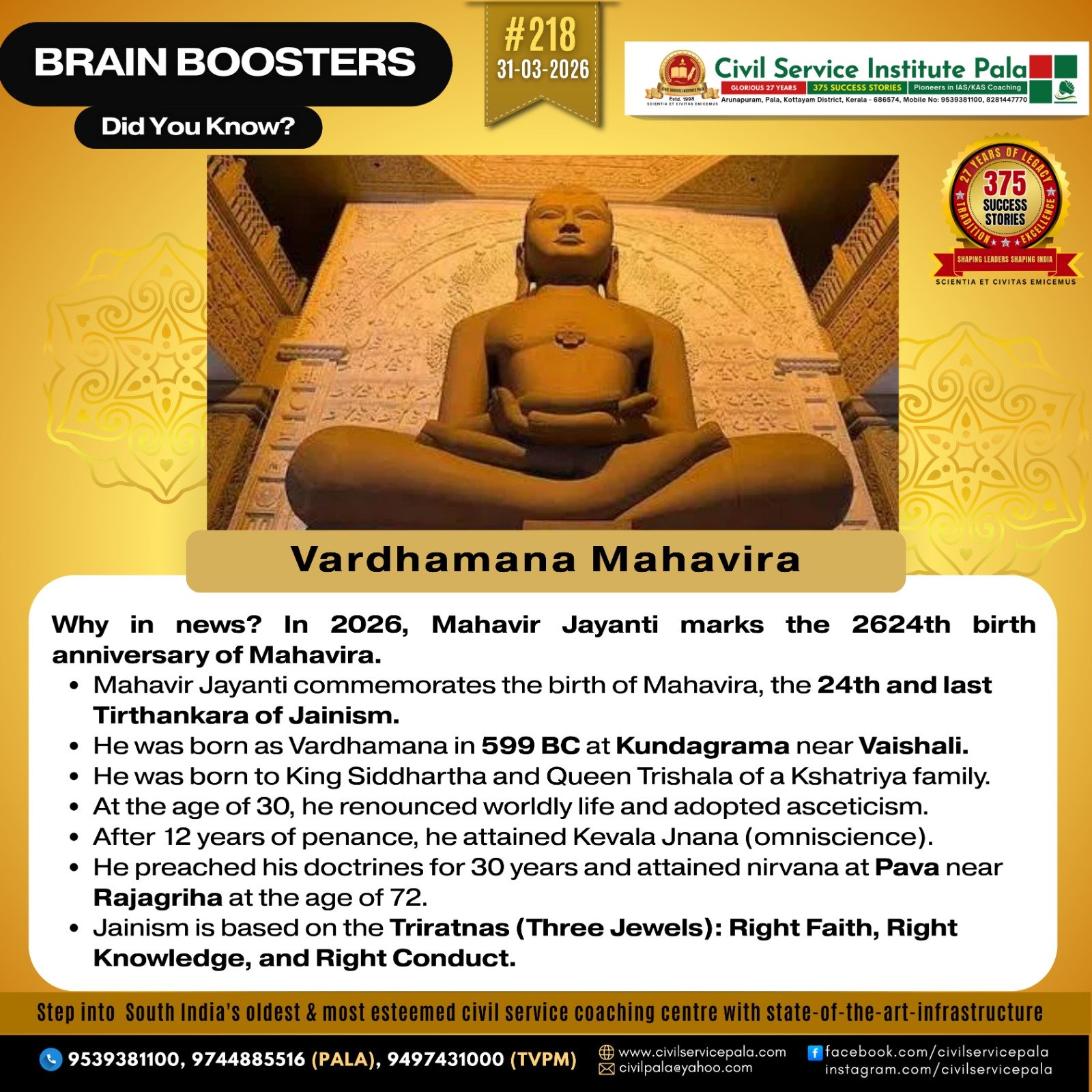
Vardhamana Mahavira
Based on Jain tradition, which places Mahavira’s birth in 599 BC, Mahavir Jayanti in 2026 marks his 2624th birth anniversary.
• Mahavir Jayanti commemorates the birth of Mahavira, the 24th and last Tirthankara of Jainism.
• He was born as Vardhamana in 599 BC at Kundagrama near Vaishali.
• He was born to King Siddhartha and Queen Trishala who ruled over the Jnatrika clan.
• At the age of 30, he renounced worldly life and adopted asceticism.
• After 12 years of penance, he attained Kevala Jnana (omniscience) and became a spiritual teacher.
• He preached his doctrines for 30 years and attained nirvana at Pava near Rajagriha at the age of 72.
• He was given the title ‘Mahavira’ or the great hero. Some of the other titles given to him are jaina or jitendriya i.e., one who conquers all his senses and nirgrantha or the one who is free from all bonds.
Core Teachings of Jainism
• Anekantavada, the fundamental doctrine of Jainism emphasises that the ultimate truth and reality is complex, and has multiple aspects. Hence, there exists non-absolutism, that means no single, specific statement can describe the nature of existence and the absolute truth.
• Jainism is based on the Triratnas (Three Jewels): Right Faith, Right Knowledge, and Right Conduct.
• The ethical framework is based on the Five Great Vows (Mahavratas):
o Non-violence (Ahimsa)
o Truth (Satya)
o Non-stealing (Asteya)
o Chastity (Brahmacharya)
o Non-possession (Aparigraha)
• Experts highlight that Ahimsa is the central doctrine, extending to all living beings.
• Mahavira taught that all objects, both animate and inanimate, possess a soul and consciousness.
• He rejected Vedic authority and rituals, advocating an ethical and ascetic way of life.
Popular Practices in Jainism
• Mahavira emphasised extreme asceticism, including renunciation, fasting, and self-discipline.
• Both monks and lay followers were expected to follow the doctrine of non-violence and moral conduct.
• Festivals like Mahavir Jayanti involve temple visits, meditation, scripture reading, and charity.
• Sallekhana – It is a religious practice of voluntarily fasting to death by gradually reducing the intake of food and liquids. It is not considered as a suicide by Jain scholars because it is not an act of passion, nor does it deploy poisons or weapons. It can be performed by both for Jain ascetics and householders.
• Pratikraman – It is a process during which Jains repent for their sins during their daily life, and remind themselves not to repeat them. The five types of Pratikaman include Devasi, Rayi, Pakhi, Chaumasi and Samvatsari.
Eight auspicious symbols under Jainsim
1. Swastika - It signifies peace and well being of the humans.
2. Nandyavartya - It is a large swastika with nine end points.
3. Bhadrasana - A throne which is said to be sanctified by the jaina’s feet
4. Shrivasta - A mark which manifested on the Jain’s chest and signified his pure soul.
5. Darpana - The mirror which reflects the inner self
6. Minayugala - A couple of fish which signifies the conquest over sexual urges
7. Vardhamanaka - A shallow dish used as lamp which shows the increase in the wealth, due and merit.
8. Kalasha - A pot filled with pure water signifying water
Spread of Jainism
• Mahavira organised a Sangha consisting of monks, nuns, and lay followers to spread teachings.
• Jainism spread significantly in Western India and Karnataka.
• It received patronage from rulers such as Chandragupta Maurya and Kharavela of Kalinga.
• Experts suggest that royal patronage and organised missionary activity enabled its expansion.
Key Historical Developments
• A famine in the Ganga valley led to migration of Jain monks to South India.
• This resulted in the division of Jainism into:
o Svetambaras (white-clad)
o Digambaras (sky-clad or naked)
• The First Jain Council was held at Pataliputra (3rd century BC).
• The Second Jain Council was held at Valabhi (5th century AD), where Jain texts (Twelve Angas) were compiled.
