



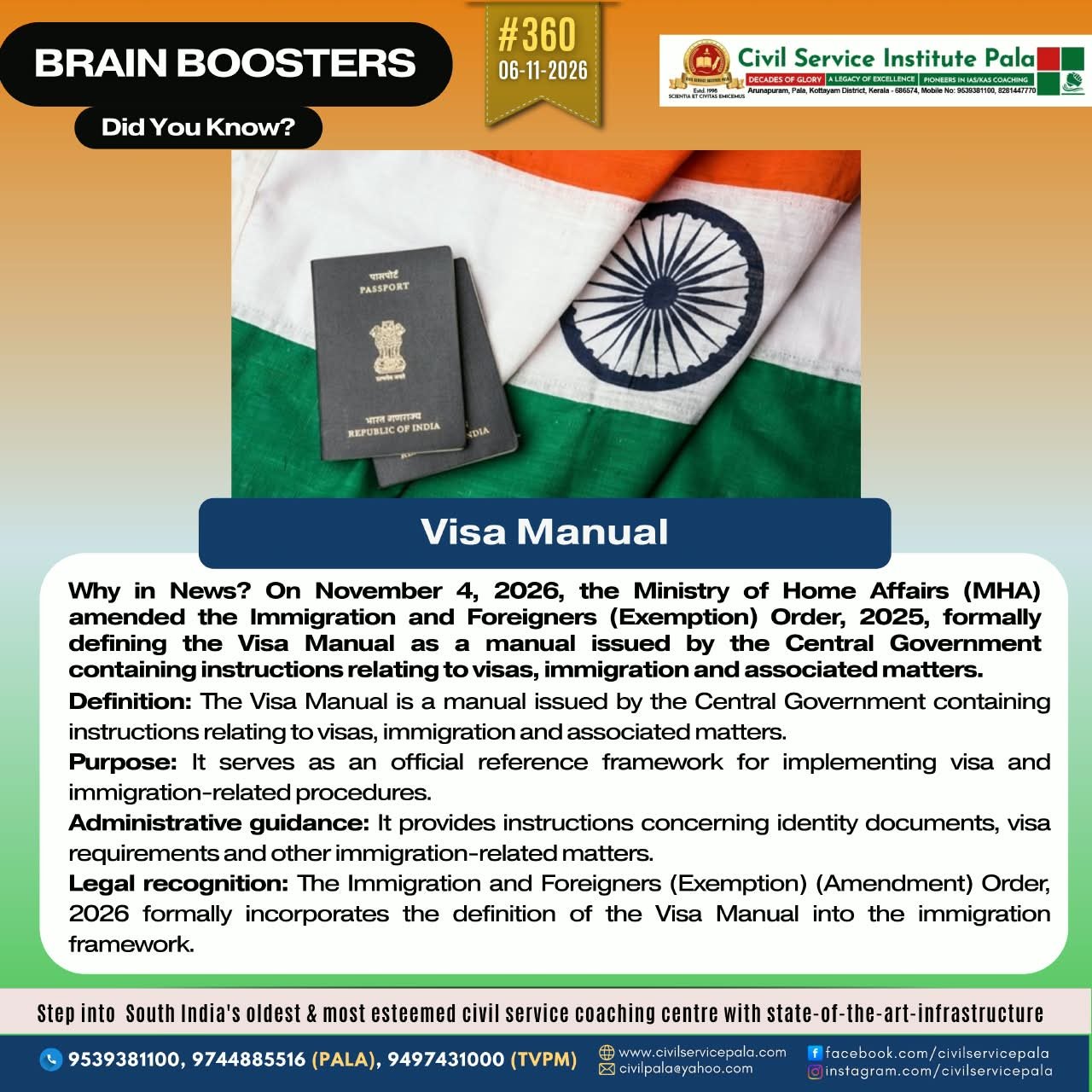
Visa Manual: A Framework for India's Visa and Immigration Procedures
Why in News?
On November 4, 2026, the Ministry of Home Affairs (MHA) amended the Immigration and Foreigners (Exemption) Order, 2025, formally defining the Visa Manual as a manual issued by the Central Government containing instructions relating to visas, immigration and associated matters.
The amendment also revised certain exemptions from passport and visa requirements. The introduction of the formal definition is significant because the Visa Manual provides an official reference framework for identity-document requirements, visa procedures and immigration-related instructions.
What Is the Visa Manual?
• Definition: The Visa Manual is a manual issued by the Central Government containing instructions relating to visas, immigration and associated matters.
• Purpose: It serves as an official reference framework for implementing visa and immigration-related procedures.
• Administrative guidance: It provides instructions concerning identity documents, visa requirements and other immigration-related matters.
• Legal recognition: The Immigration and Foreigners (Exemption) (Amendment) Order, 2026 formally incorporates the definition of the Visa Manual into the immigration framework.
What Is the Significance of the Visa Manual?
• Uniformity in procedures: It provides a common reference for visa and immigration-related instructions, supporting consistency in their administration.
• Documentation requirements: It helps establish the applicable identity-document requirements for different categories of travellers.
• Regulated movement: It provides procedural guidance for the entry, exit and stay of foreign nationals in India.
• Administrative clarity: It brings visa procedures and related immigration instructions within a formally recognised reference framework.
• Border management: Its provisions are relevant to documentation requirements for cross-border movement, including travel involving India, Nepal and Bhutan.
What Other Important Changes Were Introduced by the 2026 Amendment?
Visa requirement for specified minority communities
• Eligible communities: Hindus, Sikhs, Buddhists, Jains, Parsis and Christians from Afghanistan, Bangladesh and Pakistan are covered.
• Eligibility: The exemption applies to members of these communities who entered India on or before December 31, 2024, after being compelled to seek shelter due to religious persecution or fear of persecution.
• Entry-document exemption: They continue to be exempt from the requirement of possessing valid passports or visas at the time of entry into India, including where their documents have expired.
• Visa for continued stay: They must obtain an appropriate category of visa after entering India to continue their stay in the country.
Other immigration and documentation provisions
• Indian, Nepali and Bhutanese citizens: The amendment specifies identity-document requirements for Indian citizens travelling to Nepal or Bhutan and Nepali and Bhutanese citizens entering or leaving India.
• Onward international travel: Indian citizens using the Indo-Nepal or Indo-Bhutan borders to travel to third countries must possess valid passports and use designated immigration checkpoints.
• Specified transit routes: Nepali and Bhutanese citizens travelling beyond India, Nepal and Bhutan, or arriving after embarking from or transiting through China, Macau, Hong Kong or Pakistan, must possess valid passports and visas.
• Other exempted categories: The amendment retains or reorganises exemptions for specified Sri Lankan Tamil refugees, Tibetan refugees, military personnel and certain long-term residents, subject to the applicable conditions.
How Is the Amendment Related to the Citizenship (Amendment) Act, 2019?
• Common communities: Both the amended Order and the Citizenship (Amendment) Act (CAA), 2019, cover Hindus, Sikhs, Buddhists, Jains, Parsis and Christians from Afghanistan, Bangladesh and Pakistan.
• Different eligibility cut-off dates: The amended Order covers eligible persons who entered India on or before December 31, 2024, whereas the CAA provides an expedited route to citizenship for eligible persons who entered India on or before December 31, 2014.
• Different legal purposes: The CAA concerns eligibility for acquiring Indian citizenship, while the amended Order deals with exemptions from travel-document requirements and the visa requirements governing continued stay.
• No automatic citizenship: An exemption from passport requirements or the grant of a visa under the amended Order does not automatically confer Indian citizenship.
Significance for India
• National security: Appropriate visa requirements strengthen immigration oversight and help regulate the continued stay of foreign nationals.
• Humanitarian considerations: The retained entry-document exemptions provide relief to specified communities who sought shelter in India due to religious persecution or fear of persecution.
• Clear distinction between legal processes: The amendment distinguishes between entry-document exemptions, visa authorisation and acquisition of Indian citizenship.
• Improved border management: Specified documentation requirements support the regulation of cross-border movement and onward international travel.
• Administrative coordination: A formally defined Visa Manual provides a common reference for visa, identity-document and immigration-related instructions.
Key Takeaway
The Visa Manual serves as an official reference framework for India's visa and immigration procedures. Its formal definition under the Immigration and Foreigners (Exemption) (Amendment) Order, 2026, highlights the importance of clear documentation requirements and consistent immigration administration. The amendment also reinforces the distinction between exemption from travel-document requirements, permission for continued stay and eligibility for Indian citizenship.
