



VITT
Vaccine-Induced Immune Thrombocytopenia and Thrombosis (VITT)
Background:
• During the global rollout of COVID-19 vaccines in early 2021, rare cases of unusual blood clots accompanied by low platelet counts were reported.
• These cases were mainly linked to adenovirus-vector vaccines such as the Oxford–AstraZeneca COVID 19 vaccine and the Johnson & Johnson COVID 19 vaccine.
• The condition was termed Vaccine Induced Immune Thrombocytopenia and Thrombosis (VITT).
• The estimated incidence of VITT was about 3–10 cases per million vaccinated individuals, though it varied by age and sex.
• The key clinical feature of VITT was the combination of unusual blood clots with a low platelet count.
Biological Mechanism of VITT
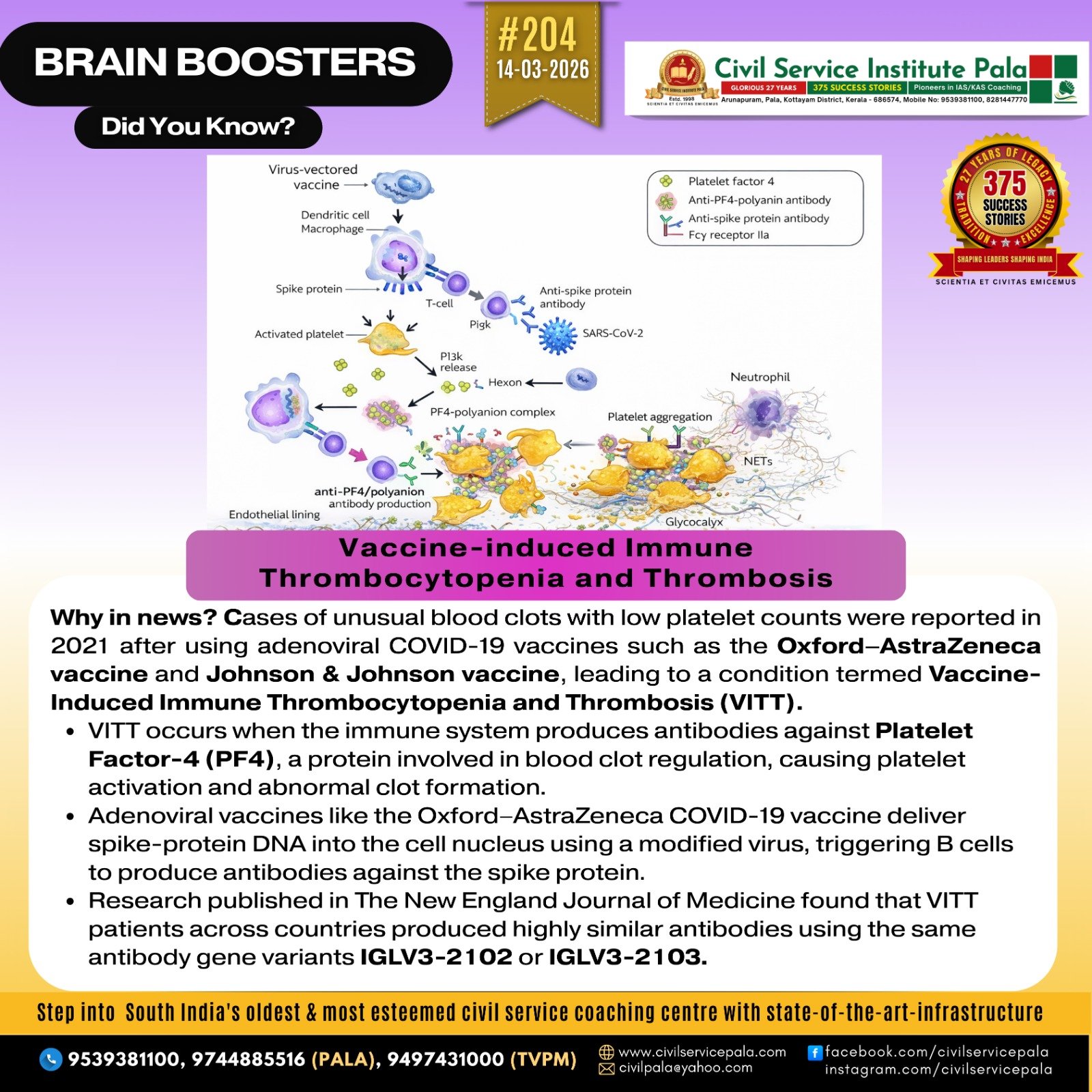
• In Vaccine-Induced Immune Thrombocytopenia and Thrombosis (VITT), patients produce antibodies against Platelet Factor 4 (PF4).
• Platelet Factor 4 is a protein released by platelets that normally helps regulate blood clot formation.
• In VITT, the antibodies bind to PF4 and form immune complexes.
• These immune complexes activate platelets, triggering abnormal clotting processes in the body.
• As a result, excessive blood clots (thrombosis) form while the number of circulating platelets falls (thrombocytopenia).
• This reaction is unusual because the immune system typically does not produce antibodies against the body’s own proteins.
How COVID-19 Vaccines Work
Vaccine Principle
• Vaccines work by exposing the immune system to a harmless representation of a pathogen so that it develops immune memory.
• COVID-19 vaccines train the immune system to recognise the coronavirus spike protein and mount a defensive response against it.
mRNA Vaccines
Examples include the Pfizer–BioNTech COVID-19 vaccine and the Moderna COVID-19 vaccine.
• mRNA vaccines deliver messenger RNA directly into the cytoplasm of human cells.
• Ribosomes in the cell translate the mRNA to produce the viral spike protein.
• The produced spike protein triggers an immune response, after which the mRNA is rapidly degraded and does not remain in the body.
Adenoviral Vector Vaccines
Examples include the Oxford–AstraZeneca COVID-19 vaccine and the Johnson & Johnson COVID-19 vaccine.
• These vaccines use a genetically modified adenovirus as a delivery vehicle for genetic material.
• The adenovirus carries DNA coding for the coronavirus spike protein.
• This DNA enters the cell nucleus, where it is transcribed into messenger RNA.
• The mRNA then directs the production of the spike protein, which stimulates the immune response.
Antibody Production and B-Cell Diversity
• B cells are immune cells responsible for producing antibodies against pathogens.
• Each B cell carries a unique receptor created through genetic recombination processes.
• Antibody diversity arises mainly through V(D)J recombination, which rearranges gene segments randomly.
• Additional diversity is generated through Somatic Hypermutation during the immune response.
• These processes together generate millions of antibody variants, making immune responses highly diverse and individualized.
Key Scientific Discovery Explaining VITT
Major Research Finding
• A study published in the The New England Journal of Medicine found that antibodies seen in patients with Vaccine-Induced Immune Thrombocytopenia and Thrombosis (VITT) were remarkably similar across patients from different countries.
• The antibodies were produced using the same genetic building blocks of antibody genes.
• Many patients carried variants of a particular antibody gene known as IGLV3-21.
Critical Molecular Mutation
• Researchers found that many patients developed a similar small mutation in their antibody genes.
• This mutation altered the electrical properties of the antibody’s binding region.
• As a result, the antibody attached more strongly to Platelet Factor 4 (PF4).
• The strong binding triggered platelet activation, which led to abnormal blood clot formation.
Role of Adenovirus Protein VII
• Scientists identified a possible trigger inside the adenovirus used in some vaccines.
• Adenoviruses contain a structural protein called Adenovirus Protein VII.
• A small part of this protein closely resembles PF4 in its structure.
• The immune system may initially produce antibodies against this viral protein.
• In some rare cases, these antibodies mistakenly recognise PF4 as the viral protein, causing an autoimmune reaction that leads to VITT.
Scientific Significance
• This research provides one of the first clear molecular explanations for why VITT occurs.
• It identifies the possible viral trigger, the antibody gene involved, and the mutation that strengthens PF4 binding.
Implications for Vaccine Technology
• Adenoviral vector vaccines remain an important platform used in many global vaccination programmes.
• Understanding this mechanism can help scientists design safer vaccine vectors in the future.
• It may also improve monitoring and early detection of rare immune reactions following vaccination.
