



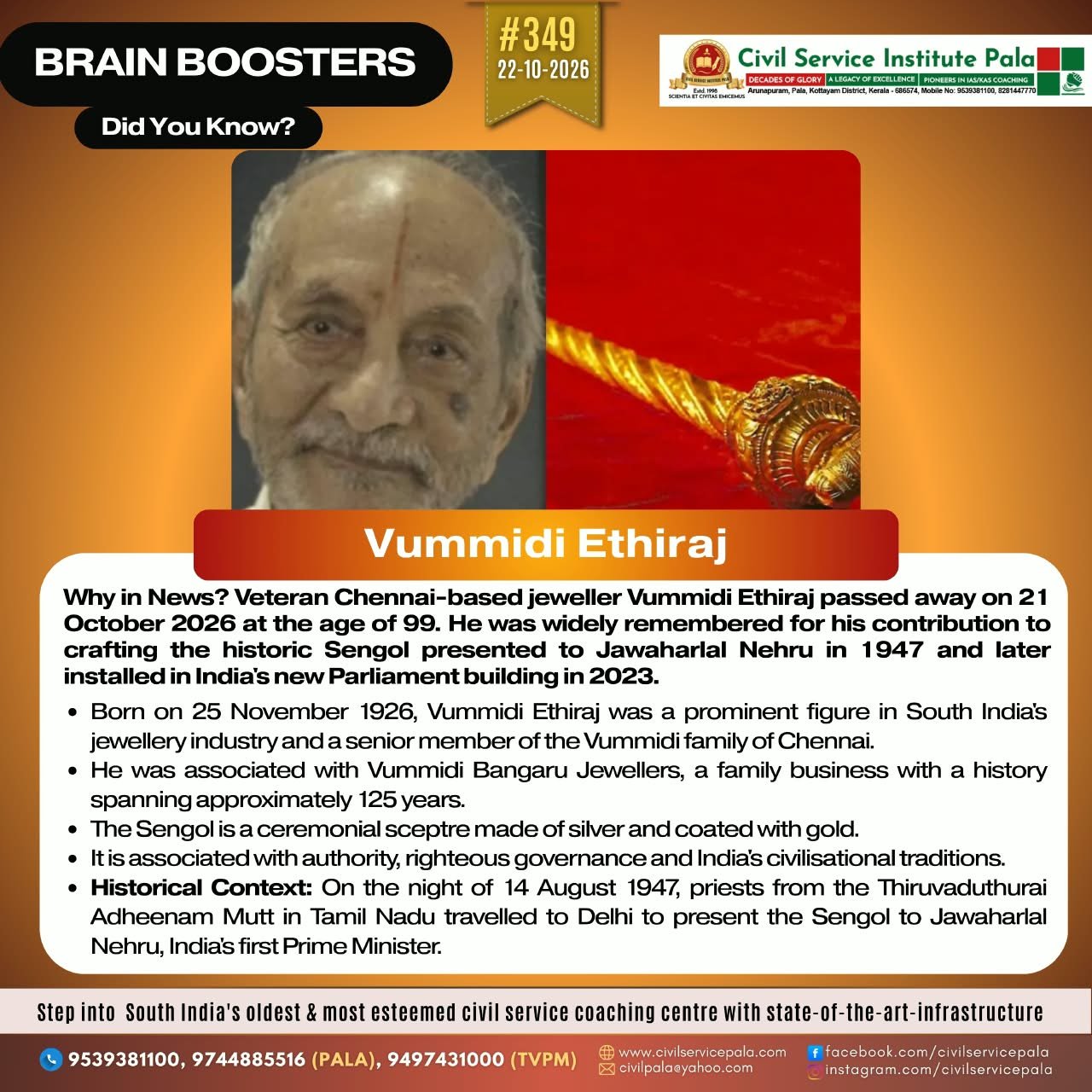
Vummidi Ethiraj: The Master Craftsman Behind the Historic Sengol
Why in News?
Veteran Chennai-based jeweller Vummidi Ethiraj passed away on 21 October 2026 at the age of 99. He was widely remembered for his contribution to crafting the historic Sengol presented to Jawaharlal Nehru in 1947 and later installed in India's new Parliament building in 2023.
Who was Vummidi Ethiraj?
• Early Life: Born on 25 November 1926, Vummidi Ethiraj was a prominent figure in South India's jewellery industry and a senior member of the Vummidi family of Chennai.
• Family Legacy: He was associated with Vummidi Bangaru Jewellers, a family business with a history spanning approximately 125 years. The family is known for its traditional jewellery-making craftsmanship.
• Contribution to Indian Heritage: Ethiraj played a significant role in crafting the Sengol in 1947. His work connected traditional Indian metal craftsmanship with an important moment in the country's history.
• Passing: He died in Chennai on 21 October 2026. His wife, Sumitra Vummidi, predeceased him. He is survived by his three children, Vijaya Bharathi, Uday Kumar Vummidi and Vijayendren Vummidi.
What is the Sengol, and why is it significant?
• Meaning and Form: The Sengol is a ceremonial sceptre made of silver and coated with gold. It is associated with authority, righteous governance and India's civilisational traditions.
• Historical Context: On the night of 14 August 1947, priests from the Thiruvaduthurai Adheenam Mutt in Tamil Nadu travelled to Delhi to present the Sengol to Jawaharlal Nehru, India's first Prime Minister.
• Symbol of Independence: The ceremonial presentation was associated with the transfer of authority from British rule to Indian leadership as India approached Independence. The Sengol subsequently became an artefact associated with this historic transition.
• Craftsmanship: The Sengol was crafted by Vummidi Jewellers, with Ethiraj playing a significant role in its creation. It highlights the contribution of traditional Indian artisans to the preservation of cultural and historical objects.
How did the Sengol regain national prominence?
• Rediscovery and Recognition: The Sengol received renewed public attention in the years leading up to its installation in the new Parliament building, bringing the craftsmen associated with its creation into the national spotlight.
• Installation in Parliament: On 28 May 2023, Prime Minister Narendra Modi ceremonially installed the Sengol in India's new Parliament building, giving it a prominent place in the country's parliamentary setting.
• Recognition of Ethiraj: During the 2023 event, Ethiraj was personally honoured for his contribution. Prime Minister Modi later recalled meeting him and expressing gratitude for his craftsmanship.
• Cultural Significance: The Sengol's renewed prominence brought attention to the relationship between India's traditional arts, historical memory and national institutions.
What was Ethiraj's wider contribution?
• Preservation of Traditional Crafts: Ethiraj's work represents the importance of skilled artisans in preserving India's traditional jewellery-making techniques and craftsmanship.
• Craftsmanship and National History: His contribution demonstrates how the work of individual craftspeople can become closely associated with important historical events and national heritage.
• Cultural Recognition: The public recognition of Ethiraj following the Sengol's installation in Parliament helped bring renewed attention to the artisans behind historically significant objects.
