



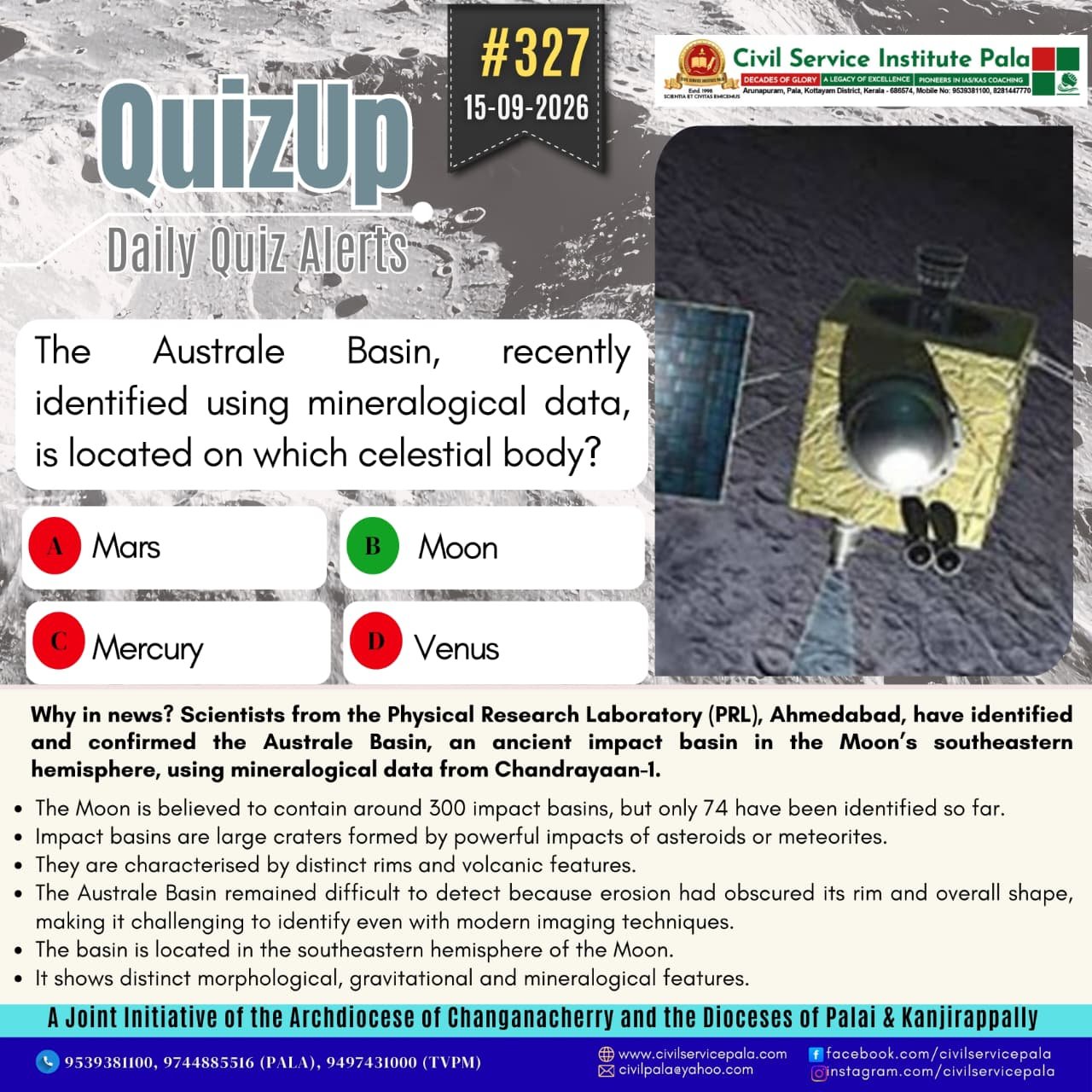
Australe Basin: A Hidden Impact Basin on the Moon
Australe Basin: A Hidden Impact Basin on the Moon
Why in News?
Scientists from the Physical Research Laboratory (PRL), Ahmedabad, have identified and confirmed the Australe Basin, an ancient impact basin in the Moon’s southeastern hemisphere, using mineralogical data from Chandrayaan-1. The basin may be older than the South Pole-Aitken Basin, the oldest and largest known lunar impact basin.
Impact Basins and the Australe Basin
• The Moon is believed to contain around 300 impact basins, but only about 74 have been identified so far.
• Impact basins are large craters formed by violent impacts of asteroids or meteorites, often extending hundreds of kilometres and leaving distinct rims and associated volcanic features.
• The Australe Basin had remained difficult to detect because erosion along its rims had obscured its morphology, making it challenging to identify even with modern imaging techniques.
• The basin is located in the southeastern hemisphere of the Moon and displays distinct morphological, gravity and mineralogical signatures.
• Scientists suggest that it could be older than the South Pole-Aitken Basin, which formed more than 4 billion years ago.
Unique Mineralogical Signature
• The basin contains volcanic material with an unusual mineral composition compared with most lunar basalts.
• While many lunar basalts are relatively high in calcium, the basalts associated with the Australe Basin are relatively lower in calcium and higher in magnesium.
• The region also contains 248 small basalt ponds arranged in a circular pattern, distinguishing it from several known impact basins characterised by extensive, smooth hardened lava surfaces.
How Was the Basin Identified?
• The mineralogical evidence came from NASA’s Moon Mineralogy Mapper (M³) aboard Chandrayaan-1.
• M³ is an imaging spectrometer designed to map the mineral composition of the lunar surface and operates in the 405–3000 nanometre wavelength range.
• Scientists analysed the absorption bands of minerals such as pyroxene, olivine and plagioclase to identify the distinctive mineralogical composition of the Australe region.
• The combination of mineralogical data, morphology and gravity signatures enabled scientists to confirm the presence of the previously untraced basin.
Significance for Future Lunar Missions
• The study can provide a broader geological context for future landing and sample-return missions by helping scientists understand where material found at landing sites may have originated.
• This is particularly relevant for Chandrayaan-4, India's proposed lunar sample-return mission, and future exploration of the Moon's South Polar region.
• The Australe region contains widespread magnesium-bearing lithologies and lies close to the lunar South Pole. Material excavated by the ancient impact may therefore have been distributed across the South Polar region.
• PRL scientists also noted higher magnesium concentrations at the Chandrayaan-3 landing site, Shiv Shakti Point, potentially linked to material originating from the South Pole-Aitken Basin.
• Understanding how such material has been transported and deposited over billions of years can help interpret the lunar regolith and identify scientifically valuable targets for future sample-return missions.
