



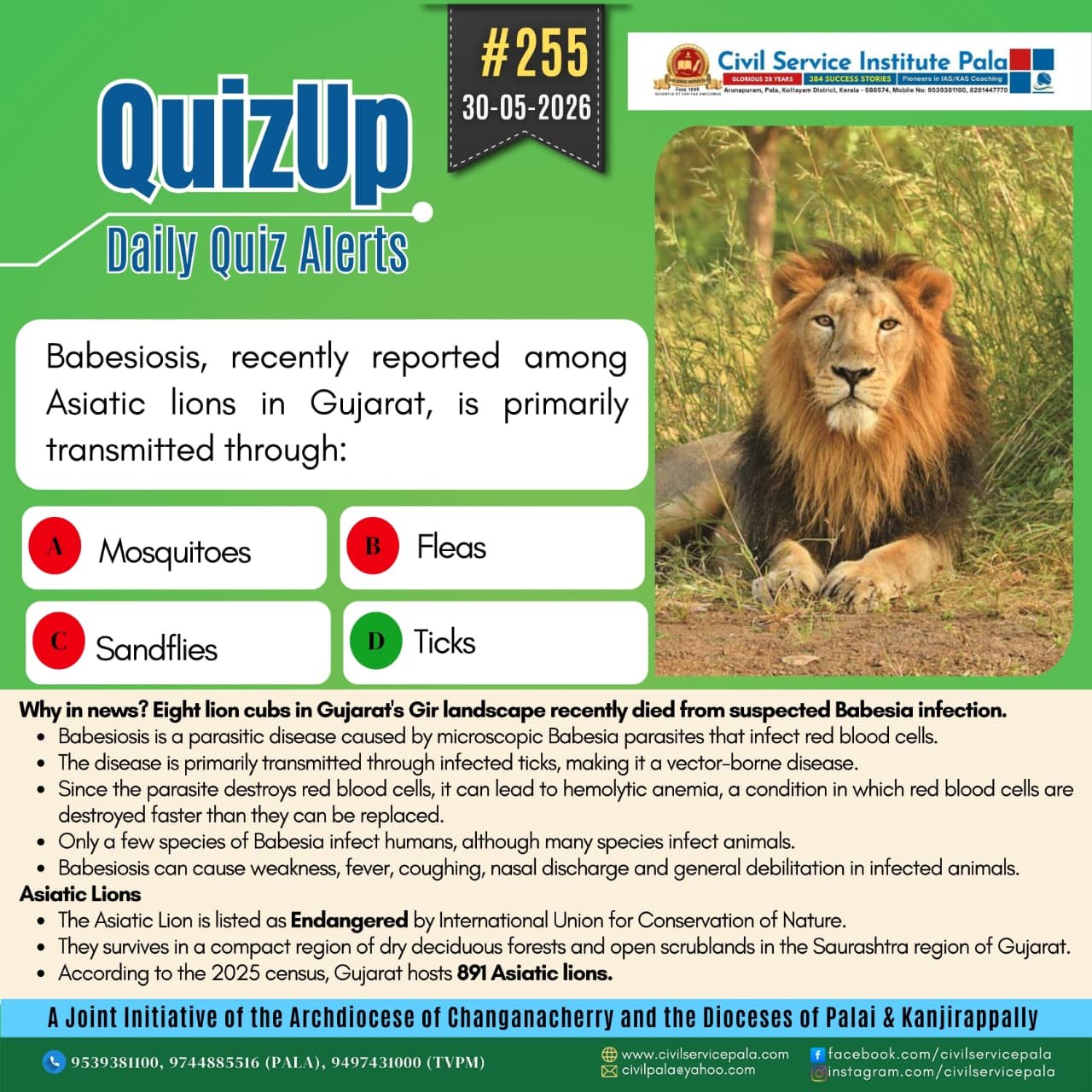
Babesia Infection
Why in News?
• Eight lion cubs in Gujarat's Gir landscape recently died from suspected Babesia infection, prompting disease-control measures, tick-removal operations, and monitoring of lions in affected areas.
What is Babesiosis?
• Babesiosis is a parasitic disease caused by microscopic Babesia parasites that infect red blood cells.
• The disease is primarily transmitted through infected ticks, making it a vector-borne disease.
• Since the parasite destroys red blood cells, it can lead to hemolytic anemia, a condition in which red blood cells are destroyed faster than they can be replaced.
• Only a few species of Babesia infect humans, although many species infect animals.
• Babesiosis can cause weakness, fever, coughing, nasal discharge and general debilitation in infected animals.
• Severe infections may increase mortality, particularly among young or vulnerable animals.
Challenges
• Tick-borne diseases can spread rapidly among wildlife populations living in open forest ecosystems.
• The concentration of the entire wild Asiatic lion population within a single landscape increases vulnerability to disease outbreaks.
• Disease outbreaks pose a significant conservation challenge for endangered species with geographically restricted populations.
• Monitoring and controlling disease transmission in free-ranging wildlife is often difficult due to constant animal movement.
Asiatic Lion (Panthera leo persica)
• The Asiatic Lion is found in the wild only in the Gir landscape of Gujarat.
• The species survives in a compact region of dry deciduous forests and open scrublands in the Saurashtra region of Gujarat.
• According to the 2025 census, Gujarat hosts 891 Asiatic lions.
• The Asiatic Lion is listed as Endangered by International Union for Conservation of Nature.
• The species is included in Schedule I of the Wildlife (Protection) Act, 1972, providing the highest level of legal protection in India.
• The Asiatic Lion is included in Appendix I of Convention on International Trade in Endangered Species of Wild Fauna and Flora, which regulates international trade in the species.
