



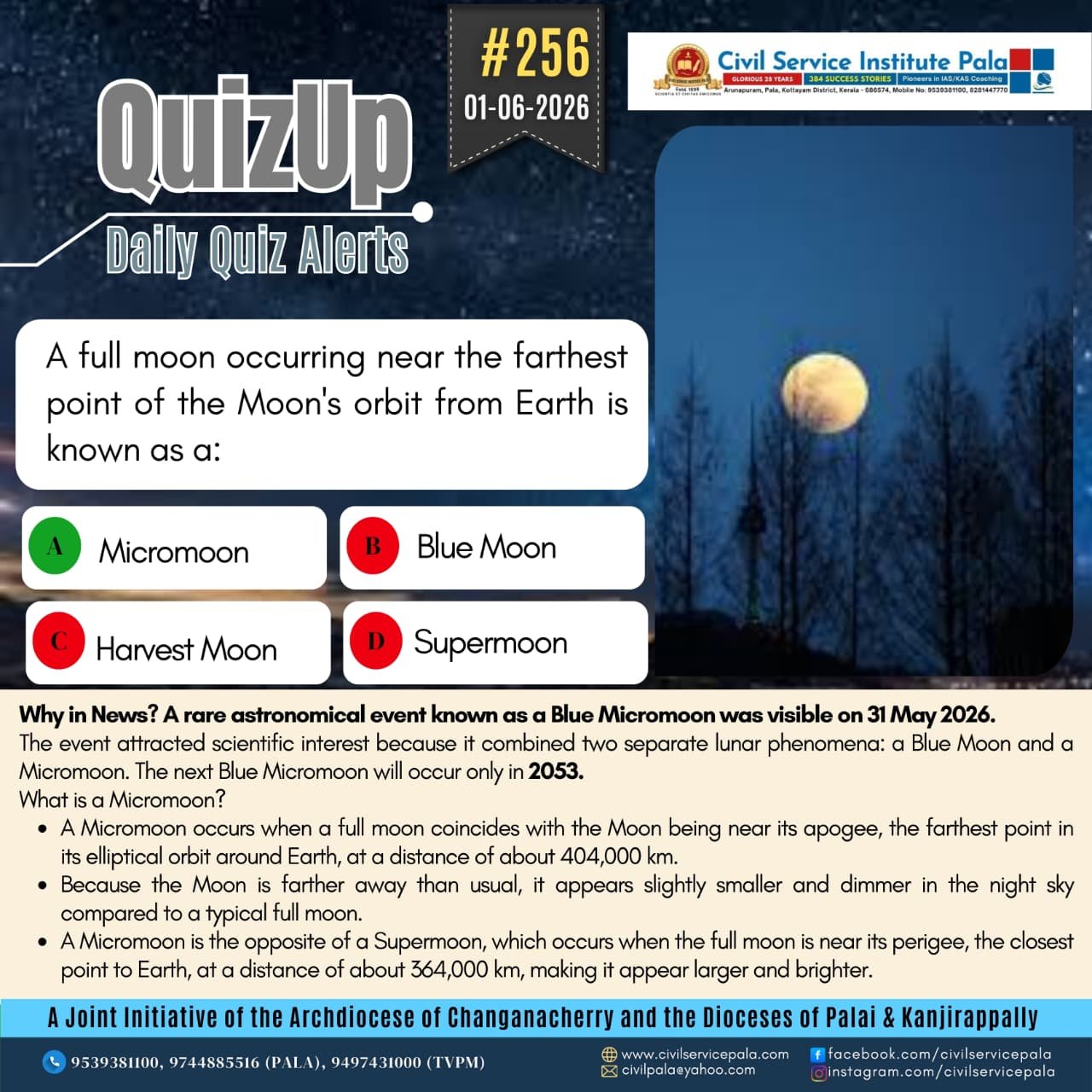
Blue Micromoon
Why in News?
A rare astronomical event known as a Blue Micromoon was visible on 31 May 2026.
The event attracted scientific interest because it combined two separate lunar phenomena: a Blue Moon and a Micromoon.
The next Blue Micromoon will occur only in 2053.
What is a Blue Moon?
A Blue Moon usually refers to the second full moon occurring within a single calendar month.
The phenomenon occurs because the lunar cycle lasts about 29.5 days, allowing two full moons to occasionally fall within the same month.
The event occurs roughly once every two to three years.
Despite its name, a Blue Moon does not normally appear blue and is primarily a calendrical phenomenon rather than a change in the Moon's colour.
What is a Micromoon?
A Micromoon occurs when a full moon coincides with the Moon being near its apogee, the farthest point in its elliptical orbit around Earth, at a distance of about 404,000 km.
Because the Moon is farther away than usual, it appears slightly smaller and dimmer in the night sky compared to a typical full moon.
A Micromoon is the opposite of a Supermoon, which occurs when the full moon is near its perigee, the closest point to Earth, at a distance of about 364,000 km, making it appear larger and brighter.
Lunar Orbit
The Moon follows an elliptical orbit around Earth rather than a perfect circle.
Variations in Earth-Moon distance cause changes in the Moon's apparent size and brightness.
The closest point in the Moon's orbit is called perigee, while the farthest point is called apogee.
