



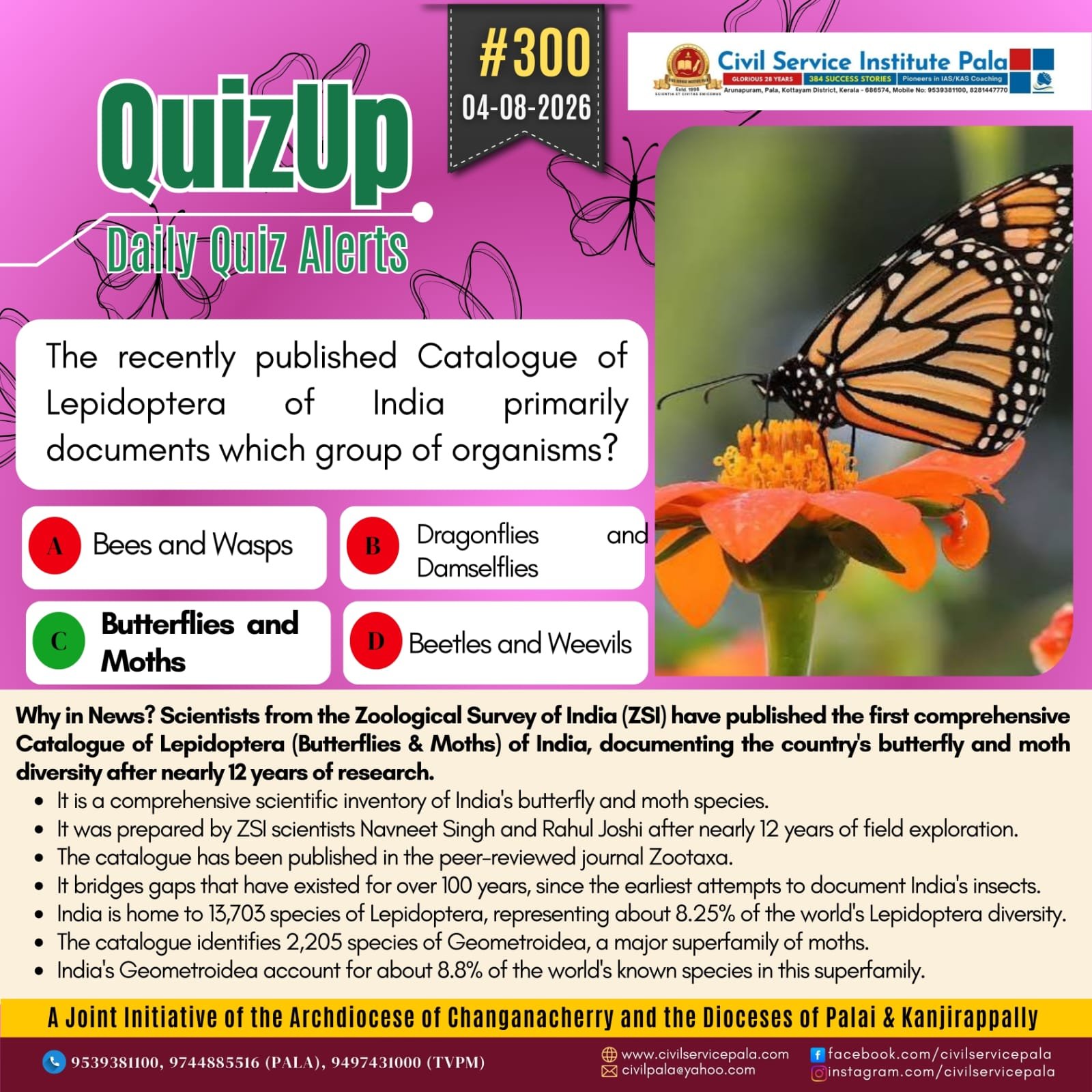
Catalogue of Lepidoptera (Butterflies & Moths) of India
Catalogue of Lepidoptera (Butterflies & Moths) of India
Why in News?
Scientists from the Zoological Survey of India (ZSI) have published the first comprehensive Catalogue of Lepidoptera (Butterflies & Moths) of India, documenting the country's butterfly and moth diversity after nearly 12 years of research. The catalogue fills taxonomic gaps that had persisted for over a century and provides an authoritative baseline for biodiversity research and conservation.
What is the Catalogue of Lepidoptera?
• The Catalogue of Lepidoptera (Butterflies & Moths) of India is a comprehensive scientific inventory of India's butterfly and moth species.
• It was prepared by ZSI scientists Navneet Singh and Rahul Joshi after nearly 12 years of field exploration, museum curation and literature verification.
• The catalogue has been published in the peer-reviewed journal Zootaxa.
• It bridges taxonomic gaps that have existed for more than 100 years, since the earliest attempts to document India's insect fauna.
Key Findings
• India is home to 13,703 species of Lepidoptera, representing about 8.25% of the world's known Lepidoptera diversity.
• The catalogue records:
o 1,417 species of butterflies.
o 12,286 species of moths.
Geometroidea: The Nocturnal Pollinators
• The catalogue identifies 2,205 species of Geometroidea, a major superfamily of moths.
• India's Geometroidea account for about 8.8% of the world's known species in this superfamily.
• These moths serve as important nocturnal pollinators, carrying out pollination when many daytime pollinators are inactive.
Why are Butterflies and Moths Important?
Lepidoptera play a vital role in maintaining ecological balance by serving as:
• Important pollinators of flowering plants.
• Herbivores and detritivores, contributing to ecosystem functioning.
• A major food source for birds, bats and other insect-eating animals.
• Valuable indicators of biodiversity and ecosystem health.
The catalogue will support:
• Biodiversity research.
• Ecological monitoring.
• Species identification and taxonomy.
• Conservation planning and policy formulation.
Why is this Significant?
• Provides the first updated and authoritative national inventory of India's butterflies and moths.
• Strengthens India's position among the world's megadiverse countries with comprehensive biodiversity documentation.
• Establishes a long-term scientific reference for future research, monitoring and conservation of Lepidoptera.
