



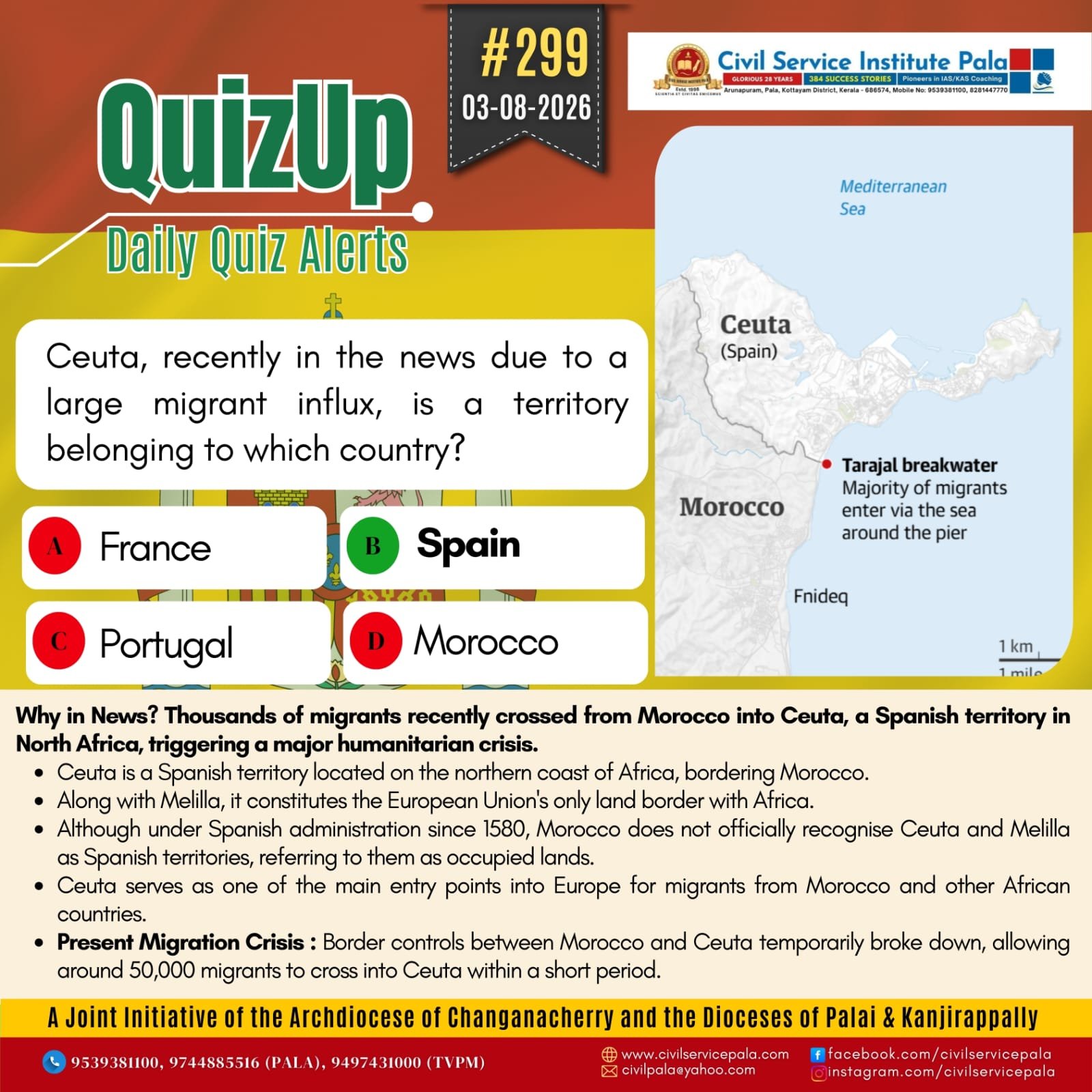
Ceuta – Europe's Gateway from Africa
Ceuta – Europe's Gateway from Africa
Why in News?
Thousands of migrants recently crossed from Morocco into Ceuta, a Spanish territory in North Africa, triggering a major humanitarian crisis. The sudden influx overwhelmed border controls, resulting in dozens of deaths and renewed attention on one of Europe's most sensitive migration routes.
What is Ceuta?
• Ceuta is a Spanish territory located on the northern coast of Africa, bordering Morocco.
• Along with Melilla, it constitutes the European Union's only land border with Africa.
• Although under Spanish administration since 1580, Morocco does not officially recognise Ceuta and Melilla as Spanish territories, referring to them as occupied lands.
• Ceuta has a mixed population of Christians and Muslims, with long-standing social and economic ties between Spanish and Moroccan residents.
Why is Ceuta Strategically Important?
• Ceuta serves as one of the main entry points into Europe for migrants from Morocco and other African countries seeking:
o Better economic opportunities.
o Protection from conflict and instability.
Present Migration Crisis
• Border controls between Morocco and Ceuta temporarily broke down, allowing around 50,000 migrants to cross into Ceuta within a short period.
• The number of arrivals exceeded two-thirds of Ceuta's normal population, creating severe humanitarian and administrative challenges.
• The chaotic crossings resulted in at least 67 reported deaths.
• Spanish authorities subsequently returned most of the migrants to Morocco, while others remained in shelters awaiting asylum procedures.
Why Does Ceuta Witness Frequent Migration Attempts?
• Ceuta is viewed as a gateway to Europe because it lies within Spanish—and therefore EU—territory.
• Spain has progressively fortified the borders of Ceuta and Melilla to curb illegal migration.
• Despite strict border controls, migrants continue attempting dangerous crossings by land and sea in hopes of reaching Europe
