



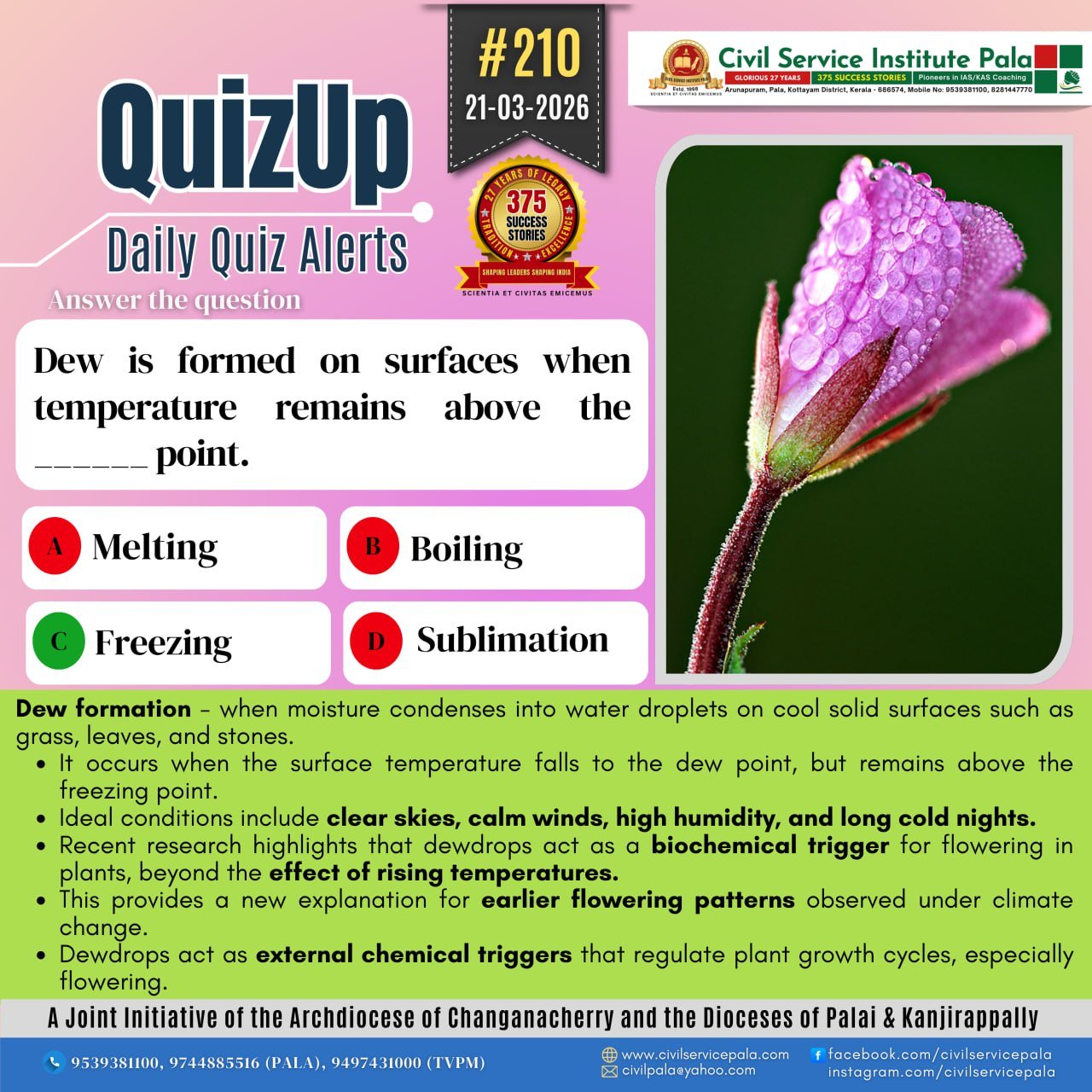
Dew Formation
Dew Formation
• Dew is formed when moisture condenses into water droplets on cool solid surfaces such as grass, leaves, and stones.
• It occurs when the surface temperature falls to the dew point, but remains above the freezing point.
• Ideal conditions include clear skies, calm winds, high humidity, and long cold nights.
Latest research developments
• Recent research highlights that dewdrops act as a biochemical trigger for flowering in plants, beyond the effect of rising temperatures.
• This provides a new explanation for earlier flowering patterns observed under climate change.
• Earlier flowering in plants has been linked to climate change, but temperature alone does not fully explain the phenomenon.
• Experts suggest that increased humidity due to warming leads to earlier formation of dewdrops, which influence plant processes.
Mechanism: How Dewdrops Influence Flowering
• When dewdrops form on leaf surfaces, they initiate chemical reactions at the interface of water and plant tissue.
• These reactions generate highly reactive molecules (radicals) such as hydrogen and hydroxyl radicals.
• These molecules combine to form hydrogen peroxide, which further reacts to produce nitric oxide (NO).
• Nitric oxide acts as a signaling molecule, entering plant cells and triggering biochemical pathways that induce flowering.
Scientific Significance
• Experts highlight that while the role of nitric oxide in plant signaling was known, its generation through dewdrops is a new discovery.
• Large-scale analysis of flowering data shows a strong correlation between flowering time and dew point, in addition to temperature and day length.
• This establishes dew formation as a previously overlooked environmental regulator of plant phenology.
Role in Plant Health
• Dewdrops act as external chemical triggers that regulate plant growth cycles, especially flowering.
• They contribute to plant signalling pathways without requiring direct water uptake through roots.
• This indicates that plants respond not only to internal physiology and climate factors, but also to micro-scale surface interactions.
Way Forward
The findings suggest potential for agricultural innovation, such as:
• Inducing flowering through controlled misting or humidity regulation
• Improving crop yield and flowering synchronisation
• Dew-based mechanisms may become a low-cost, non-invasive tool in crop management.
