



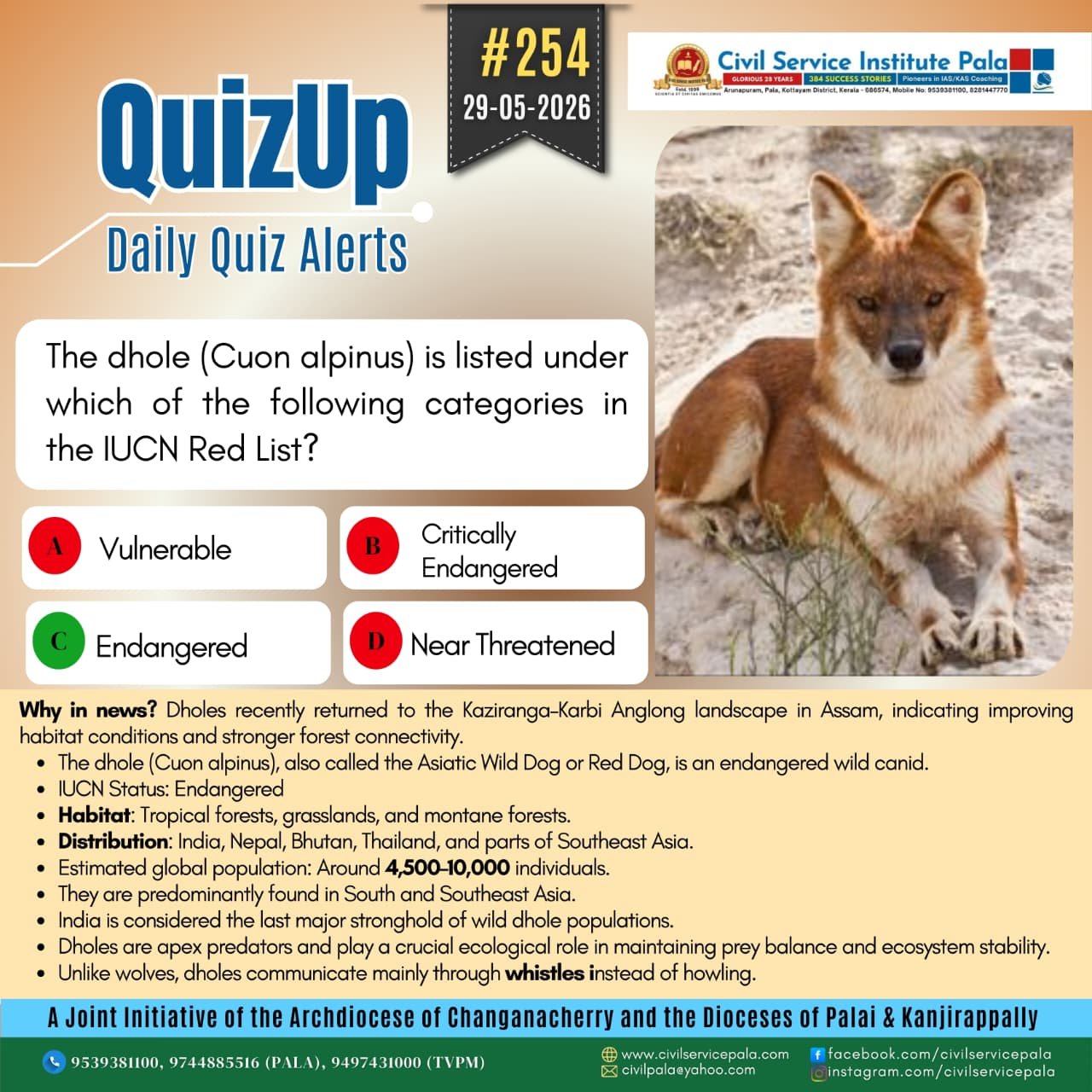
Dhole (Asiatic Wild Dog)
Dhole (Asiatic Wild Dog)
The dhole (Cuon alpinus), also called the Asiatic Wild Dog or Red Dog, is an endangered wild canid found in South and Southeast Asia.
India is considered the last major stronghold of wild dhole populations.
The species recently returned to the Kaziranga–Karbi Anglong landscape in Assam, indicating improving habitat conditions and stronger forest connectivity.
Dholes are apex predators and play an important ecological role in maintaining prey balance and forest ecosystem stability.
Unlike wolves, dholes communicate mainly through whistles instead of howling.
Dhole
Scientific name: Cuon alpinus
Family: Canidae
IUCN Status: Endangered
Habitat: Tropical forests, grasslands, and montane forests.
Distribution: India, Nepal, Bhutan, Thailand, and parts of Southeast Asia.
Estimated global population: Around 4,500–10,000 individuals.
Estimated mature adults: Around 1,000–2,500.
Dholes usually hunt in packs and primarily target medium-sized herbivores.
Ecological Importance
Dholes function as apex predators and help regulate herbivore populations.
Presence of dholes indicates healthy prey availability and habitat connectivity.
They coexists with tigers and leopards through differences in prey preference and behavioural adaptation.
Their return to protected landscapes is often considered a sign of ecosystem recovery.
Major Threats
Habitat Loss and Fragmentation
Habitat loss remains the biggest threat to dhole survival.
Expanding agriculture, urbanisation, infrastructure projects, and deforestation reduce suitable forest habitats.
Fragmented protected areas restrict movement and reduce genetic diversity.
Human-Wildlife Conflict
Dholes occasionally prey on livestock when wild prey becomes scarce.
Retaliatory killings by local communities remain a major conservation challenge.
Conflict is especially severe in areas where pastoral communities depend heavily on livestock income.
Disease Transmission
Dholes are vulnerable to diseases such as rabies, canine distemper, parvovirus, and mange.
Contact with feral and domestic dogs increases disease transmission risks.
Negative Human Perception
Historically, dholes were labelled as vermin and persecuted because of their hunting behaviour.
Lack of public awareness compared to species like tigers and leopards weakens conservation attention.
Conservation Challenges in Predator Landscapes
Dholes share habitats with tigers and leopards, leading to competition for prey resources.
However, studies suggest that these predators coexist through prey selection and spatial adaptation.
Conservation planning must therefore focus on maintaining adequate prey populations and large connected habitats.
Way Forward
Conservation efforts should prioritise habitat connectivity between protected areas.
Strengthening compensation schemes for livestock loss can reduce retaliatory killings.
Vaccination and control of feral dog populations are important to reduce disease spread.
Increasing public awareness about dholes is essential for long-term conservation support.
Landscape-based conservation integrating local communities is critical for protecting wide-ranging carnivores like dholes.
