



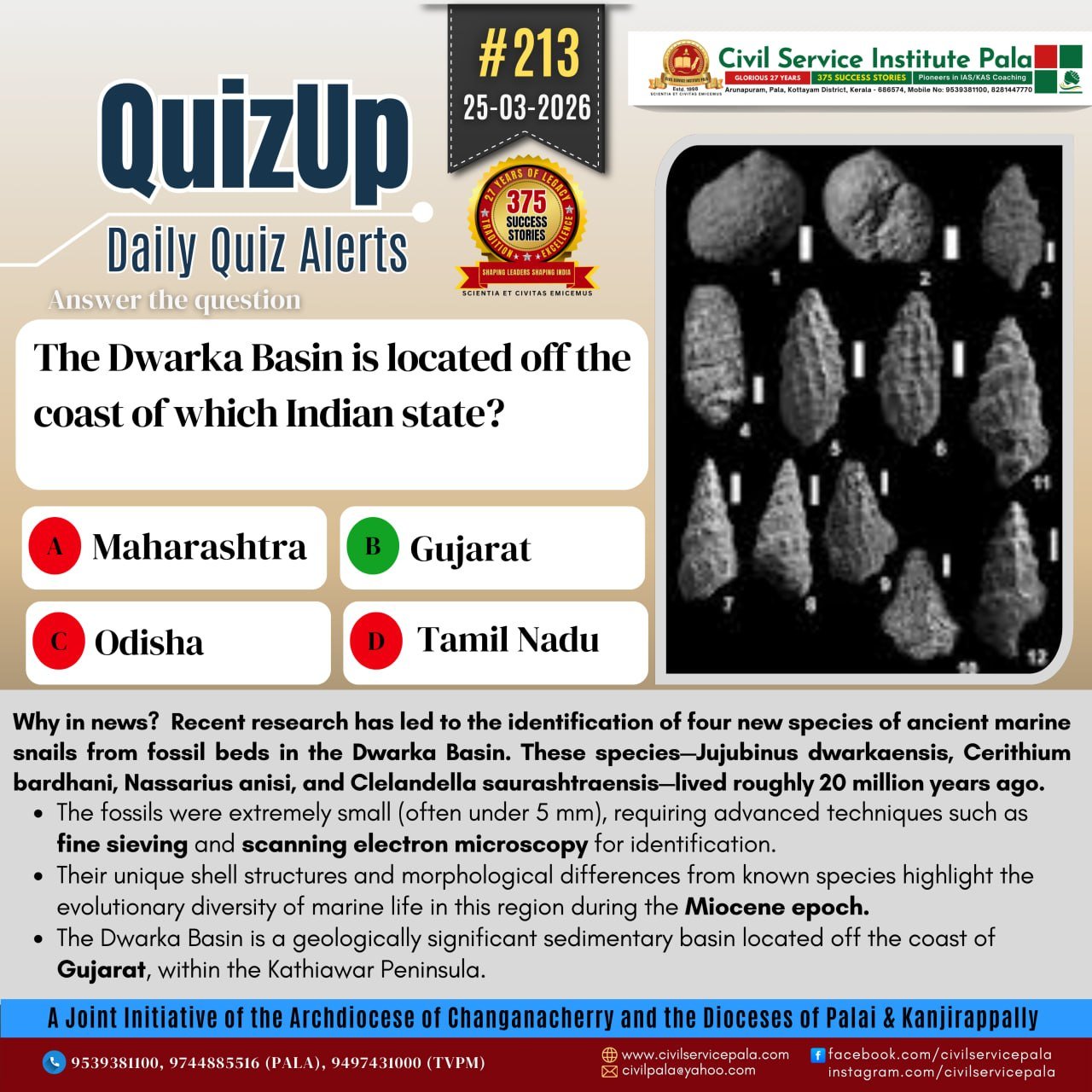
Dwarka Basin
The Dwarka Basin is a geologically significant sedimentary basin located off the coast of Gujarat, within the Kathiawar Peninsula.
• It contains marine rock formations such as the Gaj and Dwarka formations dating back to the Miocene epoch, making it an important site for reconstructing Earth’s deep-time environmental history.
• The basin has long attracted interest not only from geologists studying ancient climates and marine ecosystems, but also from archaeologists due to submerged structures near Dwarka, and from energy companies exploring hydrocarbon potential beneath volcanic layers.
Key Discovery: New Marine Fossil Species
• Recent research by scientists from Indian Institute of Technology (IIT) Bombay, the Indian Statistical Institute, and the Indian Institutes of Science Education and Research (IISER) Kolkata has led to the identification of 42 species of snails, including four new species of ancient marine snails from fossil beds in this basin.
• These species—Jujubinus dwarkaensis, Cerithium bardhani, Nassarius anisi, and Clelandella saurashtraensis—lived roughly 20 million years ago.
• The fossils were extremely small (often under 5 mm), requiring advanced techniques such as fine sieving and scanning electron microscopy for identification.
• Their unique shell structures and morphological differences from known species highlight the evolutionary diversity of marine life in this region during the Miocene.
Evidence of a Nutrient-Rich Ancient Sea
• The fossil assemblage discovered in the basin is described as turritelline-dominated, indicating a dense accumulation of filter-feeding marine snails.
• Such organisms thrive only in nutrient-rich waters, suggesting that the Dwarka region was once a warm, shallow, and highly productive marine environment.
• This points to the presence of Ocean upwelling, where deep, cold, nutrient-laden waters rise to the surface, supporting abundant marine life.
Clues to Past Climate and Ocean Systems
• The discovery is highly significant for understanding paleoclimate and paleoceanography. These fossils act as “micro time capsules,” helping scientists reconstruct ancient ocean currents, temperature conditions, and ecological responses to climate change.
• The presence of such biodiversity during the Miocene suggests that western India once experienced dynamic marine conditions influenced by global climatic shifts, offering parallels to present-day climate change studies.
Scientific and Broader Significance
• Overall, the Dwarka Basin serves as a multi-disciplinary research hub, linking geology, paleontology, climate science, and archaeology.
• The recent discoveries not only expand the known biodiversity of ancient marine ecosystems but also enhance our understanding of how marine life responds to environmental changes over geological timescales.
• This has implications for modern climate studies, biodiversity conservation, and even resource exploration, making the basin a site of enduring scientific importance.
