



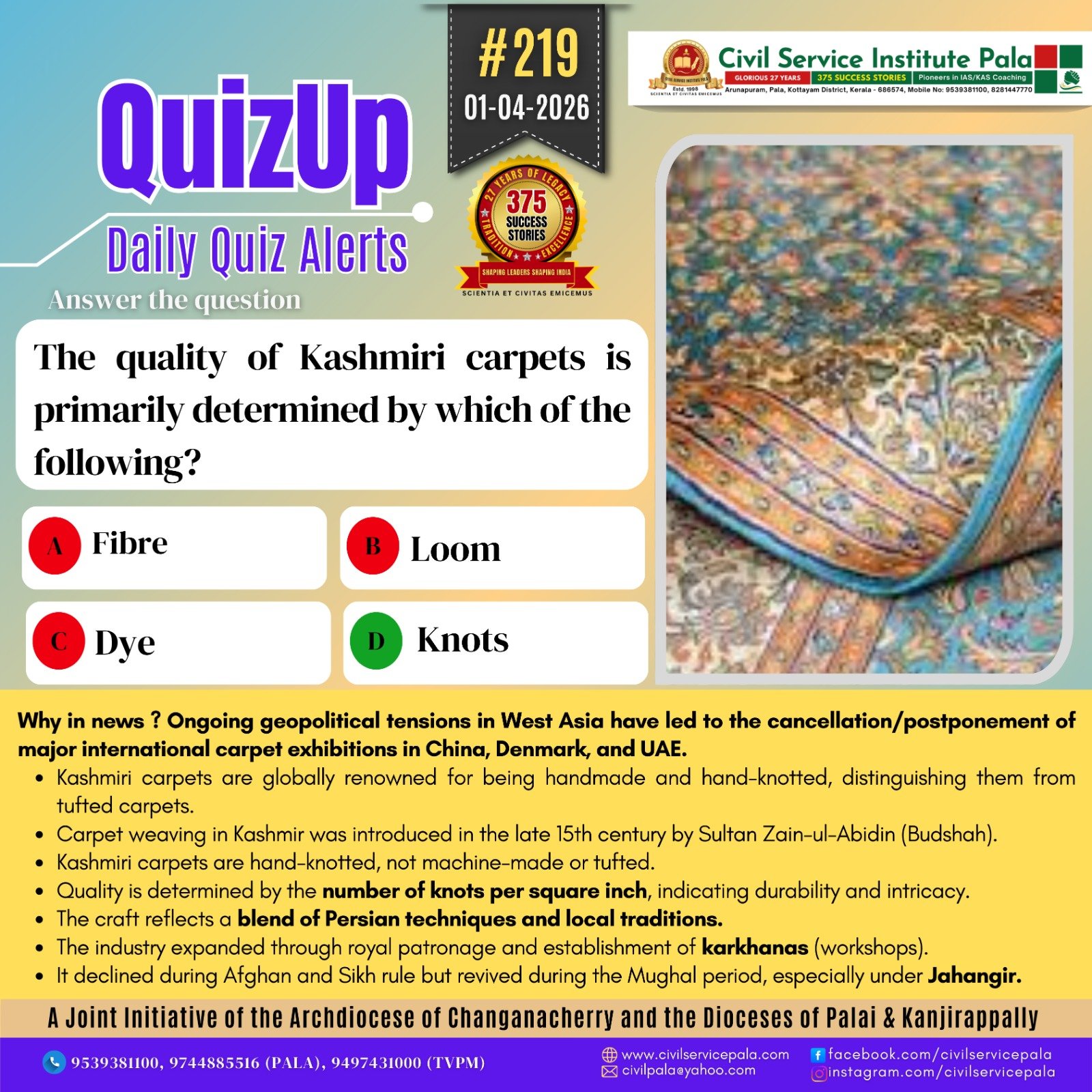
Kashmiri Carpets
Why in News
• Ongoing geopolitical tensions in West Asia have led to the cancellation/postponement of major international carpet exhibitions in China, Denmark, and UAE.
• Experts highlight that this has negatively impacted export prospects and tourism-linked sales of Kashmiri carpets.
Kashmiri Carpets
Kashmiri carpets are globally renowned for being handmade and hand-knotted, distinguishing them from tufted carpets.
• Carpet weaving in Kashmir was introduced in the late 15th century by Sultan Zain-ul-Abidin (Budshah), who brought Persian artisans.
• The craft reflects a blend of Persian techniques and local traditions.
Historical Development
• The industry expanded through royal patronage and establishment of karkhanas (workshops).
• It declined during Afghan and Sikh rule but revived during the Mughal period, especially under Jahangir.
• Experts suggest that exposure to international markets increased after display at the Crystal Palace Exhibition in London (18th century).
• The industry faced setbacks during economic recessions and Partition, but revived in the late 20th century with government support.
Key Features of Kashmiri Carpets
• Kashmiri carpets are hand-knotted, not machine-made or tufted.
• Quality is determined by the number of knots per square inch, indicating durability and intricacy.
• High-quality carpets (especially silk) may have 500–9000 knots per square inch.
• Materials used include pure wool, silk (especially mulberry silk), or blends in lower-quality variants.
• Production is labour-intensive, often taking 8–10 months for a single carpet.
Economic Significance
• Around 80,000 people are associated with the carpet industry in Kashmir.
• Exports have shown fluctuations, with a decline from ₹357 crore (2022–23) to ₹260.70 crore (2024–25).
• Experts highlight that the sector is highly dependent on global exhibitions, exports, and tourism demand.
Challenges
• Geopolitical tensions affecting global trade and exhibitions.
• Declining export trends in recent years.
• Dependence on tourism for domestic sales.
• Labour-intensive nature leading to higher costs and competition from machine-made carpets.
Way Forward
• Experts suggest diversification of export markets to reduce geopolitical risks.
• Strengthening branding and GI-based promotion can enhance global demand.
• Technological integration in marketing (e-commerce) can reduce dependence on exhibitions.
• Policy support and skill preservation are essential for sustaining the traditional craft.
