



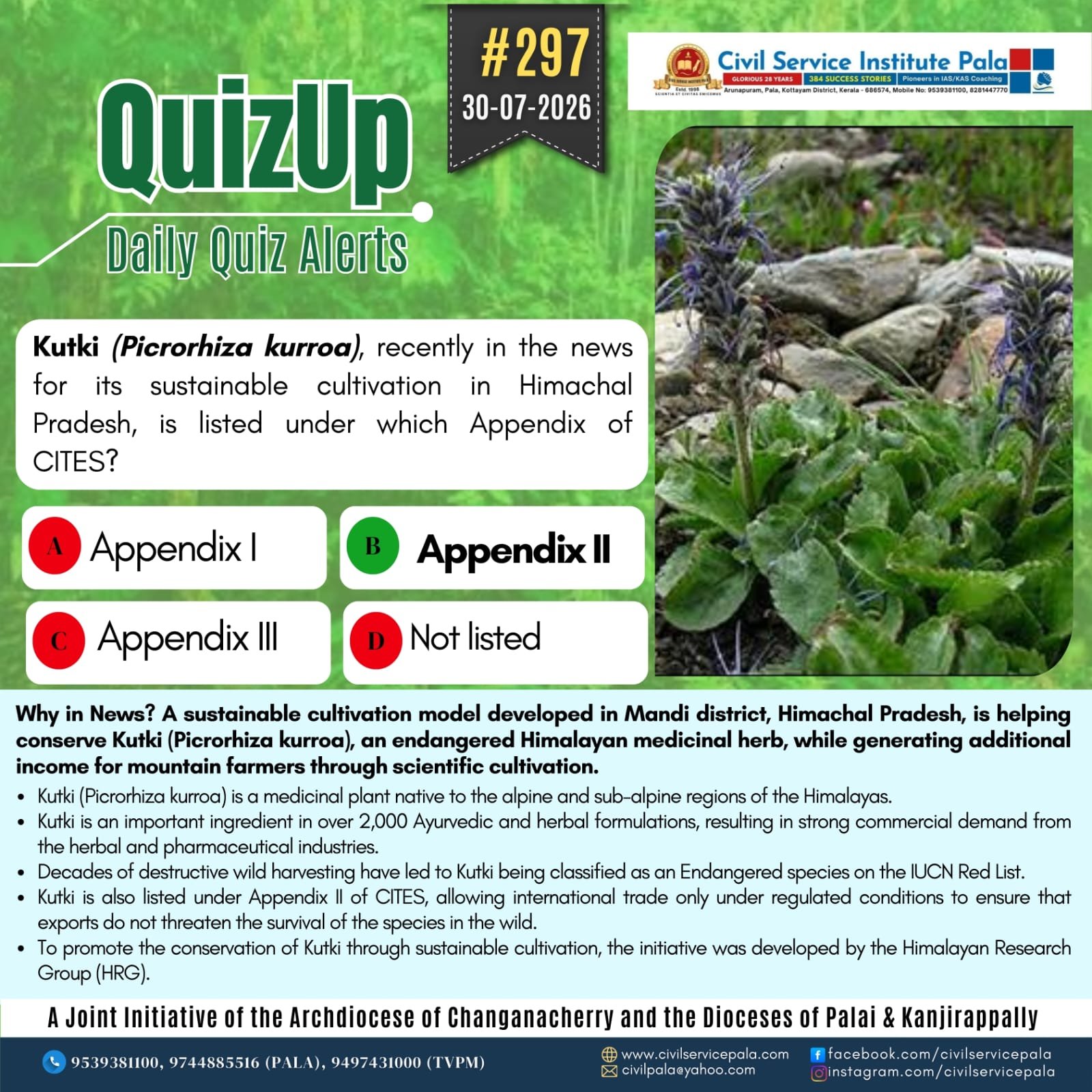
Kutki (Picrorhiza kurroa)
Kutki (Picrorhiza kurroa)
• Why in News?
• A sustainable cultivation model developed in Mandi district, Himachal Pradesh, is helping conserve Kutki (Picrorhiza kurroa), an endangered Himalayan medicinal herb, while generating additional income for mountain farmers through scientific cultivation.
• Kutki: The Medicinal Himalayan Herb
• Kutki (Picrorhiza kurroa) is a high-value medicinal plant native to the alpine and sub-alpine Himalayas (2,700–4,500 m). It is used in over 2,000 Ayurvedic and herbal formulations, resulting in strong commercial demand. However, decades of destructive wild harvesting caused a sharp decline in natural populations, leading to its classification as Endangered on the IUCN Red List. It is also listed under Appendix II of CITES, which permits international trade only under regulated conditions to ensure that wild populations are not adversely affected.
• The Sustainable Cultivation Model
• The initiative was developed by the Himalayan Research Group (HRG), a Department of Science and Technology (DST) Core Support Group under the Science for Equity, Empowerment and Development (SEED) Programme, and later expanded under the Department of Biotechnology's Himalayan Bioresource Mission (2022).
• Earlier, Kutki was harvested by uprooting the entire plant because it was wrongly believed that the roots possessed medicinal value. Researchers demonstrated that the medicinal component is actually the stolon—a creeping underground stem—while the roots have no medicinal value. Farmers now harvest only the stolons, leaving the mother plant intact so that it regenerates naturally, making Kutki a perennial and sustainably harvested crop.
• Significance
• The initiative has expanded to around 180 farmers in Mandi district, creating the largest private-land cultivation cluster of Kutki.
• The model demonstrates how scientific research, biodiversity conservation and rural livelihood enhancement can complement each other. It promotes sustainable utilisation of medicinal plants, supports the herbal medicine industry and serves as an example of community-based conservation in the Himalayan region.
