



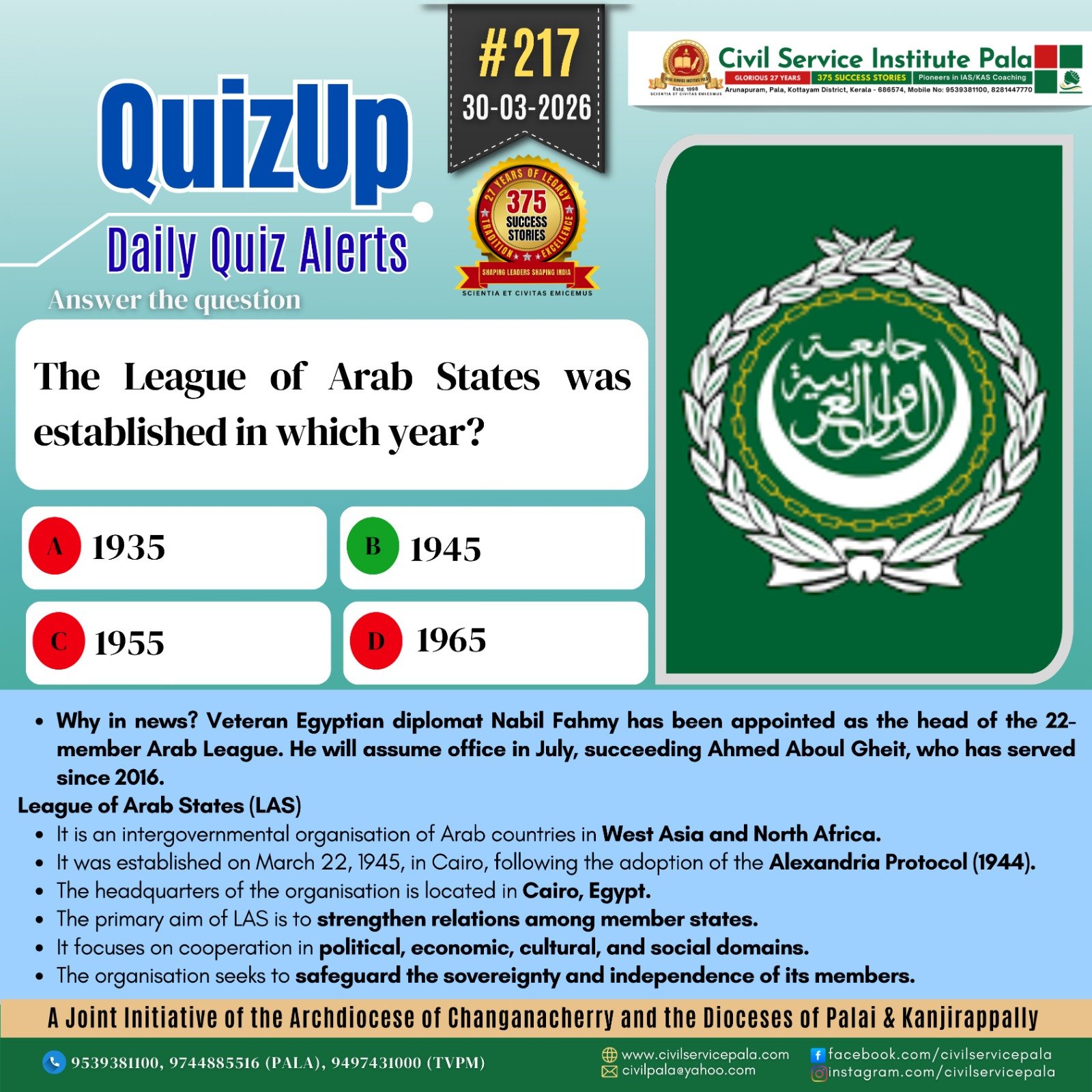
League of Arab States (LAS)
Veteran Egyptian diplomat Nabil Fahmy has been appointed as the head of the 22-member Arab League.
He will assume office in July, succeeding Ahmed Aboul Gheit, who has served since 2016.
League of Arab States (LAS)
Establishment & Nature
• The League of Arab States (LAS) is an intergovernmental organisation of Arab countries in West Asia and North Africa.
• It was established on March 22, 1945, in Cairo, following the adoption of the Alexandria Protocol (1944).
• The headquarters of the organisation is located in Cairo, Egypt.
Membership
• The organisation currently comprises 22 member states from the Arab world.
•
• Currently it gathers 22 Arab countries: Algeria, Bahrain, Comoros, Djibouti, Egypt, Iraq, Jordan, Kuwait, Lebanon, Libya, Mauritania, Morocco, Oman, Palestine, Qatar, Saudi Arabia, Somalia, Sudan, Syria, Tunisia, the United Arab Emirates, and Yemen.
• These include countries from both West Asia and North Africa, making it the only pan-Arab organisation.
Objectives & Mandate
• The primary aim of LAS is to strengthen relations among member states.
• It focuses on coordination of policies and cooperation in political, economic, cultural, and social domains.
• The organisation seeks to safeguard the sovereignty and independence of its members.
• It also works towards conflict resolution and dispute settlement among member states.
• At present, it also focuses on collective defence and military coordination.
Institutional & Functional Role
• The League has developed frameworks for pan-Arab cooperation in areas such as politics, security, economy, and law.
• It has promoted initiatives like the Arab Petroleum Congress (1959) and established institutions such as the Arab League Educational, Cultural and Scientific Organization (ALECSO) (1964) for cultural and scientific cooperation.
• The Council of Arab Economic Unity was created to promote economic integration and free movement of labour, capital, and services.
Challenges
• The League has faced internal divisions, especially on issues like Israel–Palestine.
• Events such as the 1990 Iraqi invasion of Kuwait and the Arab Spring have tested its unity and effectiveness.
• Political differences and varying economic policies have often limited deeper integration and cooperation.
External Engagement (EU–LAS Cooperation)
• The 2014 Athens Declaration established the EU–LAS Strategic Dialogue.
• A 2015 MoU between LAS and the European External Action Service strengthened cooperation in areas like counter-terrorism, crisis management, migration, and climate security.
• A liaison office (ECLASLO) was set up in Malta to promote Euro-Arab cooperation initiatives.
