



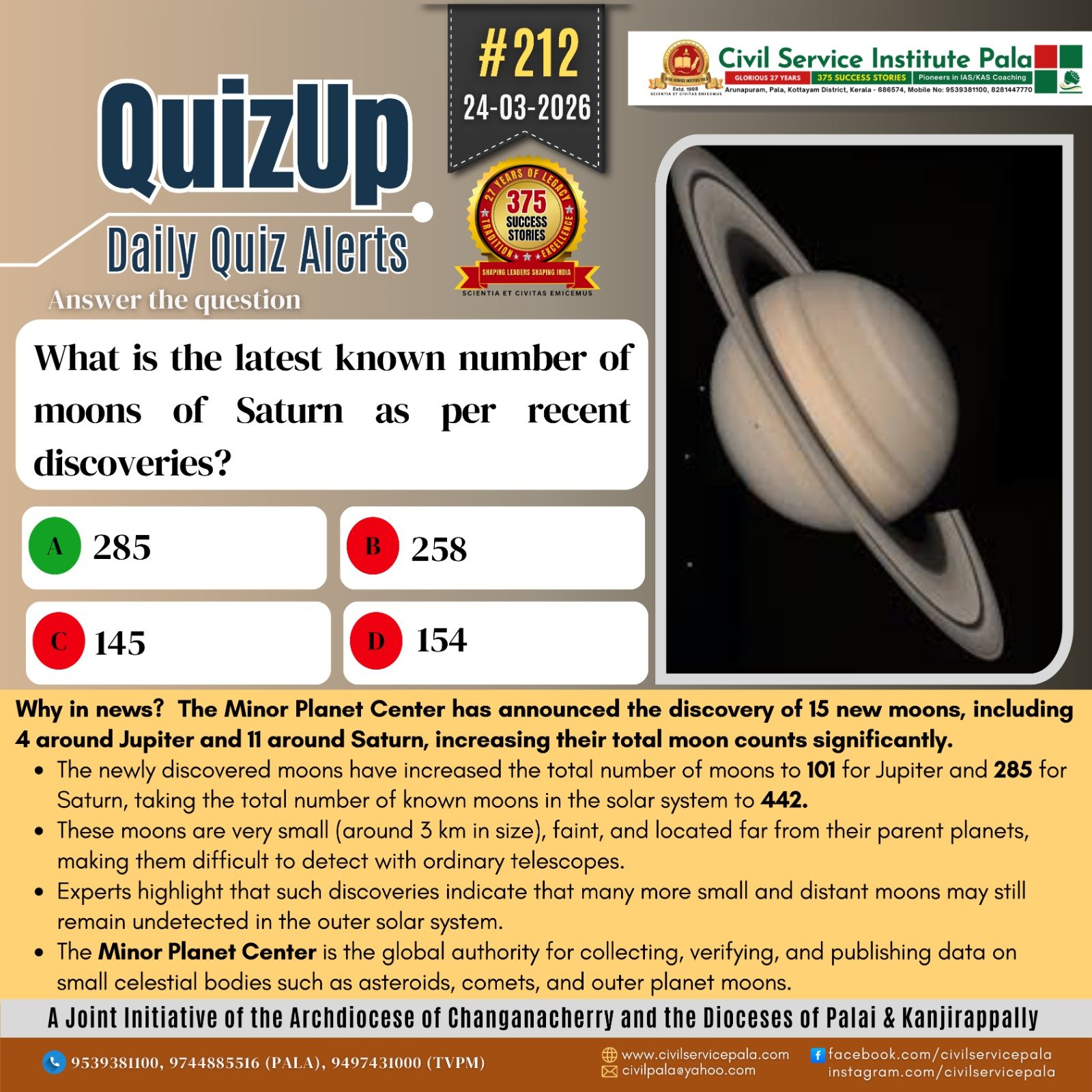
Moons of Saturn
Why in News?
* The Minor Planet Center has announced the discovery of 15 new moons, including 4 around Jupiter and 11 around Saturn, increasing their total moon counts significantly.
Key Developments
* The newly discovered moons have increased the total number of moons to 101 for Jupiter and 285 for Saturn, taking the total number of known moons in the solar system to 442.
* These moons are very small (around 3 km in size), faint, and located far from their parent planets, making them difficult to detect with ordinary telescopes.
* The discoveries were made by astronomers including Scott Sheppard, David Tholen, and Edward Ashton.
* Experts highlight that such discoveries indicate that many more small and distant moons may still remain undetected in the outer solar system.
About Minor Planet Center (MPC)
The Minor Planet Center is the global authority for collecting, verifying, and publishing data on small celestial bodies such as asteroids, comets, and outer planet moons.
* It operates under the International Astronomical Union at the Smithsonian Astrophysical Observatory in Cambridge.
When a new object is discovered, scientists submit observations to the MPC, which:
* Verifies the discovery
* Calculates the object’s orbit
* Assigns an official designation
This process ensures that all celestial objects have a unique identity and predictable trajectory, which is critical for space research and monitoring.
Moons and Solar System
• Earth has 1 moon.
• Mars has 2 moons.
• Uranus has 28 moons.
• Neptune has 16 moons.
• Venus and Mercury have no natural satellites.
