



Orangutans: Wildlife Trafficking and Conservation
Orangutans: Wildlife Trafficking and Conservation
Why in News?
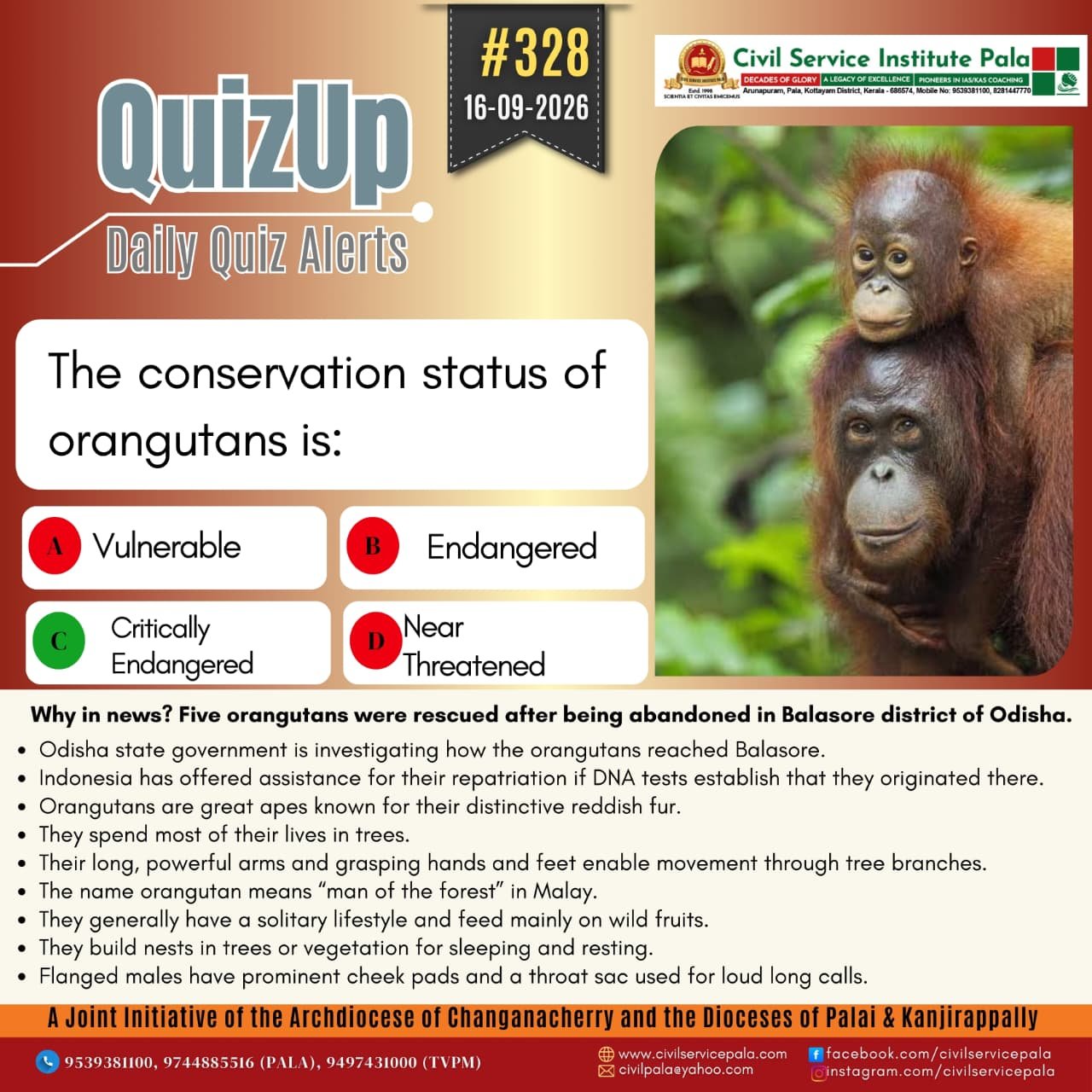
Five young orangutans were rescued after being abandoned in Balasore district of Odisha. The Odisha Police STF has detained three persons in connection with the case, while investigations are examining a possible international wildlife-trafficking link.
The Odisha Case
• The five young orangutans were found abandoned in Balasore district on September 7.
• Odisha Police is investigating how the orangutans reached Balasore, with coordination from the West Bengal Police.
• Indonesia has offered assistance for their repatriation if DNA tests establish that the animals originated there.
Orangutans and Their Habitat
• Orangutans are great apes known for their distinctive reddish fur.
• They spend most of their lives in trees.
• Their long, powerful arms and grasping hands and feet enable movement through tree branches.
• The name orangutan means “man of the forest” in Malay.
• They generally have a solitary lifestyle and feed mainly on wild fruits. They build nests in trees or vegetation for sleeping and resting.
• Adult males can weigh up to 200 pounds. Flanged males have prominent cheek pads and a throat sac used for loud long calls.
Three Orangutan Species
• Bornean orangutan and Sumatran orangutan differ in appearance and behaviour, although both have shaggy reddish fur.
• Sumatran orangutans have longer facial hair and are reported to have closer social bonds, while Bornean orangutans are more likely to descend to the ground.
• The Tapanuli orangutan, announced as a separate species in November 2017, has no more than 800 individuals. It is considered as the most endangered of the great apes.
• Population declines have affected both Bornean and Sumatran orangutans, with current estimates of about 104,700 Bornean and 13,846 Sumatran orangutans.
Conservation and Trafficking
• Orangutans are classified as Critically Endangered.
• The rescued animals are suspected to be victims of international wildlife trafficking and the illegal exotic-pet trade.
• Their conservation is closely linked to protection of their natural habitats in Indonesia and Malaysia, which are their range states mentioned in the material.
• Repatriation of the rescued orangutans depends on establishing their origin through DNA testing.
