



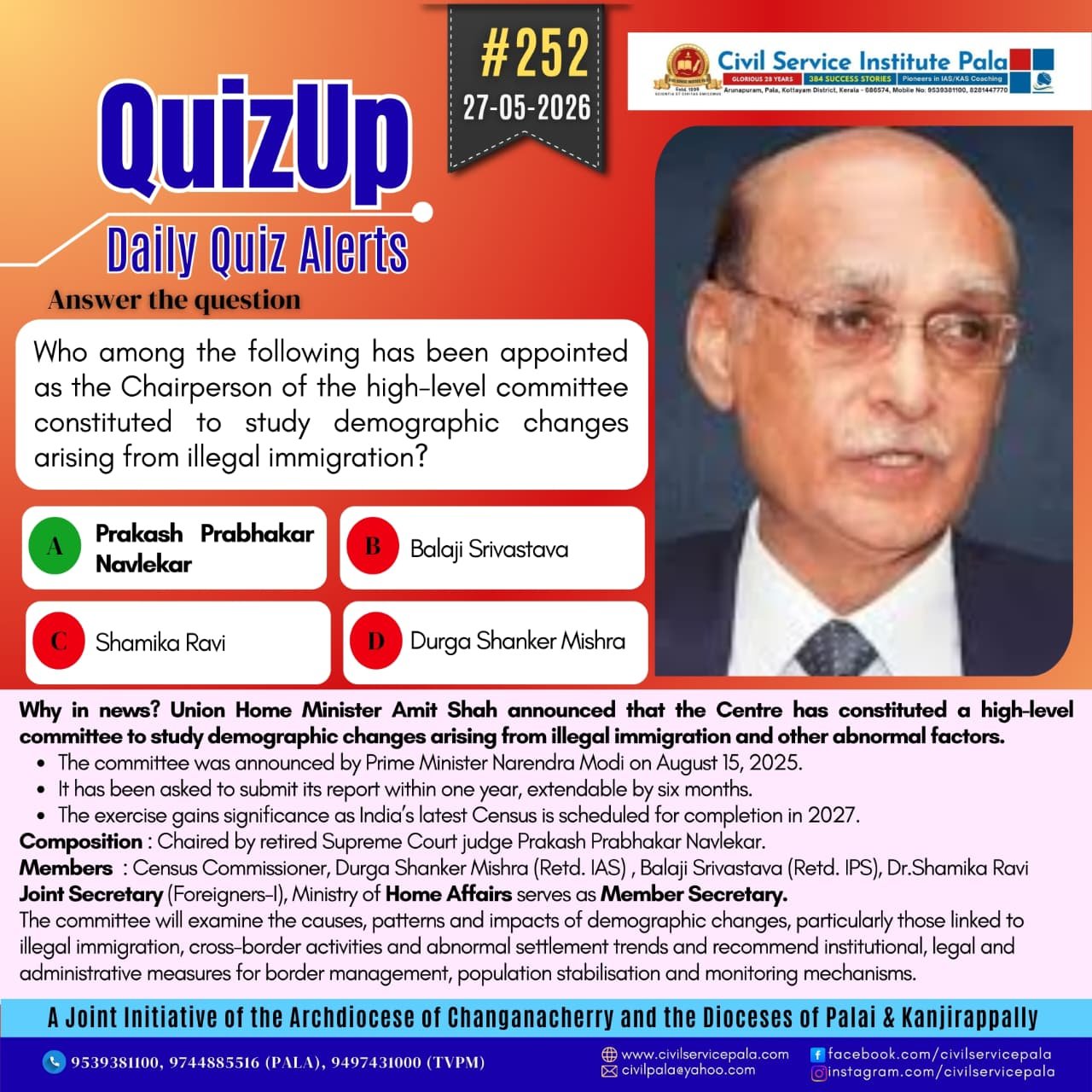
Prakash Prabhakar Navlekar
Why in News?
Union Home Minister Amit Shah announced that the Centre has constituted a high-level committee to study demographic changes arising from illegal immigration and other abnormal factors.
Background
The committee was announced by Prime Minister Narendra Modi on August 15, 2025.
It has been asked to submit its report within one year, extendable by six months.
The exercise gains significance as India’s latest Census is scheduled for completion in 2027.
Composition
· Chaired by retired Supreme Court judge Prakash Prabhakar Navlekar.
Members include:
· Census Commissioner
· Durga Shanker Mishra (Retd. IAS)
· Balaji Srivastava (Retd. IPS)
· Dr. Shamika Ravi of the Prime Minister’s Economic Advisory Council
· Joint Secretary (Foreigners-I), Ministry of Home Affairs serves as Member Secretary.
Major Areas of Study
· Comprehensively deliberate upon the challenges arising from demographic changes, including illegal immigration
· Study possible causes, such as cross-border activities, economic opportunities, and other socio-environmental factors
· Identify underlying factors like illegal immigration, abnormal settlement patterns and orchestrated migration
· Analyse structural population changes at the level of religious or social communities, particularly where they deviate from broader trends
· Recommend a streamlined and permanent operational mechanism for the legal, fair and time-bound identification, detention, and deportation of illegal immigrants residing in the country
· Recommend appropriate institutional mechanism to strengthen border management, population stabilisation and identification systems for the continuous monitoring of such trends
Significance
The committee reflects increasing policy focus on illegal immigration, border security, demographic trends and population governance.
It also aims to create a more coordinated and institutional mechanism for monitoring demographic changes.
Key Concepts
Demographic Change
Refers to changes in population characteristics such as fertility, mortality, migration and population composition.
Population Stabilisation
Refers to achieving a sustainable balance between birth rates and death rates to ensure balanced population growth through measures such as healthcare, education and family planning.
