



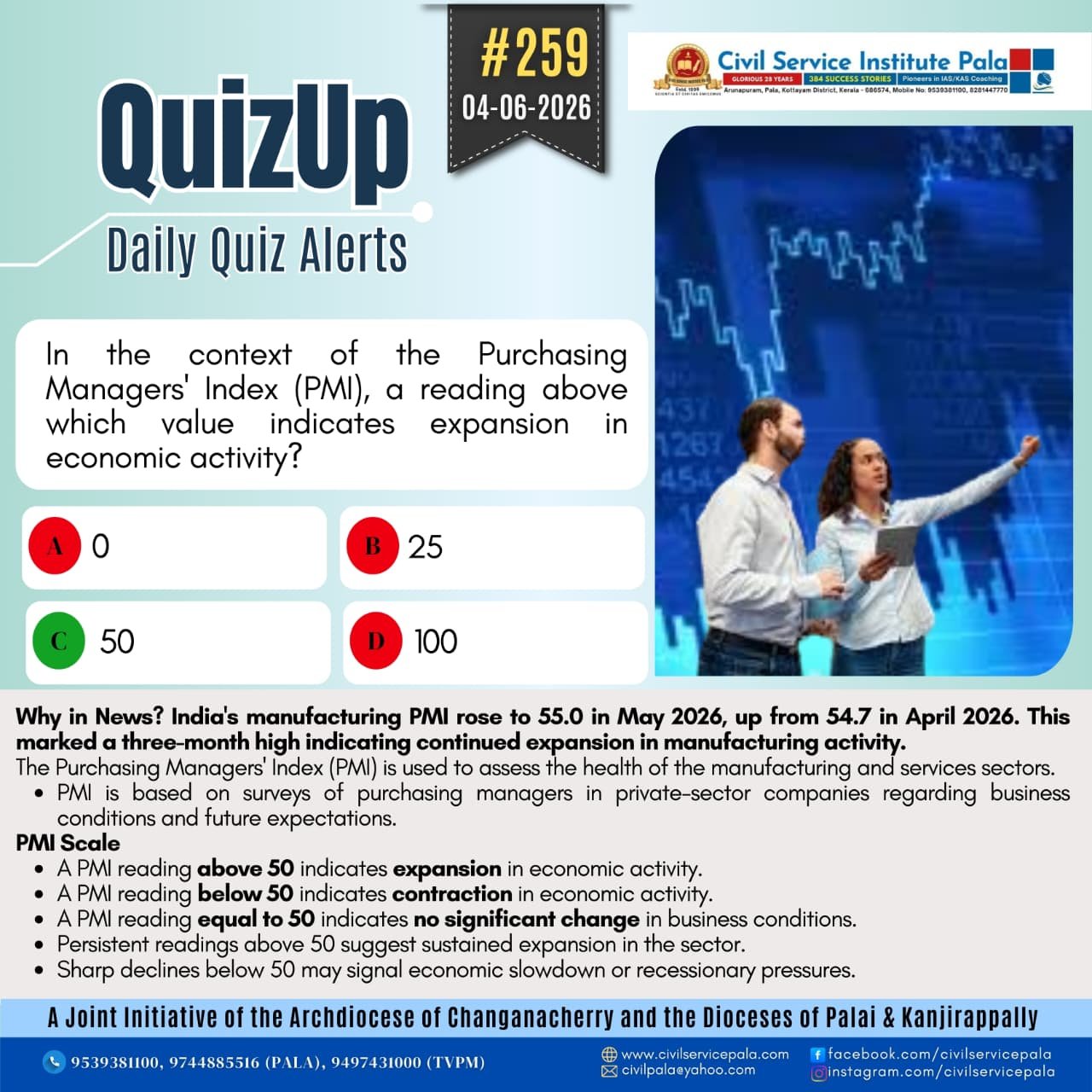
Purchasing Managers' Index (PMI)
Purchasing Managers' Index (PMI)
The Purchasing Managers' Index (PMI) is a leading economic indicator used to assess the health of the manufacturing and services sectors.
PMI is based on surveys of purchasing managers in private-sector companies regarding business conditions and future expectations.
It provides an early indication of economic activity before official industrial production and GDP data are released.
Economists and policymakers closely monitor PMI trends to gauge economic momentum.
What Does PMI Measure?
PMI captures changes in business activity through responses from purchasing managers.
The index reflects conditions related to new orders, output, employment, supplier delivery times and stocks of purchases.
Purchasing managers are considered good indicators of economic trends because they are directly involved in procurement and production planning.
The index measures whether business conditions are improving, deteriorating or remaining unchanged.
Key Components
New Orders indicate future demand for goods and services.
Output/Production reflects current production activity.
Employment measures hiring trends within firms.
Supplier Delivery Times capture supply-chain conditions.
Stocks of Purchases indicate inventory accumulation and business confidence.
How to Interpret PMI?
PMI Scale
A PMI reading above 50 indicates expansion in economic activity.
A PMI reading below 50 indicates contraction in economic activity.
A PMI reading equal to 50 indicates no significant change in business conditions.
Significance
Higher PMI values generally indicate stronger economic growth.
Persistent readings above 50 suggest sustained expansion in the sector.
Sharp declines below 50 may signal economic slowdown or recessionary pressures.
Latest Development
Manufacturing PMI – May 2026
India's manufacturing PMI rose to 55.0 in May 2026, up from 54.7 in April 2026.
The reading marked a three-month high and indicated continued expansion in manufacturing activity.
Strong domestic demand was a major driver of growth in production and new orders.
Companies reported higher purchasing activity and increased stocks of finished goods.
Manufacturing firms continued to expand employment to meet rising production requirements.
Key Drivers Behind Recent Growth
Strong domestic demand supported growth in manufacturing output.
Infrastructure projects contributed to increased industrial activity.
Businesses reported gains from new orders and improved market conditions.
Companies increased purchases of raw materials despite higher input costs.
Positive business sentiment encouraged firms to expand production and employment.
Challenges Highlighted by PMI Data
Geopolitical tensions in West Asia continued to exert pressure on supply chains and costs.
Rising prices of fuel, energy, transportation and raw materials increased input costs.
Output price inflation slowed faster than input cost inflation.
This trend could compress manufacturers' profit margins.
Export demand grew at a slower pace compared to domestic demand.
