



Railway Zones in India & the Formation of the 18th Zone
Railway Zones in India & the Formation of the 18th Zone
Background
• Indian Railways is a centrally administered national transportation system responsible for passenger and freight movement across India.
• Railway Zones are administrative units created to improve management, coordination and supervision of railway operations.
• Zonal Railways function under the Railway Board, while operational activities are primarily carried out by railway divisions.
• The zoning structure was designed to balance administrative efficiency with the need for a unified national railway network.
Evolution of Railway Zones
Before Reorganization
• At Independence in 1947–48, Indian Railways consisted of 42 different railway systems.
• These systems included networks owned by the Government of India as well as several Indian princely states.
• Following political integration, the Union Government assumed control over all railway systems.
1950 Reorganization Plan
• In 1950, the Government of India prepared a plan to reorganize railways into six large zones.
• The objective was to merge smaller railway systems in contiguous regions into economically viable administrative units.
• The plan sought to ensure operational efficiency while minimizing disruption during integration.
• The reorganization emphasized economic unity, natural traffic flows and coordinated management.
How Railway Zones Were Created
Guiding Principles
• Railway zones were created by grouping railway lines located in geographically contiguous areas.
• The zones were intended to be self-sufficient administrative units capable of managing traffic and resources efficiently.
• The design aimed to preserve economies of scale and facilitate coordinated transportation planning.
• The focus was on operational requirements rather than political or state boundaries.
Expansion of Zones
• Between 1951 and 2003, Indian Railways gradually expanded from the original six zones to 16 zones.
• Several new zonal headquarters were established by carving out territories from existing zones.
• In 2010, Kolkata Metro Railway was granted the status of a separate zonal railway, becoming the 17th zone.
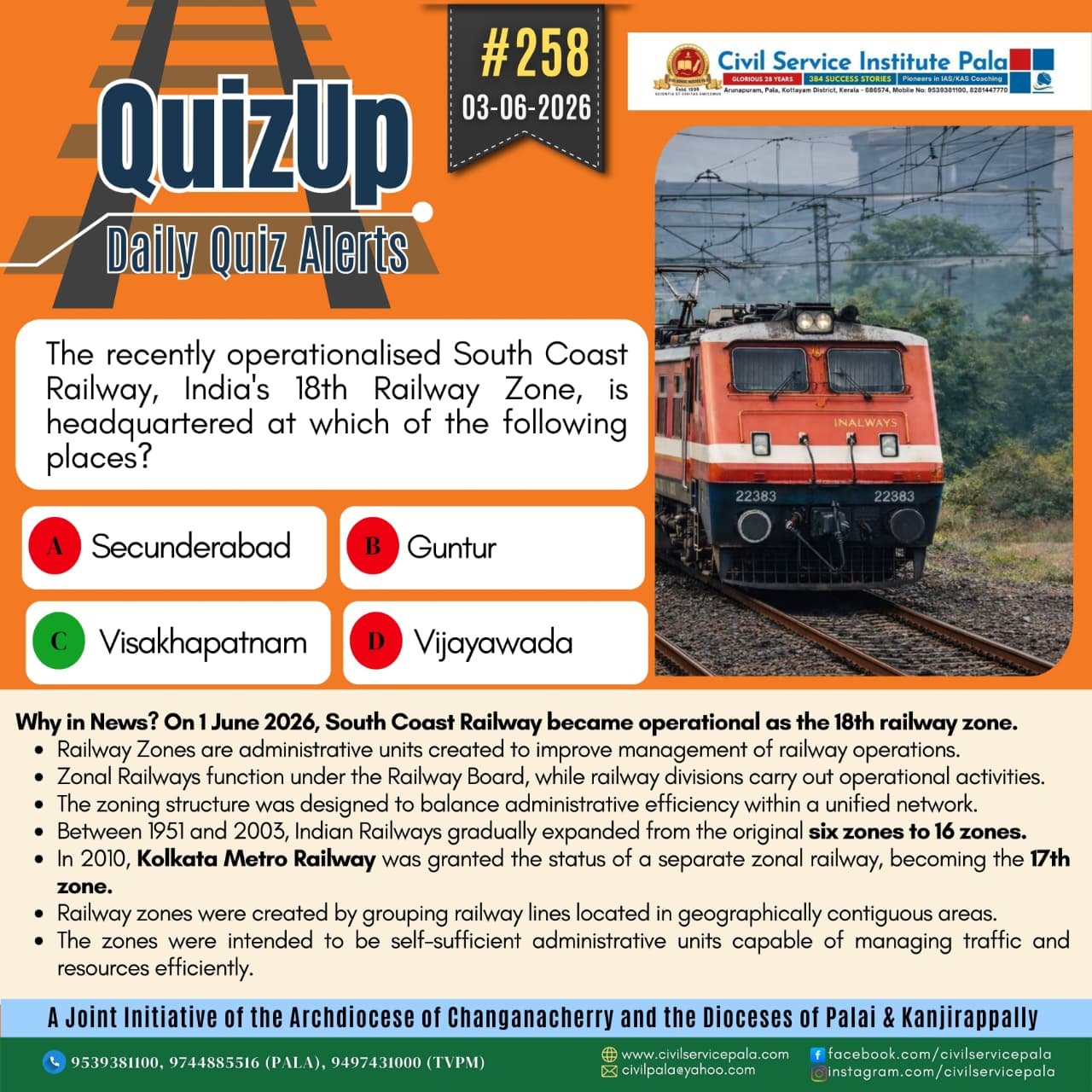
• On 1 June 2026, South Coast Railway became operational as the 18th railway zone.
Government Policy and Administrative Approach
• Railway reorganization has historically aimed to improve efficiency, coordination and economic viability.
• Successive governments have periodically reorganized railway territories to create new zones.
• Recent reforms increasingly focus on digital monitoring, data analytics and decentralized operational management.
• The creation of South Coast Railway represents the latest phase of railway administrative restructuring.
