



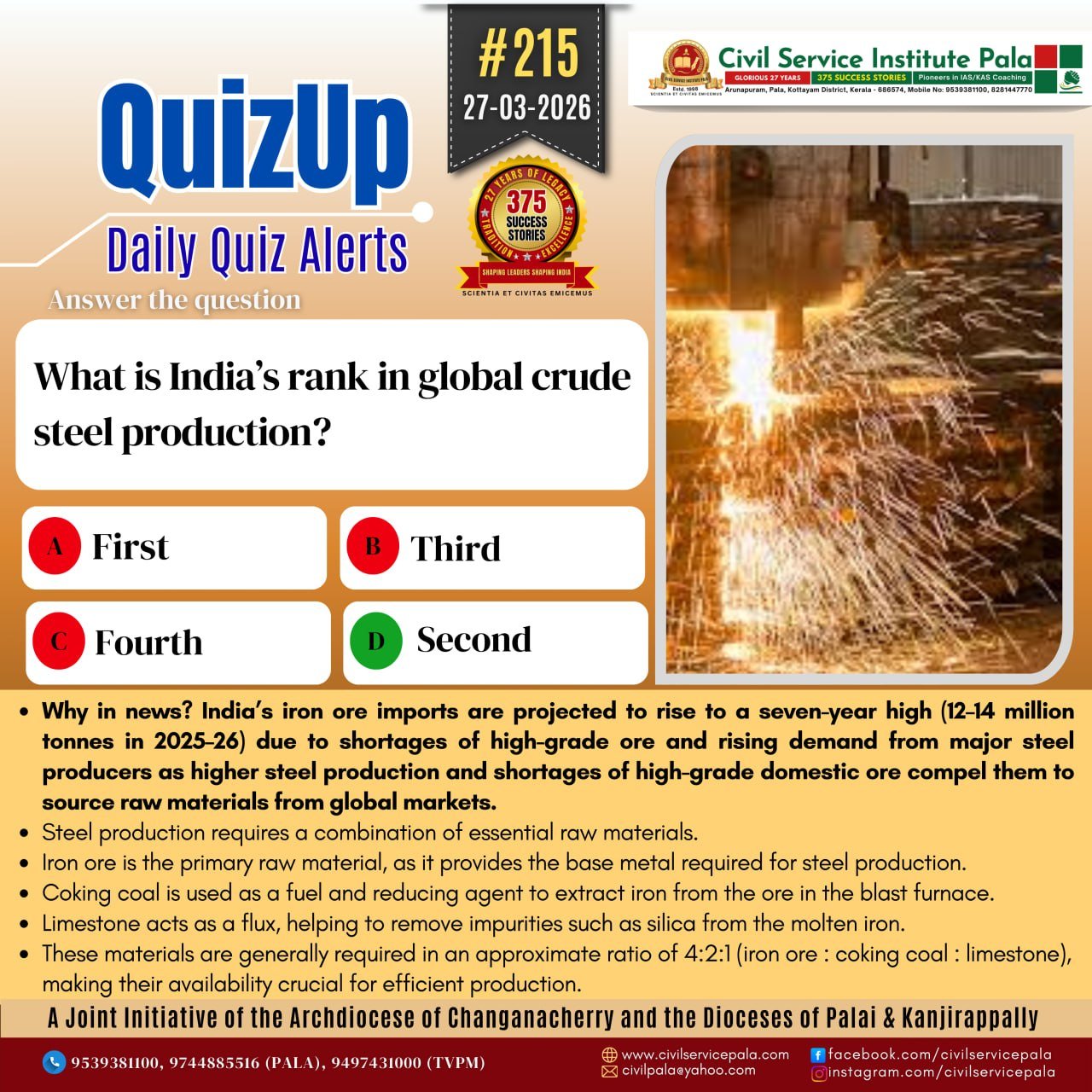
Rising Iron Ore Imports
• India’s iron ore imports are projected to rise to a seven-year high (12–14 million tonnes in 2025–26) due to shortages of high-grade ore and rising demand from major producers like JSW Steel.
• Imports are sourced from countries like Oman and Brazil, indicating gaps in domestic availability of quality raw materials despite overall abundance.
Steel production process
• Steel production requires a combination of essential raw materials, each performing a specific role in the manufacturing process.
• Iron ore is the primary raw material, as it provides the base metal required for steel production.
• Coking coal is used as a fuel and reducing agent to extract iron from the ore in the blast furnace.
• Limestone acts as a flux, helping to remove impurities such as silica from the molten iron. These materials are generally required in an approximate ratio of 4:2:1 (iron ore : coking coal : limestone), making their availability crucial for efficient production.
• In addition to these, manganese is added during the process to increase the strength and hardness of steel, improving its quality for industrial use.
India’s ranking
• India is the second-largest producer of crude steel in the world, reflecting its strong position in global industrial production.
• The country produced 151.14 million tonnes (MT) of crude steel in FY25, indicating a steady expansion of its manufacturing and infrastructure sectors.
• India’s domestic steel demand is expected to grow by around 9–10% in 2025, driven by increasing investments in infrastructure, construction, and industrial development.
• Despite having substantial domestic reserves, India imports high-grade iron ore and coking coal to meet the quality requirements of its steel industry, especially for advanced steel production.
• The country also imports ferronickel, mainly from Indonesia, which is essential for the production of stainless steel, highlighting dependence on specific critical inputs.
• In addition, India is actively securing critical minerals such as lithium from countries like Argentina to support future industrial and energy needs, particularly in emerging sectors like electric mobility and clean energy.
• These trends indicate that India’s steel sector faces certain resource gaps and is adopting a strategy of diversification by strengthening international partnerships and supply chains.
