



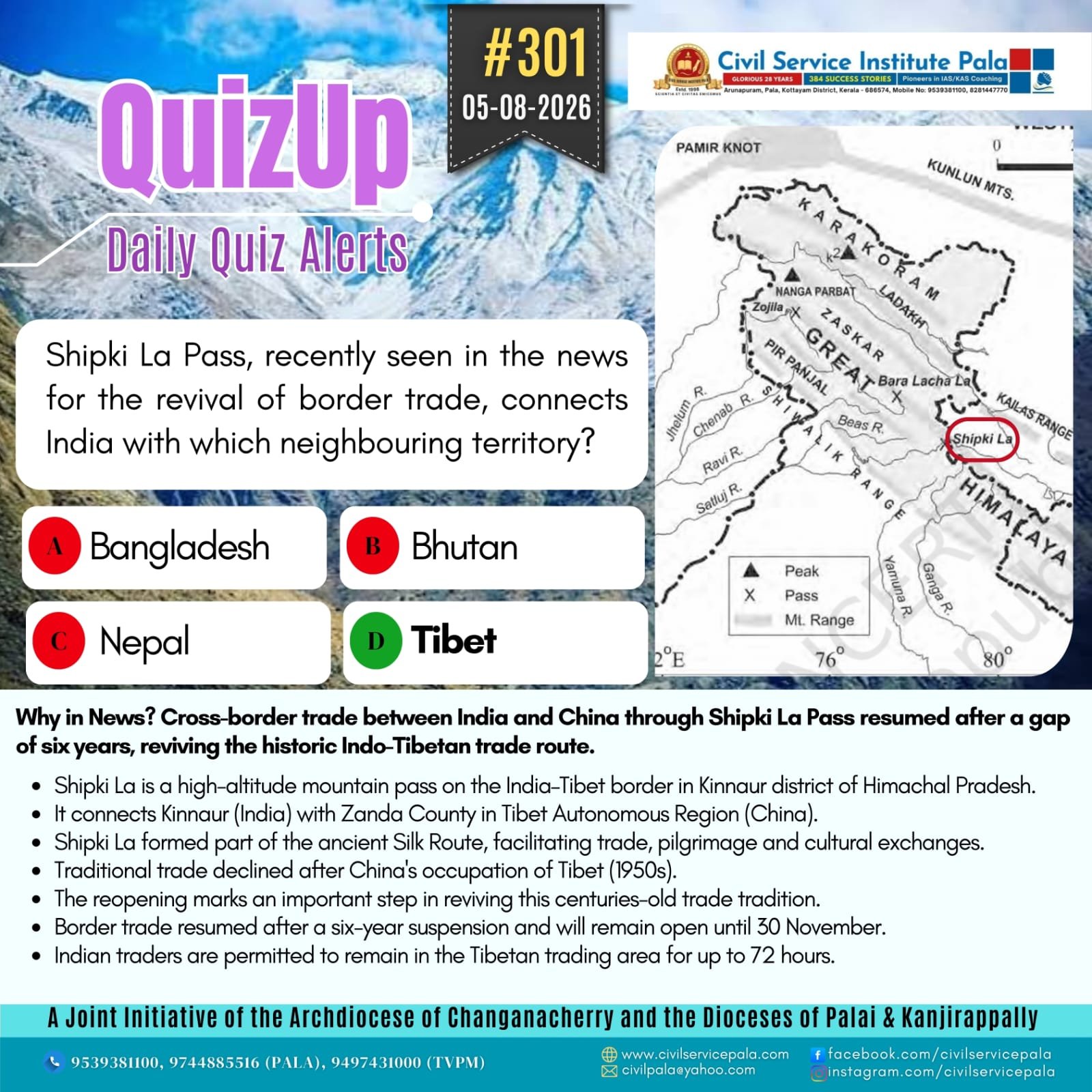
Shipki La Pass and the Revival of India–China Border Trade
Shipki La Pass and the Revival of India–China Border Trade
Why in News?
Cross-border trade between India and China through Shipki La Pass resumed after a gap of six years, reviving the historic Indo-Tibetan trade route. The reopening is expected to strengthen the economy of Himachal Pradesh's border regions while highlighting the strategic significance of the India–China frontier.
What is Shipki La?
• Shipki La is a high-altitude mountain pass located on the India–China (Tibet) border in Kinnaur district of Himachal Pradesh.
• The word "La" is a Tibetan term meaning "mountain pass."
• It connects Kinnaur (India) with Zanda County in Tibet Autonomous Region (China).
• For centuries, Shipki La formed part of the ancient Silk Route, facilitating trade, pilgrimage and cultural exchanges between India and Tibet.
Historical Significance
• Shipki La was one of the principal Indo-Tibetan trade corridors, where local communities exchanged goods through a barter system.
• Traditional trade declined after:
o China's occupation of Tibet (1950s).
o The Sino-Indian border dispute and subsequent tightening of border controls.
• The reopening marks an important step in reviving this centuries-old trade tradition.
Latest Developments
• Border trade resumed after a six-year suspension.
• Trade is conducted through the traditional barter system.
• Indian traders are permitted to remain in the Tibetan trading area for up to 72 hours.
• The trade season will remain open until 30 November.
• A new Chhuppan Trade Mart has been inaugurated near Shipki La to facilitate:
o Customs clearance.
o Trader registration.
o Import-export procedures.
How Does the Trade Operate?
• Traders transport goods by vehicle up to the border.
• Goods are then carried by mules for about 2 km inside the Tibetan side to the designated trading point.
• Only approved commodities can be exchanged under notified trade regulations.
• Security and customs checks are jointly managed by:
o Indo-Tibetan Border Police (ITBP)
o Himachal Pradesh Police
o Customs Department
Why is Shipki La Important?
Economic Importance
• Revives livelihoods in border villages such as Namgiya, Chhuppan, Nako and Chango.
• Generates employment and promotes local commerce.
• Supports the development of remote border regions.
Strategic Importance
• Lies close to the Line of Actual Control (LAC) between India and China.
• Reflects cautious efforts by both countries to revive limited border trade despite ongoing geopolitical tensions.
• The region also holds strategic significance due to China's infrastructure development, including modern settlements near the border.
Historical & Cultural Importance
• Represents one of the oldest surviving trade links between India and Tibet.
• Revives centuries-old cultural and commercial exchanges across the Himalayas.
