



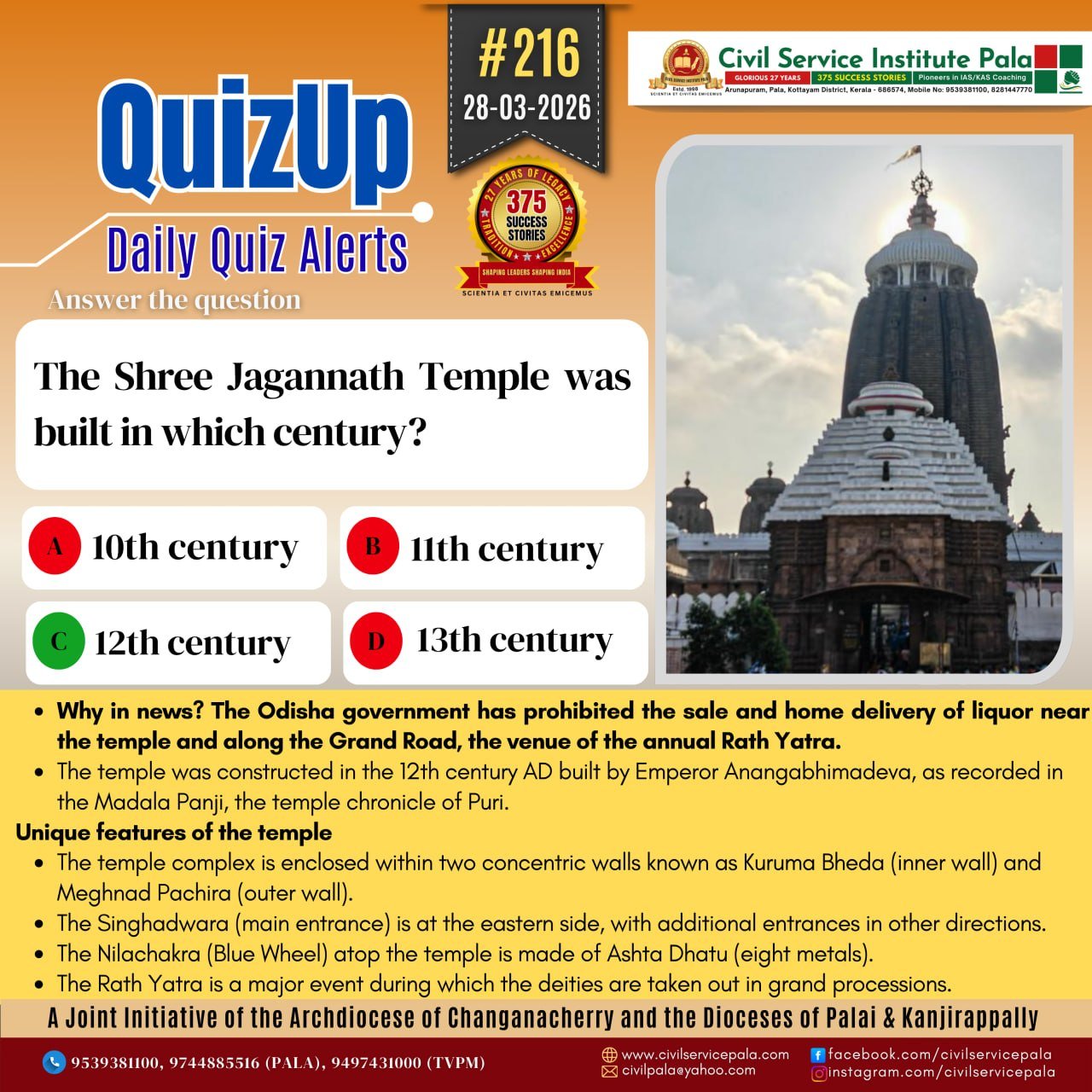
Sree Jagannath Temple
The Odisha government has prohibited the sale and home delivery of liquor near the temple and along the Grand Road, the venue of the annual Rath Yatra.
Located in Puri, Odisha, it is one of the Char Dham pilgrimage sites and is especially famous for the annual Rath Yatra (Chariot Festival).
Unique Architectural & Ritual Features
• The temple was constructed in the 12th century AD built by Emperor Anangabhimadeva, as recorded in the Madala Panji, the temple chronicle of Puri.
• The Jagannath Temple at Puri is dedicated to Lord Jagannath (a form of Vishnu/Krishna), along with Balabhadra and Subhadra. It is a classic example of the Kalinga (Oriya) style of temple architecture.
• Additions and modifications to the structure continued until the 16th century AD.
• The temple complex is enclosed within two concentric walls known as Kuruma Bheda (inner wall) and Meghnad Pachira (outer wall).
• The main entrance, called Singhadwara, is located on the eastern side, with additional entrances in other directions.
• The carvings on the temple predominantly depict gods and goddesses.
• The Nilachakra (Blue Wheel) atop the temple is made of Ashta Dhatu (eight metals) and holds religious significance.
• The temple idols are made of wood, unlike the stone or metal idols seen in most other temples.
• The preparation of Mahaprasad involves stacking earthen pots.
• The Aruna Stambha, a 33-foot monolithic pillar near the entrance, was originally located at the Sun Temple in Konark.
Important Rituals & Festivals
• Devasnana Purnima is an annual bathing ritual where the deities are brought out and bathed with purified water.
• The Rath Yatra (Chariot Festival) is a major event during which the deities are taken out in grand processions, allowing public darshan irrespective of social divisions.
