



Wetlands
Wetlands are ecosystems where water remains present permanently or seasonally and includes marshes, lakes, mangroves, floodplains, estuaries, and coastal lagoons.
Wetlands perform critical ecological functions such as groundwater recharge, flood control, biodiversity conservation, carbon sequestration, and climate regulation.
India regulates wetlands through the Wetlands (Conservation and Management) Rules notified under the Environment (Protection) Act, 1986.
National Centre for Sustainable Coastal Management (NCSCM) functions under the Ministry of Environment Forest and Climate Change and assists in wetland mapping, conservation, and coastal management.
Why in News?
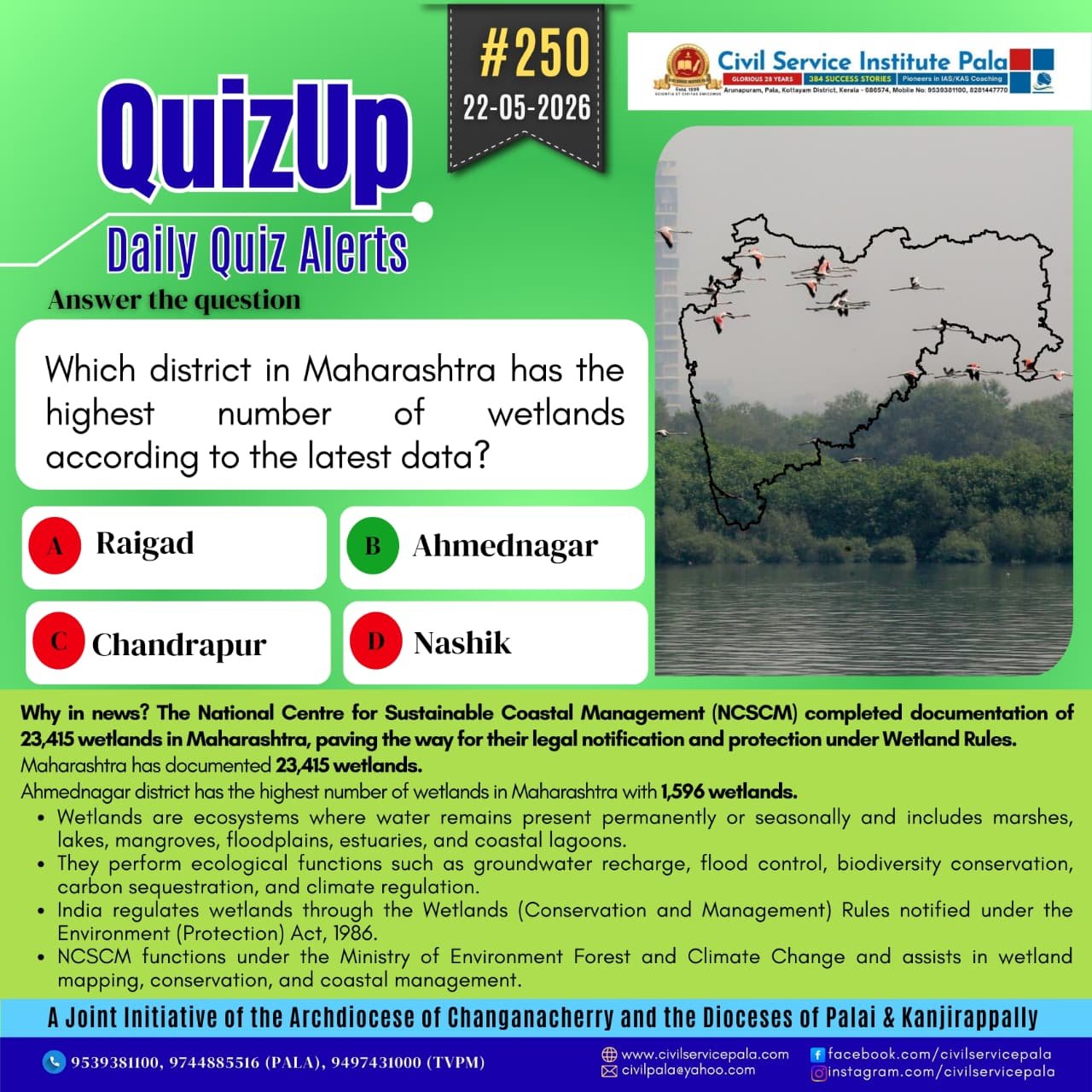
The NCSCM completed documentation and ground truthing of 23,415 wetlands in Maharashtra, paving the way for their legal notification and protection under Wetland Rules.
Notifying wetlands is important to prevent encroachment, debris dumping, reclamation, and unregulated infrastructure development.
Important Features of the NCSCM exercise
Wetland Mapping and Ground Truthing
Ground truthing refers to physical field verification of wetlands to confirm their boundaries, ecological condition, and land use against satellite imagery.
Ground truthing is essential before wetlands can receive formal legal protection.
Legal and Institutional Push
The wetland mapping exercise gained momentum after judicial interventions and Supreme Court directions asking States and Union Territories to complete wetland demarcation in a time-bound manner.
The exercise is linked to the National Wetlands Inventory and Assessment initiated by the Union Government.
The decadal-change version of the National Wetland Atlas was launched in 2020 to monitor long-term wetland changes.
Challenges
Unnotified wetlands remain highly vulnerable to encroachments and conversion for urban and infrastructure projects.
Wetlands are often treated as wastelands or dumping grounds due to lack of official recognition.
Rapid urbanisation, pollution, debris dumping, and land reclamation continue to threaten wetland ecosystems.
Weak local-level monitoring and fragmented governance reduce effective conservation outcomes.
Maharashtra Wetlands Data
Maharashtra has documented 23,415 wetlands.
Ahmednagar district has the highest number of wetlands in Maharashtra with 1,596 wetlands.
Nashik district has 1,236 wetlands.
Chandrapur district has 1,231 wetlands.
Chhatrapati Sambhajinagar division has the highest divisional wetland count with 5,196 wetlands.
Nagpur division has the second highest number with 5,086 wetlands.
Ramsar Convention Facts
India now has 96 Ramsar Sites, the highest in Asia.
India has the third-largest Ramsar network globally by number of sites.
Udaipur and Indore became India’s first Ramsar-accredited Wetland Cities.
The Ramsar Convention is an international treaty for wetland conservation adopted in 1971 at Ramsar, Iran.
Government Policy measures
The Wetlands (Conservation and Management) Rules provide the legal framework for wetland protection and regulation in India.
The National Wetland Atlas tracks wetland distribution and ecological changes using satellite-based assessment.
India has expanded Ramsar site designation as part of biodiversity conservation and climate resilience efforts.
Ecological Importance of Wetlands
Wetlands act as natural sponges that absorb excess rainfall and reduce flood risks.
Wetlands support migratory birds, aquatic biodiversity, and fisheries.
Coastal wetlands such as mangroves help reduce cyclone and storm-surge impacts.
Experts highlight that wetlands are important carbon sinks and support climate-change mitigation.
