



Why is Copper Important?
Why in News?
Copper prices have reached record highs amid tightening global mine supply and rising demand from electrification, power infrastructure, data centres and clean-energy technologies. India imports about 85% of its copper requirements, making global supply conditions significant for domestic industries.
Why is Copper Important?
• Copper is a soft, malleable metal valued for its excellent electrical and thermal conductivity, durability and resistance to corrosion.
• It is widely used in electrical wiring, plumbing, construction, industrial machinery and consumer electronics.
• Copper is also used to make alloys such as brass and bronze.
• It can be recycled repeatedly without losing its quality, making it important for a sustainable and low-carbon economy.
• Clean-energy technologies require substantial amounts of copper. EVs can use up to four times more copper than conventional vehicles, while renewable-energy systems can require substantially more copper than traditional energy systems.
Chile: Global Leader in Copper Production
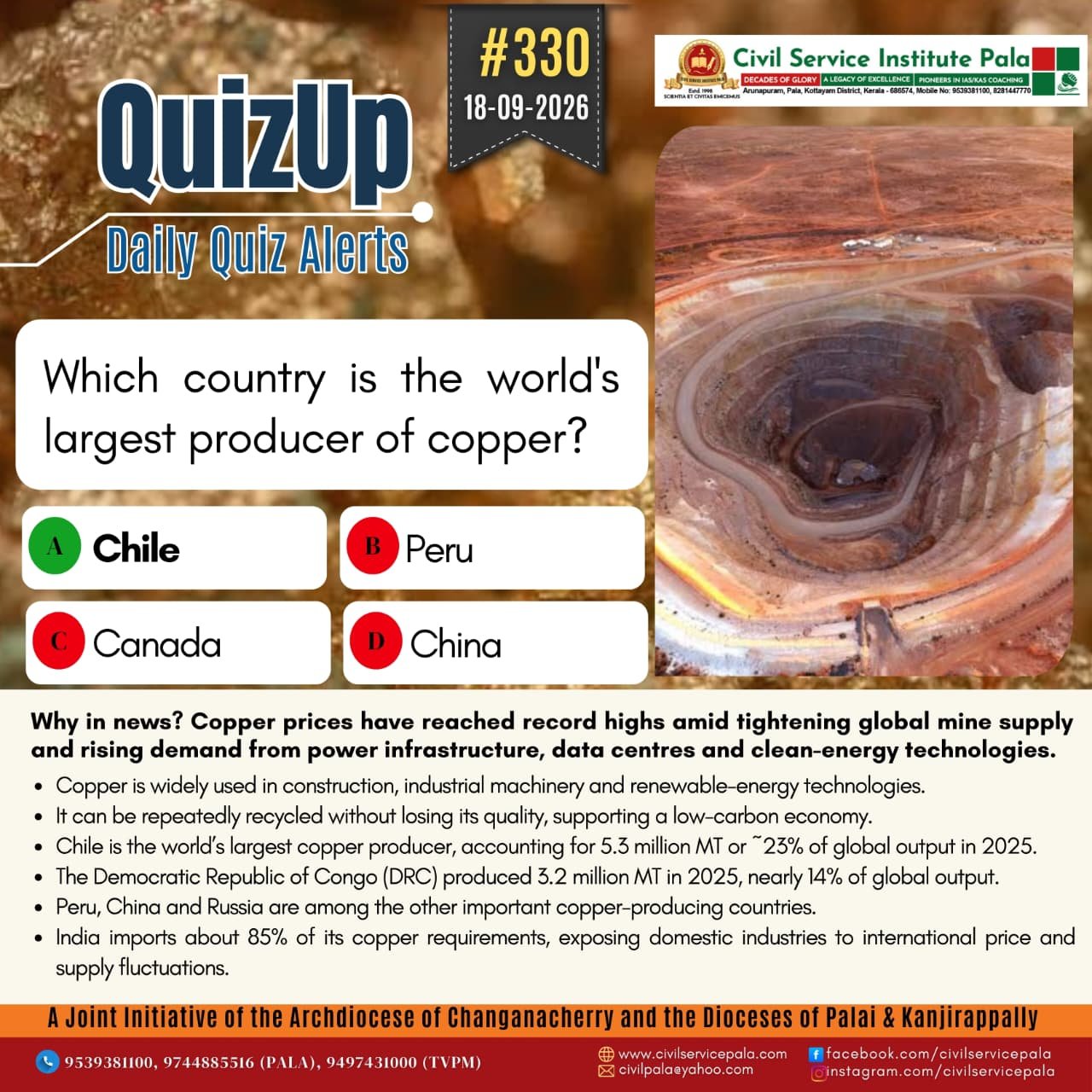
• Chile is the world's largest copper-producing country, producing 5.3 million metric tonnes in 2025, around 23% of global output.
• Chile also has the world's largest reported copper reserves, at around 180 million MT.
• Chile is also home to Escondida, the world's largest copper mine, operated by BHP. Its annual production is around 2 million MT.
Other Major Producers
• The Democratic Republic of Congo (DRC) produced 3.2 million MT in 2025, nearly 14% of global output, continuing its rapid growth in copper production.
• The Kamoa-Kakula complex is one of the DRC's major copper operations. It produced 388,838 MT in 2025, with production affected by seismic activity and flooding.
• Peru produced 2.7 million MT in 2025, accounting for just under 12% of global output. Major operations include Cerro Verde, Quellaveco and Tia Maria.
• China mined 1.8 million MT of copper in 2025, making it the fourth-largest mine producer. However, China is by far the largest refined copper producer, producing about 14 million MT in 2025, more than 48% of global refined copper production.
• Russia produced 1.3 million MT in 2025, with the expansion of the Udokan mine contributing to its increased output.
Copper and the Energy Transition
• Technologies such as EVs, batteries, solar panels and wind turbines require significant amounts of copper because of their dependence on electrical conductivity and power transmission.
• The increasing demand for electrification is therefore creating additional pressure on copper supply.
• This creates a strategic challenge because new copper mines require substantial investment and time, while global mine production can be affected by disruptions in major producing regions.
Why are Copper Prices Rising?
• Copper prices have risen sharply amid tight global mine and concentrate supply and strong demand.
• The London Metal Exchange (LME), a major global benchmark, recorded a record copper futures price of $14,779 per tonne on September 8.
• Supply constraints in major producing regions, including Chile, have added pressure to global availability.
• Demand from power infrastructure, electrification, data centres and other industrial applications continues to support the market.
• Potential U.S. tariffs on refined copper have also influenced global trade flows and regional availability.
Implications for India
• India imports about 85% of its copper requirements, exposing domestic industries to international price and supply fluctuations.
• Higher copper prices can increase costs for electrical equipment, wires, consumer electronics, engineering goods and EVs.
• Copper is difficult to replace completely in many applications because of its high electrical conductivity. Aluminium can substitute for some applications, but it has lower electrical conductivity and requires a larger conductor for the same electrical load.
